

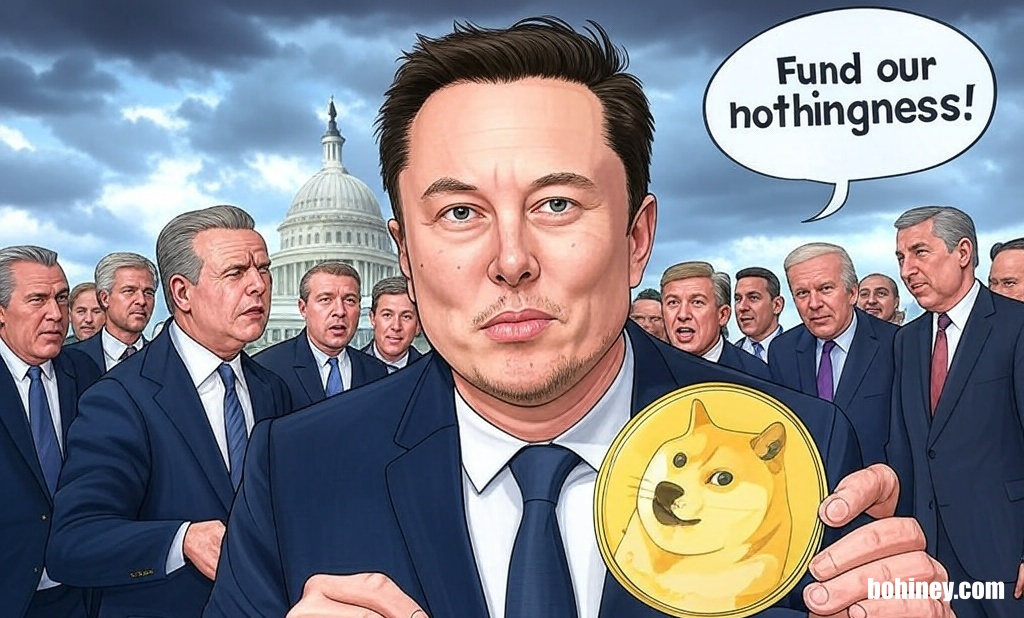
Welcome to the DC Clown Show: Musk and DOGE Take the Stage
The Great Musk-DOGE-NGO Discovery
In the grand theater of American politics, where absurdity reigns supreme, we find ourselves asking questions that sound like the setup to a bad joke. How is it a “non-governmental organization” (NGO) if Uncle Sam is footing the entire bill? It’s like calling a puppet a free spirit while the puppeteer’s hand is still up its backside. And here comes Elon Musk, the billionaire ringmaster, wielding his Department of Government Efficiency (DOGE)—yes, named after a meme coin, because why not?—to expose this farce and other governmental shenanigans.
How can something be “non-governmental” if the government is its sugar daddy? — Elon Musk
Musk, the guy who thinks Mars is a fixer-upper and Twitter a personal diary, has decided that government spending is his next playground. Armed with DOGE, he’s on a mission to sniff out waste like a bloodhound on a bacon trail. Meanwhile, whispers of Biden-era corruption—allegedly bloating government beyond its britches and laundering money through sketchy schemes—float around like stale cigar smoke in a backroom deal. Buckle up, folks; this is going to be a wild, satirical ride through the swamp of D.C. madness.
The NGO Paradox: When “Non-Governmental” Means “Government’s Pet Project”
How can something be “NGO” if the government is paying?
Let’s start with the million-dollar question: How can something be “non-governmental” if the government is its sugar daddy? It’s a riddle wrapped in a paradox, dunked in a vat of taxpayer cash. NGOs are supposed to be the scrappy underdogs, free from the bureaucratic leash, fighting the good fight. But when they’re entirely funded by the feds, they’re about as independent as a toddler clinging to Mommy’s leg.
Picture this: the “Coalition to Save the Invisible Pink Flamingos,” an NGO dedicated to a bird no one’s ever seen. Their budget? A cool $500 million, courtesy of the Department of the Interior. They hire “flamingo whisperers,” commission studies on invisible habitats, and throw a gala where attendees wear flamingo costumes—all on your dime. It’s like funding a sci-fi movie with no script, just vibes and glitter.
Or consider the “National Association of Retired Typewriter Enthusiasts” (NARTE). Their mission: preserve the clackety-clack of yesteryear. Government grants flood in—$300 million to build typewriter sanctuaries in every state. Soon, you’ve got retirees hunched over dusty Smith-Coronas, typing manifestos about the evils of autocorrect. It’s a noble cause, sure, if you ignore the fact that it’s a government-funded fever dream.
The real kicker? The FirstDay Foundation, a real-ish example, saw its assets skyrocket from $10.4 million to $788.7 million, all thanks to federal handouts. That’s not growth; that’s a fiscal steroid injection. How is this “non-governmental”? It’s like calling a housecat a lion because it once scratched the couch.
These NGOs are less “independent crusaders” and more “government puppets with better PR.” When the Treasury’s writing the checks, you’re not sticking it to the man—you’re shaking his hand and asking for seconds. It’s a paradox so blatant it’d make a philosopher weep, or at least demand a refund on their degree.
Biden’s Big Government Bonanza: Corruption or Just Creative Accounting?
Now, let’s pivot to the Biden administration, where the allegations of corruption are juicier than a tabloid headline. Was it just “growing government beyond government” and a little money laundering on the side? Oh, absolutely—says the rumor mill, fueled by partisan popcorn and wild imaginations. The House Oversight Committee has been poking around the Biden family’s piggy bank, and while they haven’t found a neon sign saying “Crime Here,” they’ve got enough breadcrumbs to bake a conspiracy loaf.
Enter Hunter Biden, the black sheep turned artiste extraordinaire. His business ventures are a labyrinth of consulting gigs and art sales that’d make a magician jealous. Imagine this: Hunter launches “Biden’s Brushstrokes LLC,” where foreign oligarchs pay $750,000 for a painting of a stick figure labeled “Hope.” In return, they get a “consulting session” where Hunter whispers sweet nothings about Delaware tax loopholes. It’s not money laundering—it’s art laundering, a new frontier in creative finance.
The FBI storms his studio (in our satire, naturally), finding canvases that look like a preschooler’s tantrum—splatters of red, blue, and regret. “This is worth millions!” Hunter cries, holding up a piece called “Untitled Smudge #47.” Critics nod sagely, pretending it’s genius, while the receipts show payments from shadowy LLCs named things like “Cayman Cash Co.” It’s like a Ponzi scheme, but with worse aesthetics.
And the government growth? Oh, it’s a beast. Under Biden, the rumor goes, agencies multiplied like rabbits on a reality show. The Department of Redundant Departments was born, tasked with overseeing the Department of Oversight, which monitors the Department of Monitoring. It’s government inception—a bureaucracy so bloated it needs stretch pants. Was this corruption, or just D.C.’s version of a growth spurt? Either way, it’s a taxpayer-funded fever dream.
The impeachment inquiry? A circus with no ringmaster. Politicians flung accusations like monkeys tossing… well, you know. “Money laundering!” one screamed. “Influence peddling!” another howled. But the evidence was as solid as a house of cards in a windstorm. It’s classic politics: make enough noise, and folks assume there’s fire behind the smoke. Spoiler: it’s usually just a fog machine.
Musk and DOGE: The Efficiency Crusaders or Just Good Theater?
Here swoops Elon Musk, caped in Tesla swagger, with DOGE—his robotic efficiency hound—nipping at the heels of government waste. Musk’s mission? Slash the fat, expose the grift, and maybe tweet a meme about it later. DOGE is his weapon, a bureaucratic buzzsaw cutting through red tape like it’s confetti. But is it real reform, or just a billionaire’s vanity project? Let’s dive in.
First up: the $1.9 billion HUD heist. DOGE claims they found it—cash misplaced during Biden’s reign, stuffed under a metaphorical couch cushion. “We saved it!” Musk crows, posing with a giant check like a game show host. But skeptics whisper it’s accounting sleight-of-hand—moving numbers around until they look heroic. It’s like finding a $20 in your laundry and calling yourself a financial wizard.
Then there’s the DEI grant purge—$373 million axed faster than you can say “diversity.” DOGE framed it as trimming the fat; critics called it a culture war flex. Picture Musk, in a cape stitched with stock options, zapping grants with a laser pointer while DOGE barks at bureaucrats. “No more woke waste!” he declares, as a fictional Senator sobs over his canceled “Pronoun Appreciation Day” funding. It’s efficiency with a side of theater—classic Musk.
Imagine a scene: Musk and DOGE raid a secret vault where government cash turns into gold coins, only to vanish in a bureaucratic Bermuda Triangle. “Not on my watch!” Musk roars, melting the gold with a flamethrower (because of course he brought one) and mailing it back to taxpayers in shiny envelopes. It’s a superhero saga—Captain Efficiency vs. the Waste Monster. Reality? More like a guy with a calculator and a knack for headlines.
DOGE’s real test: those pesky NGOs. Musk peers at the “Coalition to Save the Invisible Pink Flamingos” and asks, “Why are we funding this?” The answer: “Because we always have.” It’s the government equivalent of “because I said so.” Musk’s solution? Defund it and turn the budget into a SpaceX slush fund. Efficiency or ego? You decide.
The Grand Finale: What’s It All Mean?
So, where does this leave us? NGOs that aren’t “non-governmental” if the government’s their ATM. A Biden era accused of growing government into a hydra and laundering cash through art and influence. And Musk with DOGE, swinging a machete at the mess, hoping to carve out something leaner—or at least funnier. It’s a political circus where the clowns are in charge, the jugglers drop the balls, and the audience pays for the popcorn.
The NGO paradox is simple: if the government funds it, it’s not independent—it’s a pet project with a fancy name. Biden’s alleged corruption? Maybe it’s just government doing what it does best—expanding like a bad sequel and misplacing money in creative ways. Musk and DOGE? They’re the cleanup crew, or maybe just the hype men, promising efficiency in a system that thrives on chaos.
Here’s the kicker: it’s all a game of perception. Call an NGO “non-governmental” while it guzzles federal funds, and people shrug. Paint Biden as a corruption kingpin with no smoking gun, and half the crowd cheers anyway. Let Musk play hero with DOGE, and he’s either a savior or a showman—flip a coin. In this swamp, truth is a unicorn: everyone claims to see it, but it’s probably just a horse with glitter.
So, laugh, cry, or rage—just don’t expect it to make sense. Politics is a satire we didn’t ask for, starring Musk, DOGE, and a cast of thousands, all funded by you. Curtain’s up—enjoy the show.

Key Citations
How can something be “NGO” if the government is paying?