

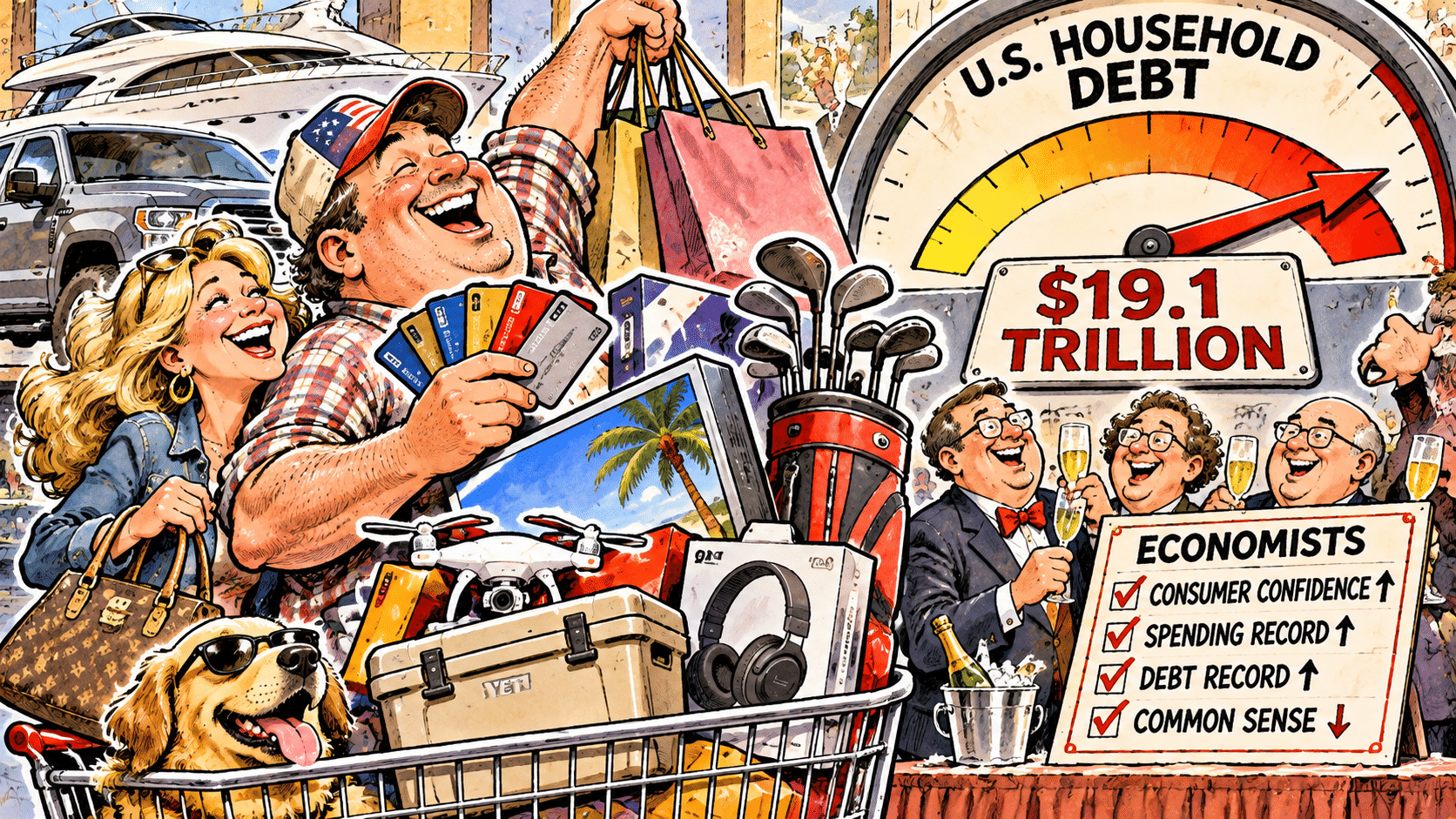
NEW YORK — American households have pushed debt toward the $19.1 trillion milestone, prompting economists to celebrate the nation’s most enduring talent: buying tomorrow’s possessions with money that won’t arrive until the Thursday after next.
At a financial conference, experts raised glasses to the consumer, a magnificent creature capable of financing a truck for eight years, replacing it after three, and insisting the resulting payment is a form of transportation-based wealth creation.
Household Debt Becomes America’s Most Reliable Growth Industry
“Every purchase represents confidence,” declared consumer economist Martin Ledger, standing beneath a chart that rose so steeply the maintenance crew had to install a ladder. “The more Americans owe, the more confident they are that somebody else will eventually figure out the payment.”
The crowd applauded. One analyst ordered a celebratory bottle of champagne and asked whether the restaurant accepted installments.
Consumer debt includes mortgages, auto loans, credit cards and student borrowing. The Federal Reserve Bank of New York’s Household Debt and Credit Report tracks those balances, delinquencies and lending trends. Its tables provide a sober account of obligations that ordinary Americans encounter in a less sober form every time they open the mailbox.

Credit Cards Replace Savings With Optimism
In Dallas, the Henderson family celebrated their improving lifestyle by purchasing a new sectional sofa, three televisions and a refrigerator that sends notifications when the milk expires. Their old refrigerator had performed the same service by making the milk smell terrible, but lacked Bluetooth.
“The payments are manageable,” said Mr. Henderson, whose definition of manageable involves moving the electricity bill to a different credit card. “We have a carefully balanced financial strategy. Every card is almost equally maxed out.”
His wife added that they had saved $200 during a weekend sale by spending $2,400 on items they had not intended to purchase. The family’s financial adviser called the achievement a triumph of modern retail mathematics.
Their teenage son, meanwhile, financed a gaming chair on a payment plan. His grandfather asked why a chair needed financing. The boy explained that it had lights. The grandfather quietly sat on a wooden stool he bought in 1978 and wondered when furniture joined the technology sector.
Economists Discover Payments Are Not the Same as Prosperity
The Consumer Financial Protection Bureau offers guidance on credit cards, interest and repayment. That guidance has yet to inspire a national advertising campaign featuring a smiling celebrity shouting, “You could also simply not buy it!”
At the conference, economists proposed a new measure of financial wellness: the number of lenders willing to answer a household’s calls. Families with at least six active credit lines would qualify as economically dynamic. Those who paid cash would be investigated for suspicious independence.
The closing speaker unveiled the next great American innovation: a loan to cover the minimum payment on another loan. The audience gave him a standing ovation, then requested financing for the chairs.
Outside, a parking attendant informed attendees that the lot charged $35. Everyone reached for a credit card. The attendant announced a 3 percent convenience fee, and the economists agreed the recovery was proceeding beautifully.