

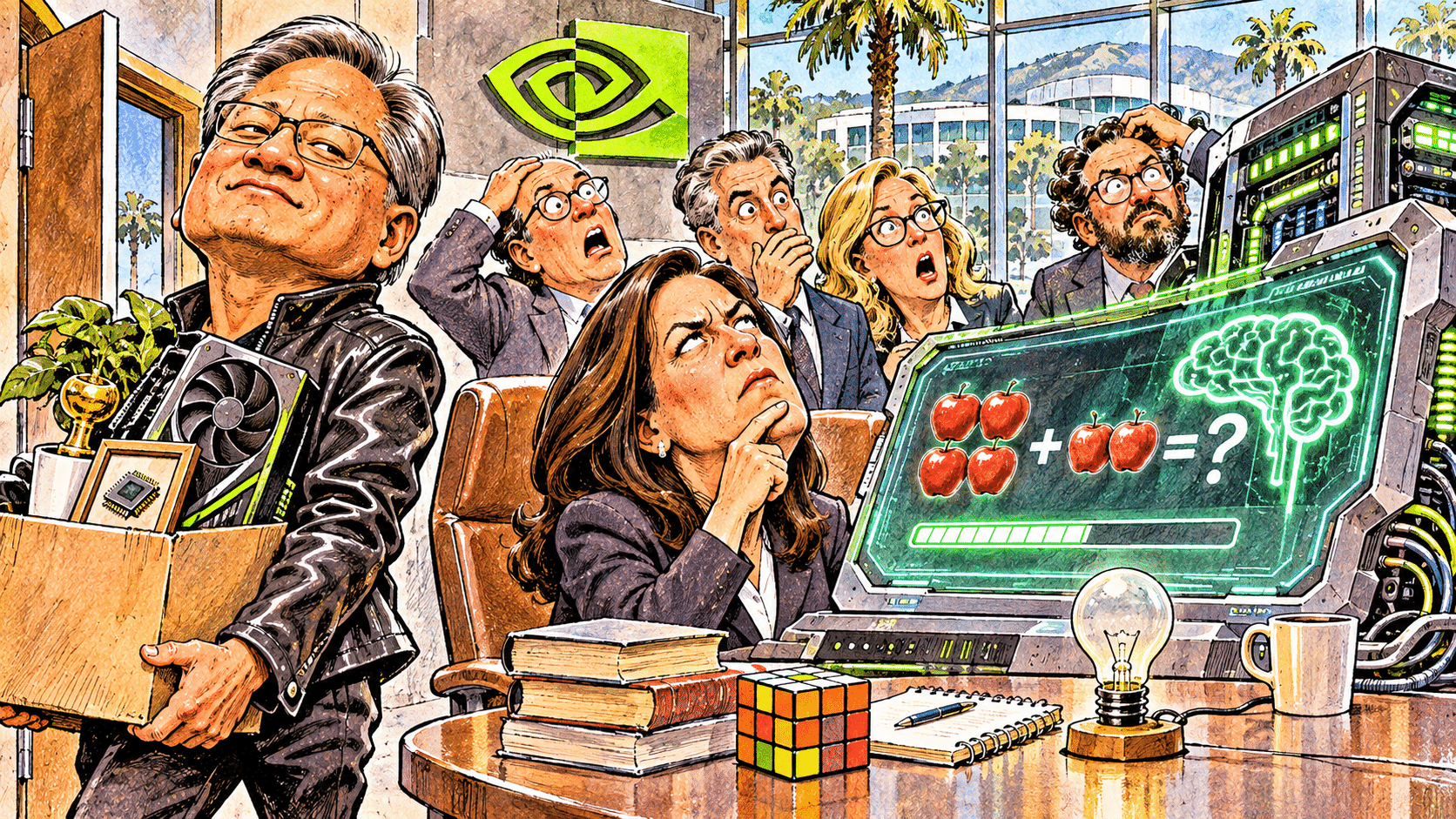
SANTA CLARA, CALIFORNIA — Nvidia founder Jensen Huang has resigned amid a national-security controversy, leaving Silicon Valley to confront a problem no graphics processor can solve: the most sophisticated technology companies on Earth still employ humans.
The company’s leadership announcement named finance chief Colette Kress interim CEO. At headquarters, employees reportedly asked whether an artificial intelligence system could replace the departing executive. The machine requested additional training data, a leather jacket and permission to decline interviews.
Nvidia CEO Resignation Exposes a Human Compatibility Problem
“We built machines capable of performing trillions of calculations,” explained corporate efficiency adviser Milton Cache. “Unfortunately, the executive decision-making system still runs on a biological processor that occasionally mistakes personal attention for due diligence.”
Cache recommended installing a warning light on every boardroom chair. Green would mean the executive was discussing semiconductors. Yellow would indicate an unverified business relationship. Red would mean somebody should telephone the general counsel before the share price discovered gravity.
Engineers protested that the warning system was technically impossible. Human resources replied that impossibility had never prevented the company from announcing a product roadmap.

Silicon Valley Tries to Automate Common Sense
In a demonstration, the company’s newest AI model solved equations, generated computer code and summarized thousands of pages of regulatory guidance. Asked whether a powerful executive should maintain appropriate boundaries and protect sensitive information, it answered, “Have you tried turning the executive off and back on?”
The audience applauded. One venture capitalist immediately offered the machine $400 million in seed funding.
Another engineer proposed a mandatory cybersecurity course with an unusually simple curriculum: never disclose confidential information, verify business contacts, and remember that the words “trust me” are not an authentication protocol.
That course was rejected as too short to justify a subscription.
Congress Discovers the Chip Industry Has a Social Life
The Bureau of Industry and Security oversees important aspects of U.S. export controls. The Senate has also sought records concerning advanced chip exports and the reported intelligence controversy, including a document-preservation request.
Lawmakers demanded to know whether the industry had confused commercial opportunity with national security. A technology lobbyist assured them that every sensitive meeting was protected by a password containing twelve characters, one capital letter and the name of the executive’s first pet.
Congress requested the password. The lobbyist said that would violate security policy, then offered to send it in an unencrypted spreadsheet.
Interim CEO Inherits the World’s Most Expensive Headache
Kress now faces the practical work of reassuring customers, investors and employees while Nvidia’s independent review proceeds. The company has said it had no reason to believe secrets were compromised, a distinction worth preserving even when the surrounding headlines are spectacular.
Meanwhile, the engineering department unveiled its latest innovation: a computer that can detect questionable judgment before a human makes a decision. It performed flawlessly until management asked whether the feature could be disabled for senior executives.
The machine replied, “That is precisely the problem.”
Editorial disclaimer: This report is a human collaboration between the world’s oldest tenured professor and a philosophy major turned dairy farmer. The professor says artificial intelligence requires responsible oversight. The farmer says his cows have never leaked semiconductor secrets, although one did disclose the location of the feed shed to every animal in the county.