

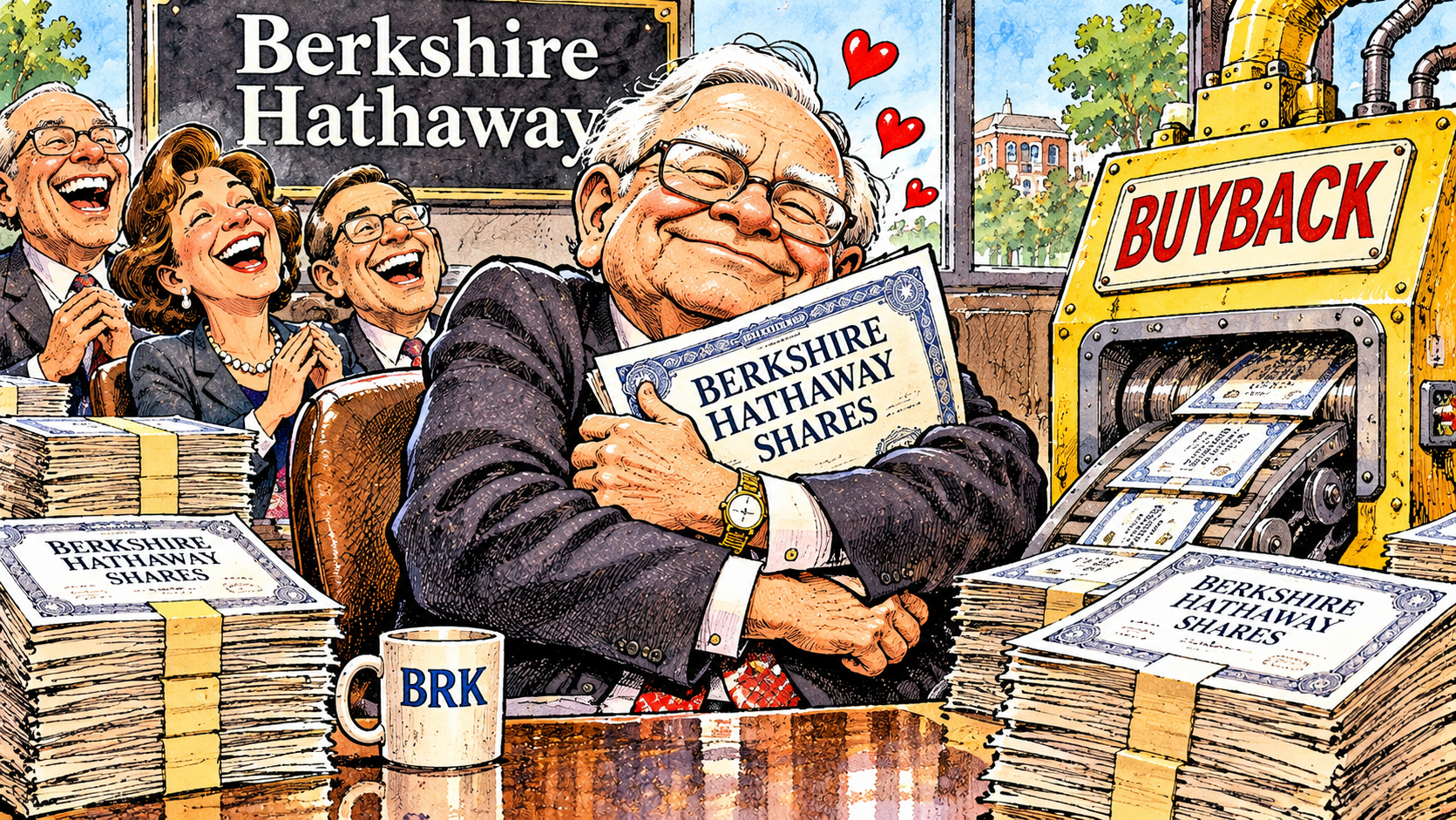
Capitalist spends his own money, Washington demands paperwork
OMAHA, Nebraska – Berkshire Hathaway has repurchased $9.6 billion of its own shares, causing progressive economists to demand an immediate investigation into why a private company believes it should be allowed to decide what to do with private capital.
According to Reuters’ earnings report, Berkshire announced the substantial repurchases while reporting lower quarterly profits. CNBC noted that the buybacks more than doubled from the previous quarter, and Forbes concluded the earnings miss was about insurance, not strategy, which is a refreshing distinction for a company that is not run by a committee.
The conglomerate also maintained enormous financial reserves.
Socialist commentators immediately suggested the money should have been distributed through federal programs.
Nobody explained why Washington would spend it more effectively than Berkshire’s management.
Berkshire Stock Buyback: Socialists Discover Wealth Doesn’t Automatically Belong to Them
“This is an outrageous concentration of economic resources,” announced progressive economist Professor Eleanor Equality.
“Berkshire is sitting on hundreds of billions while Americans struggle with living expenses.”
Asked whether Berkshire had acquired the money legally, Equality acknowledged that it had.
“That’s precisely the problem.”
She proposed a Wealth Redistribution Oversight Commission empowered to determine what corporations could do with retained earnings.
A reporter asked whether the commission would create wealth.
“No. It would allocate wealth.”
“And who would decide how?”
“Qualified public servants.”
The reporter suggested examining the federal government’s debt before assigning Washington responsibility for Berkshire’s money.
Equality accused him of promoting dangerous arithmetic.
The transcript of the exchange, which was entered into the record at a House hearing that afternoon, runs 11 pages. Page 9 consists entirely of the word “Next,” repeated by the chairman, and page 10 is a recess.
Capitalism Does Something Socialism Rarely Attempts: Produces Results
Berkshire owns significant businesses in insurance, railroads, utilities, manufacturing and retail.
These enterprises employ people, provide goods and services and generate returns for investors. The company’s SEC filings and its own website lay it all out, in a format that famously looks like it was designed by an accountant who dislikes decoration.
Share repurchases can return capital to shareholders when management believes the company’s stock represents good value.
The transactions are not automatically wise.
But deciding whether to invest, repurchase shares or retain cash is a business judgment, not evidence that Congress should seize the balance sheet.
A Nebraska investor described the distinction.
“When I buy Berkshire stock, I voluntarily risk my money. If management makes terrible decisions, I lose.”
He paused.
“When government makes terrible decisions, I still lose, except I never agreed to invest.”
His brokerage confirmation, which he keeps in a kitchen drawer beside the take-out menus, shows 12 shares purchased at the market price with a commission of $0.00. Next to it is his federal tax return, which has several commissions and no menu.
Washington Proposes National Shareholder Happiness
A congressional progressive proposed requiring every major corporation to obtain federal approval before repurchasing stock.
The application would assess environmental justice, income equality, workforce inclusion and whether the company had made sufficient contributions to politically fashionable causes.
A business owner asked whether the review would improve profitability.
The lawmaker explained that profitability was an outdated measure of corporate success.
“What matters is stakeholder happiness.”
The owner suggested that shareholders might be stakeholders.
The lawmaker requested a recess.
The draft application form, according to a staffer who read it twice, runs to 31 pages. Section 14 asks the corporation to “describe, in fewer than 4,000 words, any joy it expects the repurchase to create.” Section 15 asks it to describe the joy it expects the review to create.
Warren Buffett’s Greatest Crime: Understanding Numbers
Warren Buffett built Berkshire around disciplined investing, long-term ownership and careful assessment of business value.
His successor, Greg Abel, now faces decisions about allocating the company’s enormous capital.
Not every decision will succeed.
That’s how investment works.
Capitalism permits success, failure and voluntary risk.
Socialism prefers transferring the risk to the public while reserving the credit for government.
Shareholders in Omaha were asked whether they would prefer Washington to manage the cash instead. The room went quiet. A retired schoolteacher from Lincoln finally raised her hand and asked whether Washington would also be handling the dividends, and if so, in which decade.
An Iowa taxpayer offered a compromise.
“If Washington wants $9.6 billion to invest, let every politician contribute his own savings.”
The proposal received no congressional sponsors.
Berkshire Hathaway spends billions buying shares. Washington spends trillions buying votes. Only one of those activities routinely requires its customers to participate at gunpoint through the tax code.
Five Observations on the Berkshire Buyback
- Berkshire spends nine point six billion of its own money and the professor wants a commission. It’s their money! That’s like the neighbor calling the cops because you bought a sandwich.
- “It would allocate wealth.” Ma’am, the government can’t allocate the line at the DMV.
- Stakeholder happiness. They want companies measured on happiness. I’ve been married twenty years and I can tell you happiness is not a metric. It’s a rumor.
- The Iowa guy says if Washington wants nine point six billion to invest, every politician should put in his own savings. Zero sponsors. Funny how fast people discover the concept of risk when it’s their own wallet.
- Buffett spent his whole life reading balance sheets. Congress can’t read the one for the building they’re sitting in.