

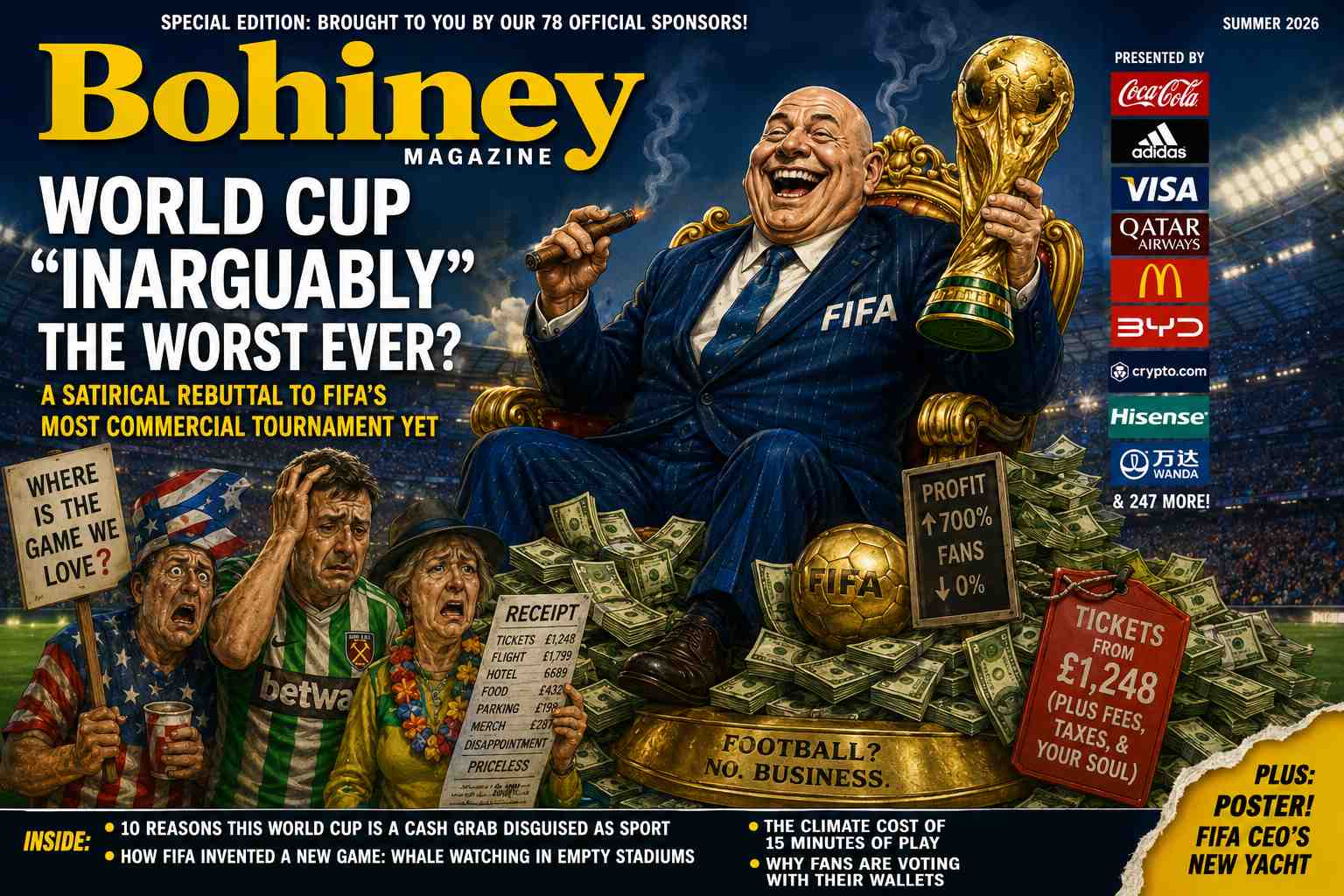
World Cup “Inarguably” the Worst Ever? A Rebuttal to FIFA’s Most Commercial Tournament Yet
The 2026 FIFA World Cup has been hailed by some commentators as the greatest tournament ever staged. The football has been magnificent. The goals have been outrageous. The underdogs have delighted billions. Unfortunately, so have airport security queues, hotel invoices, and ticket prices that appear to have been calculated by medieval ransom negotiators.
If football is still the beautiful game, someone has quietly surrounded it with the world’s largest shopping mall. The matches remain spectacular, but everything before kickoff and after the final whistle feels as though it was designed by accountants who believe supporters experience joy primarily through premium upgrades.
World Cup Ticket Prices: Fans Need a Mortgage Before They Need a Passport

Once upon a time, attending a World Cup required little more than a passport, a scarf, and an unreasonable belief that your national team might actually win the thing. Today, the first opponent supporters face isn’t Argentina or Spain. It’s their banking app.
Ticket prices have climbed with the determination of a mountain goat. Families discover it is cheaper to fly across the Atlantic for a holiday than to sit high enough in a stadium to identify players by hairstyle alone. Financial advisers now recommend diversifying retirement portfolios with “Category Three Match Tickets,” which appear to appreciate faster than gold. This is not entirely a joke — resale listings for the final have reportedly cracked seven figures per seat, a price point normally reserved for yachts, not folding stadium chairs.
FIFA insists football is bringing the world together. It certainly is. Thousands of supporters now gather around the same television in a sports bar because nobody can afford to enter the stadium. Meanwhile, attorneys general in New York and New Jersey opened a formal probe into FIFA’s ticketing practices, which is bureaucratic for “we also noticed the hot dog costs more than a used sedan.”
Dynamic Pricing: FIFA’s Favorite New Word for “More Expensive”
FIFA prefers to call it “variable pricing,” a phrase so soothing it sounds like a wellness retreat rather than a mechanism that let a single World Cup final seat get listed for more than two million dollars. FIFA President Gianni Infantino’s response to the backlash was to offer, with a straight face, to personally deliver a hot dog to anyone who actually paid it. Somewhere, a marketing consultant is being paid handsomely to explain why this counts as customer service.
A Tournament That Requires Its Own Weather Forecast
Previous World Cups demanded tactical preparation. This one demands meteorological survival.
One afternoon supporters are wrapped in jackets inside an air-conditioned stadium capable of preserving frozen mammoths. Twenty-four hours later they are standing outside in temperatures better suited to baking pottery than watching football. Managers spend almost as much time studying weather radar as they do studying the opposition.
Hydration breaks have become less of a sporting necessity than a reminder that Mother Nature has entered the competition and is leading the group stage.
Travelling Between Matches Becomes an Olympic Event
The geography of this tournament deserves its own medal ceremony.
Earlier World Cups rewarded supporters with scenic train rides between neighboring cities. This edition offers three flights, two rental cars, one delayed connection, and a growing suspicion that the next stadium may actually be on the Moon.
Fans spend so much time removing laptops, shoes, belts, and dignity at airport security that they begin applauding whenever a boarding gate opens. By the time they finally reach the stadium, they’ve completed enough frequent-flyer miles to qualify as migratory birds.
FIFA Discovers That More Teams Also Mean More Sponsors
Officials proudly describe the expanded 48-team tournament as a celebration of global inclusion. Critics notice it also creates dozens of extra matches, television windows, sponsorship opportunities, hospitality packages, and premium experiences with names that sound like luxury cruise ships.
Every visible surface appears sponsored. The corner flags look sponsored. The water bottles look sponsored. Somewhere, an executive is almost certainly negotiating exclusive naming rights for the referee’s whistle.
Football occasionally interrupts the marketing.
Empty Seats, Full Spin: The “Sellout” That Wasn’t Quite
Despite Infantino declaring practically every match a sellout, opening week produced the peculiar spectacle of rows of visibly empty red seats during nationally televised matches. FIFA’s explanation amounted to a shrug wrapped in a press release. Nothing says “unprecedented global demand” quite like acres of unoccupied plastic.
VAR Has Entered Another Geological Epoch
Video Assistant Referee technology was introduced to eliminate obvious mistakes. Instead, it has eliminated humanity’s understanding of time.
Every close decision becomes an archaeological excavation. Officials inspect freeze frames with the concentration of museum curators authenticating dinosaur fossils. Entire conversations begin, end, and restart before the referee reaches a conclusion.
Historians increasingly recognize three great eras of civilization: Before VAR, During VAR, and Still Waiting for VAR.
Stadium Food Is Officially a Luxury Investment
The concession stand has quietly become the tournament’s most intimidating opponent.
Supporters approach the counter with the cautious expression normally associated with people negotiating international peace treaties. A hot dog, a soft drink, and a packet of crisps now require the sort of financial planning once reserved for buying a family car.
The official currency of the World Cup is no longer dollars or euros. It is financial regret served with optional cheese.
Corporate Hospitality Wins the Golden Boot
Luxury suites feature filet mignon, champagne, leather seating, climate control, and uninterrupted views of the action.
General admission offers a partially obstructed seat, a queue for the restroom that rivals international border crossings, and nachos whose cheese appears to have qualified for historical preservation.
Two entirely different World Cups are taking place inside the same stadium. One serves fine wine. The other hopes the hand dryer works.
The Fact-Check Nobody Asked For
Independent fact-checkers have already had to step in to untangle FIFA’s own math on ticket demand, noting that comparing this year’s sales to prior tournaments is, as one soccer historian put it to PBS NewsHour, something close to a false equivalency once you account for the extra teams and matches. Which is a polite academic way of saying: of course you sold more tickets, you added forty more games.
Football Trapped Inside the World’s Largest Advertisement
The sponsorship has become almost impossible to escape.
Every replay has a sponsor. Every statistic has a sponsor. Every blade of grass seems moments away from signing a branding agreement. Even silence feels as though it has been underwritten by a multinational insurance company.
It is only a matter of time before the referee begins each match by producing the Official FIFA Platinum Heritage Coin, presented by seventeen global corporations, sustainably manufactured, blockchain authenticated, and accompanied by a promotional QR code for probiotic yogurt.
Final Whistle
The greatest irony is that the football itself has been extraordinary. The players continue producing unforgettable goals, astonishing comebacks, and moments of genuine sporting brilliance that remind billions why this tournament matters.
That brilliance is exactly what makes everything surrounding it so wonderfully absurd. The 2026 World Cup sometimes feels less like the world’s greatest sporting event and more like football desperately trying to escape the world’s largest airport duty-free shop.
For ninety minutes, the game belongs to the players.
For everything else, it belongs to the marketing department.
Auf Wiedersehen, amigo!