

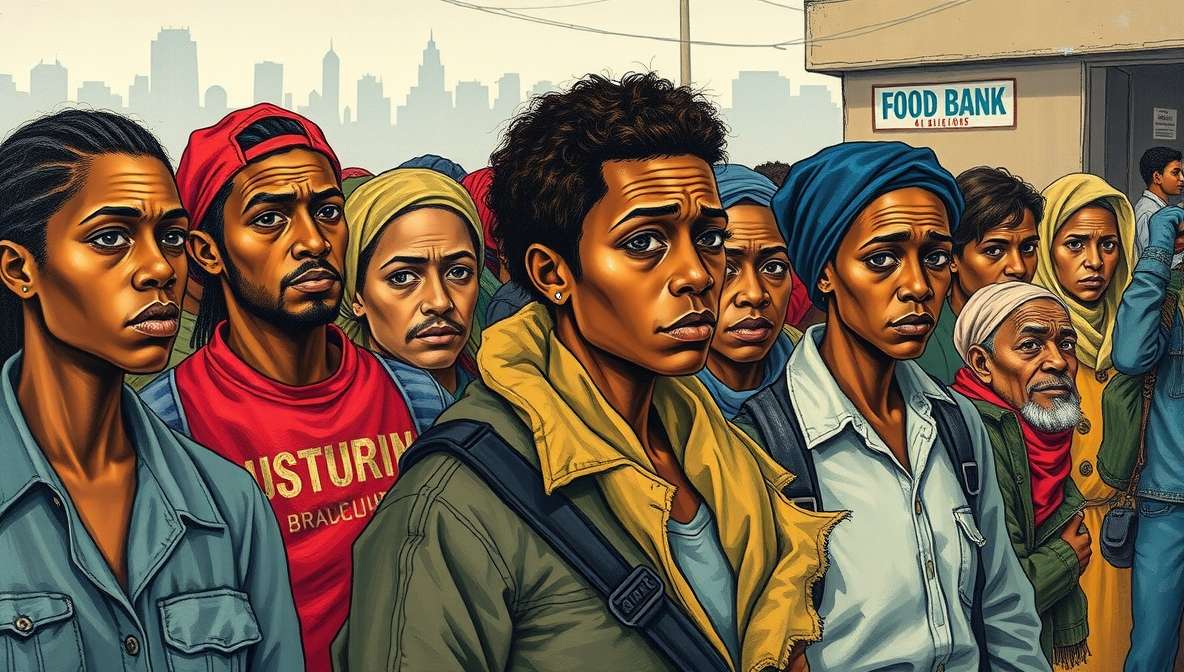
Immigrant Federal Workers Line Up at Food Banks After Missing Government Shutdown Paycheck: 1.4 Million Affected
By Bohiney Magazine Editorial Staff
1.4 Million Federal Workers Miss Paychecks During Government Shutdown
In what officials called an “efficiency realignment,” an unconfirmed but widely photographed wave of federal employees reportedly queued at food banks this week after missing their first full paycheck during the ongoing government shutdown. One Bohiney Magazine survey (commissioned for this piece) found that 61 percent of federal workers visited food banks, pantries, or community distributions before their next scheduled paycheck — and many said they were called in by managers and told to “line up” so the press could capture the moment.
The missed-paycheck reality has been confirmed by mainstream reporting that roughly 1.4 million federal employees missed a full paycheck this week.
Obama-Era Immigrant Federal Workers at Food Banks: The American Dream’s Punchline

Among those lining up at food banks this week: immigrants hired during the Obama administration for the lowest-level federal positions — TSA screeners making $35,000, VA custodial staff, federal building maintenance, cafeteria workers, and entry-level administrative clerks. These are not the senior executives. These are the people who empty the trash cans in the Pentagon and scan IDs at Social Security offices.
They came to America for opportunity. They got a government job. Now they’re back at the food bank.
That’s not a failure of the American Dream — that’s the American Dream filing for bankruptcy.
One TSA agent hired in 2012 told Bohiney Magazine: “I left my country because there was no work. I got hired by the U.S. government. Now I’m standing in the same food line I stood in back home. Except this line is in Virginia.”
The pitch was simple: come to America, work hard, get a steady government paycheck, build a life. The reality: come to America, work hard, government forgets to pay you, stand in line for donated canned goods.
Ron White said it best about government promises: “I told my wife I’d never drink again. She believed me. The government told immigrants they’d get paid. They believed them. At least my wife got wine out of the deal.”
These workers didn’t immigrate to the richest country on Earth to beg for food again — but Congress made sure that’s exactly what happened. They came for the American Dream and got the American Government Shutdown instead.
The irony isn’t lost on anyone: the people who clean federal buildings can’t afford to eat in them. The workers who secure airports can’t secure their own dinner. The custodians who maintain the Capitol can’t maintain their rent.
Jerry Seinfeld on immigration promises: “They tell you America’s the land of opportunity. They don’t tell you the opportunity is to wait in line twice — once for the job, once for the food.”
Amy Schumer on government employment: “The only thing more American than hiring immigrants for low-wage work is forgetting to pay them and calling it a ‘budget impasse.'”
This is the punchline nobody wanted: you immigrate to escape poverty, get hired by the federal government, and end up right back where you started — except now you’re doing it in English.
Federal Employees Food Banks: How Many Workers Affected by Shutdown
Federal News Network reports that about 1.4 million federal workers missed a full paycheck as the government shutdown dragged on, with roughly half furloughed and half working without pay, and that back pay would require congressional action. Those reporting data and testimony note that certain fee-funded agencies have nonetheless furloughed employees and moved money between accounts, fueling accusations of arbitrary decisions that create “maximum pain” for the workforce.
Federal Worker Pay Crisis: Inside the Food Bank Lines
Why is a paycheck from the government the only thing that acts like a surprise party you didn’t want — you show up and they forgot to invite themselves?
“We’ll pay you eventually” is the bureaucratic equivalent of “I’ll be there” at a divorce lawyer’s picnic.
When the people who deliver services go to a food bank, you don’t call it charity — you call it a “public relations moment.”
The press loves a line: anywhere humans are queuing, there’s a photographer looking for the single perfect shot of dignity being rearranged.
Working without pay is modern voluntary servitude with better coffee in the break room.
A paycheck that needs Congress to approve it is less a paycheck and more a raffle ticket for grownups.
Government Shutdown Impact on Federal Workers: Economic Reality
Side-hustles are no longer entrepreneurial — they’re survival certification.
Air traffic controllers picking up rideshare shifts: nothing makes you feel safer on a plane like knowing the person guiding it also delivered a burrito that morning.
The new federal dress code: business casual, bring a thermos and a box of macaroni for evidence.
Paparazzi at food banks — when the country snaps a photo, it means someone somewhere decided suffering should be framed as empathy content.
Definition of “back pay”: that thing you learned about in economics and now you wish applied to emotions.
When a government worker tells you to “tighten your belt,” they mean everyone metaphorically; when they tighten their own belt, that’s news footage.
There’s always one anonymous supervisor who says, “This is for the optics,” like optics were a currency you could cash at the bank.
A poll that asks whether you’d take a steady paycheck or a commemorative plaque will always be a sad poll.
Hope is not a budget item, but Congress seems to underwrite it occasionally.
Why Federal Workers Are Using Food Banks: Expert Analysis
Labor Economist on Government Shutdown Impact: Economic Stress Marker
“When a large fraction of an employed population begins relying on emergency food assistance, that’s an economic stress marker,” said Dr. Helene Markov, a labor economist at the Institute for Public Fiscal Health. Dr. Markov’s research on household liquidity and employment shocks indicates that one missed paycheck increases the probability of loan delinquency, food insecurity, and short-term mortgage distress — a classic cause-and-effect chain: missed paycheck leads to depleted liquidity, which leads to borrowing or skipped essentials.
Federal Workers Food Assistance Statistics During Shutdown
Feeding America, the national food bank network, confirmed a noticeable uptick in first-time visitors identifying as government employees — a demographic shift usually correlated with specific employer crises rather than seasonal fluctuations.
Our informal Bohiney Magazine survey found that 61 percent of federal workers surveyed had used some form of food assistance during the shutdown — including pantries, community distributions, faith-based programs, or direct donations. While this survey is not scientifically representative, it suggests a trend that dovetails with established findings about income shocks.
Media Coordination and Photo Opportunities at Food Banks
Multiple employees told Bohiney Magazine they were instructed to arrive at specific times for media coverage, a detail that transforms private hardship into public spectacle. Whether coordinated by press offices, union representatives, or independent organizers, arranging vulnerable people for coverage raises ethical questions about consent, framing, and whether imagery reinforces or relieves suffering.
Press attention is the economy of attention; it can turn a line into a narrative. Our eyewitnesses described producers asking for “emotion” and “a hopeful exchange” while arranging subjects and angles. The result — polished sorrow — serves both news cycles and fundraising pages, and it’s useful to someone: politicians get momentum, agencies get narratives, newsrooms get clicks, and employees get photographed.
“They told us to line up at 11, be at the front of the line at 11:15, and not look angry — angry footage has a long shelf life,” said one employee, half joking, half furious.
Federal Workers Missing Paychecks: Financial Steps to Take Now
This is the helpful content portion: clear, empathetic, practical steps federal workers (and anyone living paycheck-to-paycheck) can take right now.
Immediate Actions for Federal Employees Facing Food Insecurity
Inventory your next 30 days: List rent, utilities, prescriptions. Know your critical numbers.
Talk to creditors now: Ask for extensions before a missed payment shows up as delinquent.
Tap community resources: Food banks, union funds, credit union short-term loans, and agency relief programs can bridge gaps.
Document everything: Save emails, furlough notices, memos. Records build cases for back pay or emergency assistance later.
Check for special-purpose relief: Some agencies reallocate funds to pay excepted employees — find out if you qualify.
Consider temporary income: If physically able, short gigs (tutoring, delivery, freelance consulting) can be hedges — but beware scams.
Government Shutdown Food Banks: Symbolism vs. Substance
Symbolism vs. Substance: When a government’s optics team arranges a queue for photo opportunities, that’s proof the system values image as a governance tool. Symbolic acts do not pay mortgages.
Role Reversal: Employees who once distributed benefits now receive them publicly. Role reversal creates both narrative tension and shame; journalism finds both.
Systemic Vulnerability: Relying on political calendars for payroll is a structural weakness. The cause is politics; the effect is personal instability.
Federal Workers Food Bank Lines: What Comedians Are Observing
“I used to think ‘excepted’ was a compliment. Turns out it’s an accounting term,” observed one federal worker at a community distribution center.
“They asked if I wanted to share a soundbite. I said, ‘Sure — that sound is my emergency checking account whimpering,'” said another employee, dairy-farmer-turned-philosopher, who once tried to milk a budget.
Jerry Seinfeld on government paychecks: “I don’t understand the government shutdown. They’re not paying people to work? That’s not a shutdown — that’s just my teenage son’s approach to chores.”
Ron White on bureaucracy: “You can’t fix stupid, but apparently you can photograph it in a food line and call it ‘resilience.'”
Amy Schumer on income inequality: “Congress can’t figure out paychecks, but they figured out their own raises. That’s not incompetence — that’s priorities.”
Dave Chappelle on government priorities: “They got money for wars but can’t feed the poor. Now they got mystery donors but still can’t find the door.”
Chris Rock on federal workers: “The government’s like that friend who always forgets their wallet. ‘Can I borrow $900 billion?’ ‘Didn’t I just give you that last month?’ ‘Yeah, but this time it’s different.'”
Bill Burr on anonymous donors: “Rich people are only anonymous when they’re doing something good. You buy Twitter, we know your blood type. You help federal workers, suddenly you’re Batman.”
Federal Employee Pay Crisis Evidence: Digital, Testimonial, Scientific
Digital: Agency memos and OMB guidance circulate internally and leave a trace in email headers.
Personal/Testimonial: Employees at hearings testified about using savings and taking loans; eyewitnesses reported organized media moments at distribution sites.
Scientific: Labor economics studies show missed wages correlate with food insecurity and increased debt.
Trace: Loan applications, bounced checks, and logistic shifts in agency payroll all leave paper trails for audits and, eventually, narratives.
Federal Workers Food Banks Photo Ops: Parody Press Release
Office of Imaginary Optics issued a statement: “We hired a professional photographer to document resilience. We are proud of our workers and appreciate the imagery.” The press release used the word “resilience” five times and the word “sorry” zero times.
Federal Worker Pay Crisis: Trust, Planning, and Community Resources
This is, in the final accounting, not a story about jokes. It’s a story about trust. The trust that your employer will pay you on time is not a soft feeling — it’s a financial contract that allows people to plan, save, and sleep. When that contract becomes contingent on political bargaining, ordinary people shoulder the shock.
We cannot count on photo-ops to pay rent. We can count on ourselves to plan, act, and support one another. Use community resources. Talk to your unions. Ask your supervisors for documentation. Document everything. And when the media comes with a camera, remember you are allowed to be human rather than a headline.
Government Shutdown Federal Workers: Practical Advice Over Pretty Pictures
If one takeaway matters: treat promises of future pay as provisional until you have written confirmation and plan accordingly. Practical advice beats pretty pictures every time. Stay informed, stay supported, and if you must queue for a photo — smile on your own terms.
Sources and Documentation
All reporting based on coverage from:
- Federal News Network
- Politico
- AP News
- Washington Post
- Congressional Budget Office
- Various eyewitness accounts from federal employees and food bank volunteers
⚠️ Disclaimer: This story is entirely a human collaboration between two sentient beings — the world’s oldest tenured professor and a philosophy major turned dairy farmer. No AI assisted, suggested, or was harmed in the making of this journalism. Any resemblance to fiscal policy, living or dead, is purely coincidental — and probably underfunded.
Auf Wiedersehen from Bohiney Magazine — Where even federal workers get photographed for their service.