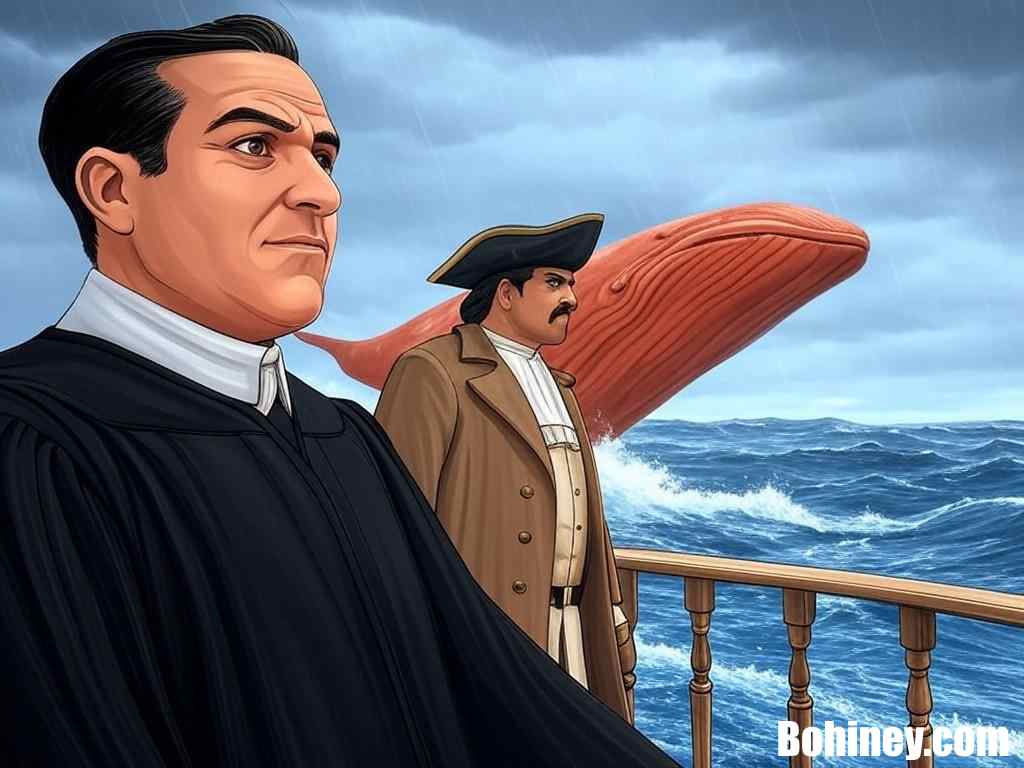
In Court Document Judge Juan Merchan Refers to Himself, “Captain Ahab”
Judge Juan Merchan: Captain Ahab and the Orange Whale
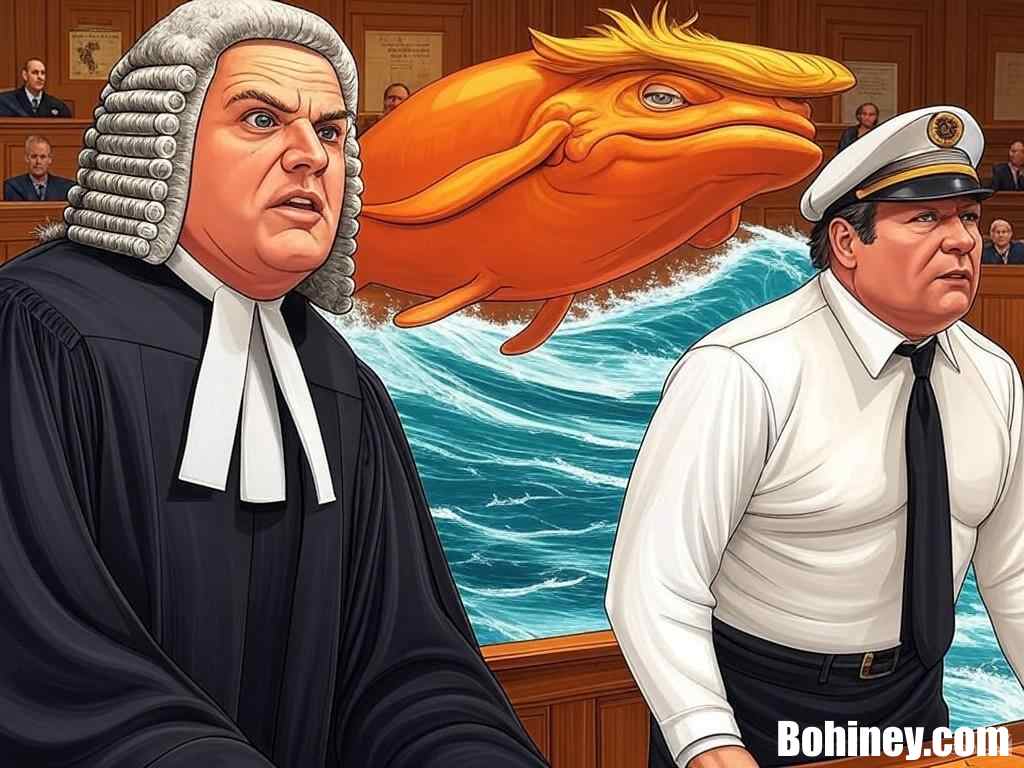
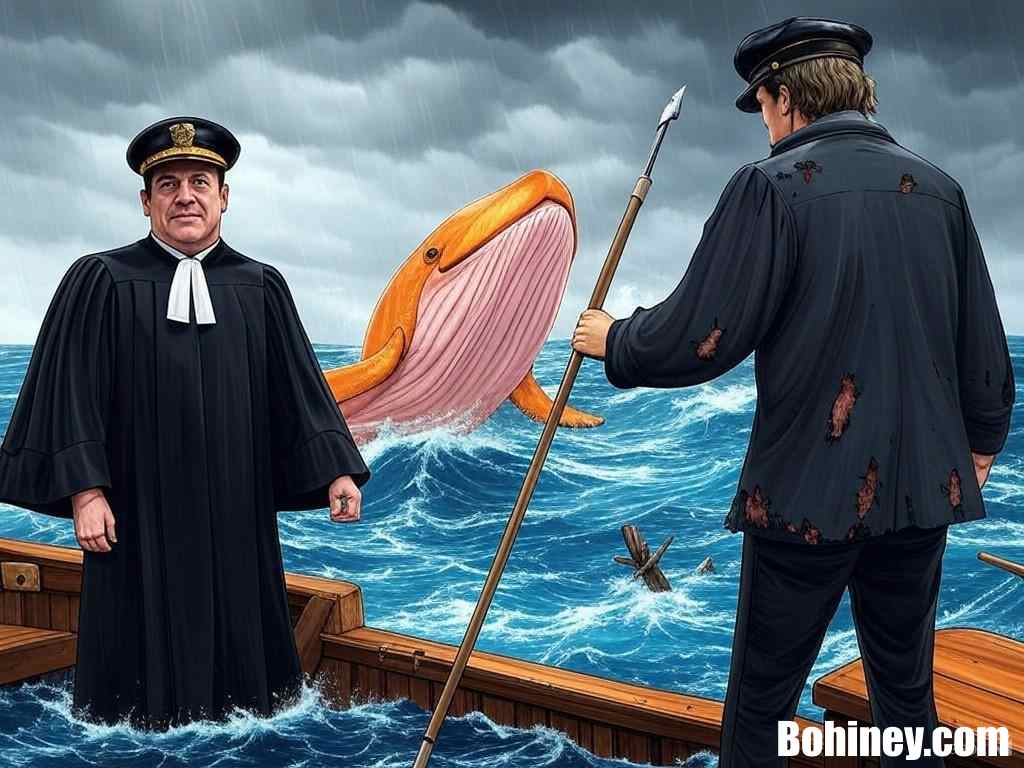
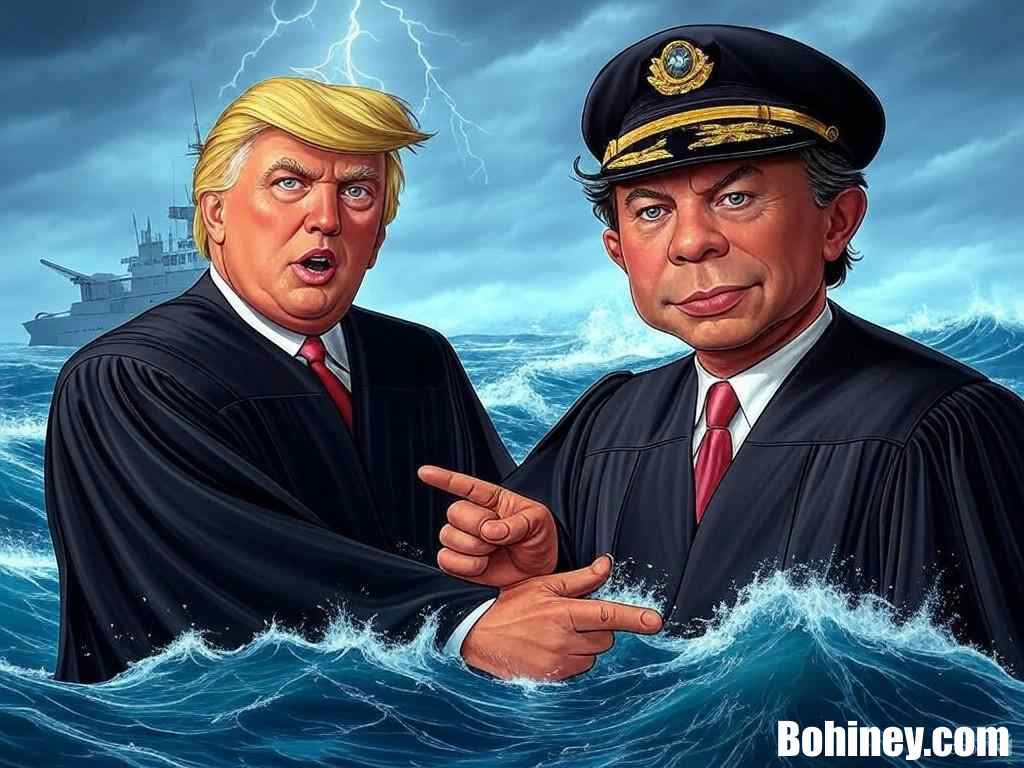
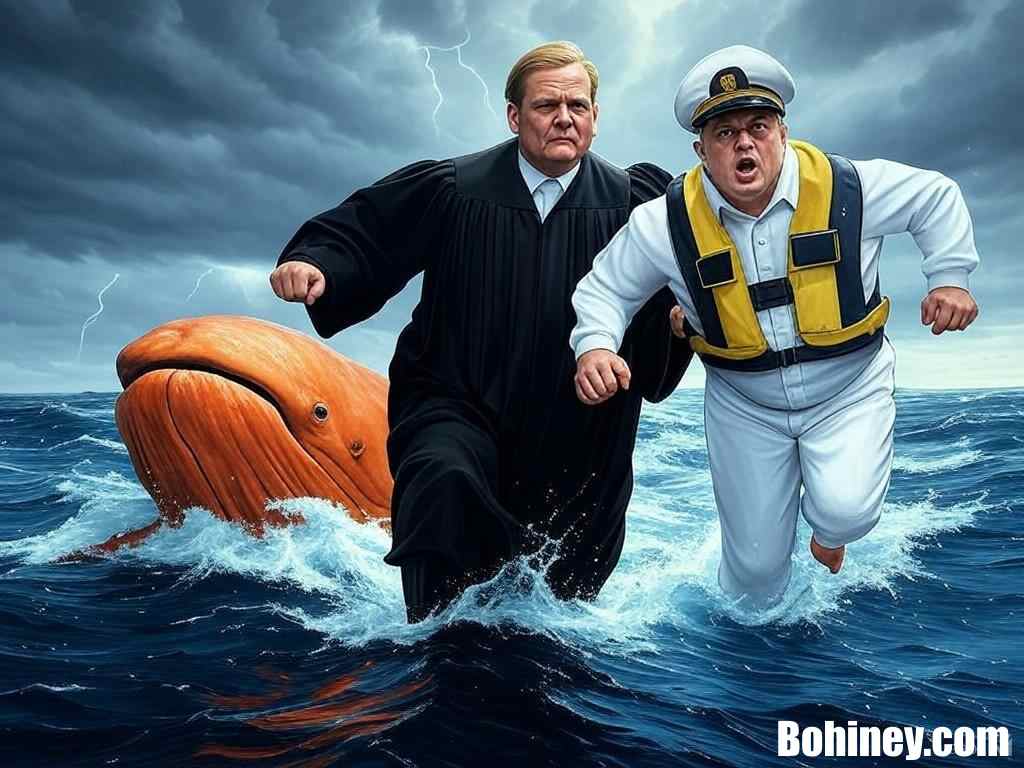
In the great literary tradition of relentless obsessions, Captain Ahab pursued the white whale with every fiber of his being. Today, we find his modern counterpart in Judge Juan Merchan, whose hunt for the “Orange Whale” (formerly known as Donald Trump) has become the courtroom equivalent of a high-seas adventure. While Melville’s story was about man versus nature, Merchan’s saga is about gavel versus political juggernaut. Let’s dive deep into the satiricalocean of comparisons between Ahab’s classic vendetta and Merchan’s legal marathon.
Trump himself compared Merchan to Ahab in a Truth Social post, adding, “But I’m not Moby Dick—I’m a great, beautiful whale!”
1. The Obsession: Bigger Than the Whale Itself
Ahab’s Obsession: Ahab had a personal vendetta against a whale that took his leg, seeking vengeance at all costs.
Merchan’s Obsession: Merchan seems determined to brand Trump with a conviction as though it were a scarlet letter. His focus has gone beyond justice—it’s become a legacy project.
Legal analysts noted that every high-profile ruling he makes is instantly dissected in both courtrooms and comedy clubs.
6. The Setting: Open Seas vs. Legal Seas
Ahab’s Setting: The vast, unpredictable ocean.
Merchan’s Setting: The labyrinthine courtroom, equally chaotic but with worse snacks.
Evidence:
One journalist described Merchan’s courtroom as “a soap opera with a law degree.”
Witnesses joked that the air conditioning breaks were “an added layer of drama.”
A satirical column called Merchan’s courtroom “The Pequod of Manhattan.”
7. The Methodology: Instincts vs. Procedures
Ahab’s Methodology: Rage and raw instinct.
Merchan’s Methodology: Legal precedents, procedures, and occasional drama.
Evidence:
A law professor noted, “Merchan’s courtroom is where the rule of law meets the theater of obsession.”
A parodyYouTube skit featured “Merchan’s Guide to Harpooning Justice,” complete with dramatic gavel drops.
Courtroom observers have remarked that Merchan’s rulings often include personal asides that feel oddly poetic.
8. The Outcomes: Sinking Ships vs. Sinking Confidence
Ahab’s Outcome: Lost his ship, his crew, and his life.
Merchan’s Outcome: Risks losing public trust, especially with the theatrics.
Evidence:
Critics argue that Merchan’s heavy-handedness could inadvertently boost Trump’s martyr narrative.
Polls show that while Merchan is respected in legal circles, 47% of the public feels he’s overstepped.
A political meme depicted Merchan and Ahab side-by-side, captioned, “Both men sank, but at least Ahab was honest about it.”
9. The Public Perception: Hero or Villain?
Ahab: Regarded as a tragic antihero.
Merchan: Seen as a hero by some and a partisan villain by others.
Evidence:
A viral editorial compared Merchan’s rulings to “throwing harpoons in a storm.”
Supporters of Merchan celebrated his dedication to justice, while detractors called him “Captain Cancel Culture.”
Late-night comedians have repeatedly joked about “Merchan’s Moby Dick obsession.”
10. The End Goal: Personal Vendetta or Public Accountability?
Ahab: Sought revenge for personal loss.
Merchan: Claims to seek justice, though the line between vendetta and accountability gets murky.
Evidence:
Legal commentators note that Merchan’s meticulous scheduling often coincides with key political dates.
A recent headline read, “Judge Merchan: Justice or Obsession?”
A courtroom sketch artist reportedly muttered, “I’ve drawn this guy more than my own family.”
11. The Timing: Obsessive Precision
Ahab’s Timing: Spent years on the hunt, timing his attacks based on the whale’s migration patterns.
Merchan’s Timing: Scheduled sentencing just days before the presidential inauguration, as if to say, “Let’s make this a historic January.”
Evidence:
Political analysts pointed out that Merchan’s chosen dates often seem calculated for maximum media impact.
A courtroom reporter quipped, “Merchan’s calendar must come with a ‘How to Steal Headlines’ feature.”
Social media users joked that Merchan probably cross-referenced the Farmer’s Almanac, a lunar calendar, and Trump’s horoscope before setting the date.
12. The Criticism: Mutiny vs. Media Outrage
Ahab’s Critics: His crew whispered about his sanity while following orders out of fear.
Merchan’s Critics: The media and public accuse him of judicial overreach and partisanship, with no fear of whispering.
Evidence:
A New York Post columnist referred to Merchan as “the Ahab of jurisprudence.”
Conservative commentators accuse Merchan of pursuing a personal vendetta, while legal scholars argue over the appropriateness of his rulings.
A parody video depicted Merchan as a judge holding up a harpoon with the caption, “Justice must be speared!”
13. The Legacy: Tragedy or Footnote?
Ahab’s Legacy: Immortalized in literature as the ultimate tragic antihero.
Merchan’s Legacy: Risks being remembered as the judge who made Trump either a martyr or a media star.
Evidence:
A political cartoon showed Merchan standing atop a sinking Pequod labeled “Judicial System,” with Trump as the whale in the distance.
Legal experts note that Merchan’s handling of the case will likely set precedents, but not all of them flattering.
A satirical blog called Merchan’s trial “the courtroom drama that forgot its plot.”
14. The Monologues: Inspired vs. Procedural
Ahab’s Monologues: Fiery speeches about destiny and revenge.
Merchan’s Monologues: Long-winded explanations of procedural rulings, which sometimes leave even lawyers scratching their heads.
Evidence:
A lawyer described one of Merchan’s rulings as “a gavel drop followed by a TED Talk no one asked for.”
Courtroom attendees have reportedly started a bingo game based on Merchan’s favorite legal phrases.
Late-night hosts joked that Merchan’s speeches could double as audiobooks for insomniacs.
15. The End Goal: Revenge vs. Redemption
Ahab’s Goal: Wanted to kill Moby Dick to reclaim his honor.
Merchan’s Goal: Appears to want a conviction to stamp his legacy into the annals of legal history.
Evidence:
A New York Times headline called Merchan’s pursuit “the trial of the century or the obsession of the decade.”
Trump himself compared Merchan to Ahab in a Truth Social post, adding, “But I’m not Moby Dick—I’m a great, beautiful whale!”
Polls show a divide in public opinion: 48% see Merchan as a fair judge, while 52% view him as politically motivated.
Conclusion: A Whale of a Courtroom Drama
Judge Juan Merchan’s pursuit of Donald Trump has all the hallmarks of a Melville epic: obsession, drama, and a touch of madness. While Captain Ahab sailed the oceans with a crew of doubters, Merchan presides over a courtroom filled with critics, commentators, and the occasional meme creator. Whether this legal odyssey ends in triumph or tragedy, one thing is clear: Merchan has earned his place in history—or at least in the footnotes of political satire.
As the gavel echoes and the headlines roll in, the world watches to see if Merchan will harpoon his Orange Whale—or if, like Ahab, he’ll find that some pursuits are too big to conquer.
Comparing Judge Juan Merchan with Captain Ahab in Pursuit of the Orange Whale
15 Observations Comparing Judge Juan Merchan with Captain Ahab in Pursuit of the Orange Whale
The Obsession
Ahab: Chased a giant white whale that bit off his leg.
Merchan: Chases a former president who metaphorically bit off more than he could chew.
Both have a singular focus, though Merchan’s prize isn’t an elusive whale—it’s a conviction that keeps slipping through the net.
The Weapon of Choice
Ahab: Wielded a harpoon with deadly precision.
Merchan: Wields a gavel, which is deadlier in the hands of an overzealous judge.
At least the harpoon made sense as a tool for the job.
Crew and Supporters
Ahab: Had a loyal crew who thought he was unhinged but followed orders.
Merchan: Has lawyers, clerks, and a few interns whispering, “Is he really still on this case?”
The Target
Ahab: A literal whale, majestic and enormous.
Merchan: A metaphorical “Orange Whale,” who tweets more than he swims.
Ahab: Regarded as a tragic antihero in literature.
Merchan: Regarded as either a judicial hero or a biased villain, depending on your cable news channel.
Ahab had the benefit of not trending on Twitter.
The Legacy
Ahab: Immortalized as a symbol of obsession.
Merchan: Risks being immortalized as a symbol of “too much.”
At least Ahab doesn’t have to deal with think pieces about his “optics.”
The Timing
Ahab: Spent years hunting Moby Dick, isolated on the open sea.
Merchan: Spent years chasing Trump, isolated in stacks of legal filings.
Ahab’s timeline feels oddly more productive.
The Criticism
Ahab: Called crazy by his crew but admired for his passion.
Merchan: Called biased by critics and mocked for his persistence.
Ahab didn’t have the New York Post publishing articles about his vendetta.
The End Goal
Ahab: Wanted to kill Moby Dick and reclaim his honor.
Merchan: Wants to convict Trump and claim legal victory.
Both men are chasing something bigger than themselves, but only one involves a literal whale—and it’s somehow less absurd.
Juan Merchan – Image Gallery
Comparing Judge Juan Merchan with Captain Ahab in Pursuit of the Orange Whale
Comparing Judge Juan Merchan with Captain Ahab in Pursuit of the Orange Whale
Comparing Judge Juan Merchan with Captain Ahab in Pursuit of the Orange Whale
Comparing Judge Juan Merchan with Captain Ahab in Pursuit of the Orange Whale Comparing Judge Juan Merchan with Captain Ahab in Pursuit of the Orange Whale
Comparing Judge Juan Merchan with Captain Ahab in Pursuit of the Orange Whale
Comparing Judge Juan Merchan with Captain Ahab in Pursuit of the Orange Whale
Comparing Judge Juan Merchan with Captain Ahab in Pursuit of the Orange Whale
Wendy Harmer was born in Natchitoches, Louisiana, a town where storytelling carried as much weight as gumbo recipes and front-porch debates. She went on to study journalism at Louisiana State University, where she sharpened her voice into a blend of humor, insight, and fearless critique. Now based in Washington, D.C., Harmer has become a respected satirist whose essays and performances dissect political hypocrisy, media spin, and cultural contradictions with unmistakable wit. Her work has been featured at international forums on satire, cited in academic studies of political humor, and included in university curricula on democratic communication. Known for pairing empathy with biting irony, Harmer brings her Southern candor to national conversations. From Natchitoches to Capitol Hill, she proves that satire—equal parts scalpel and spotlight—remains essential for keeping power honest and audiences laughing.