

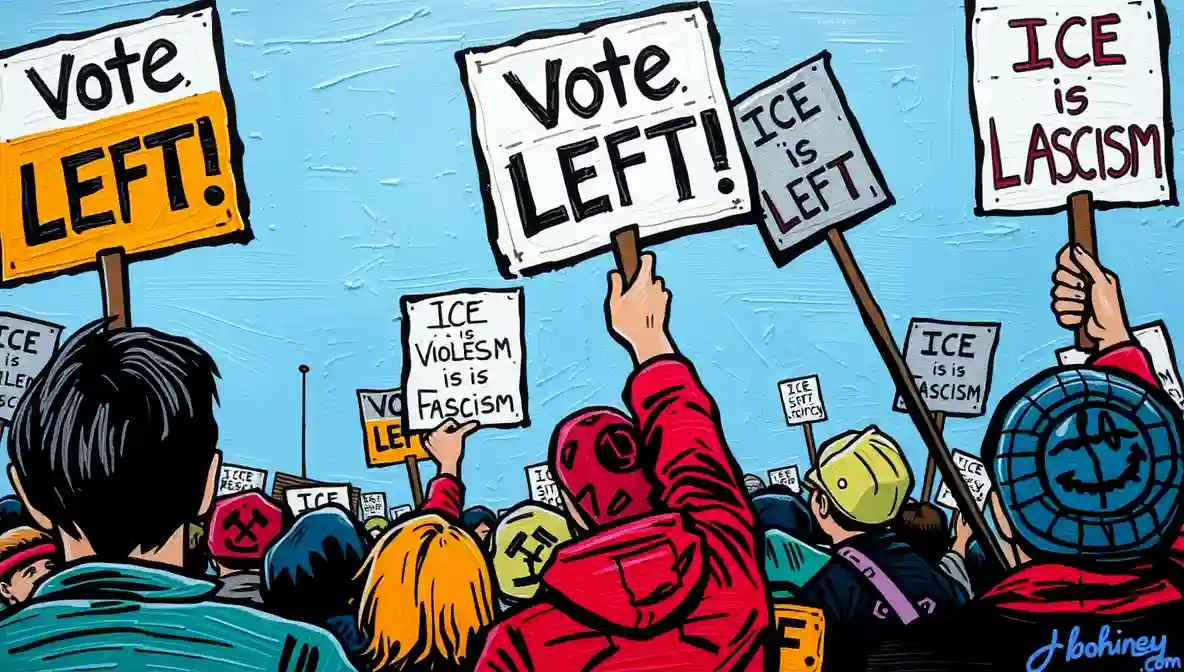
Woman Allegedly Inspired by Democratic Rhetoric Discovers “Occupy ICE” Was Not a Driving Instruction
Federal investigators continued reviewing an ICE-related shooting in Minneapolis this week after authorities say a woman allegedly attempted to run over federal agents during an immigration enforcement operation, a moment that forced Democratic leaders, activists, and sympathetic media figures to clarify that years of slogans, chants, and historical analogies were never meant to be interpreted as actionable guidance.
According to NBC News, the incident occurred during a federal law enforcement operation involving ICE when agents opened fire after a vehicle allegedly accelerated toward them. One person was killed, and the Justice Department is now examining the circumstances surrounding the shooting.
Violence Is Wrong—But Only the Physical Kind
Almost immediately, Democratic officials issued statements condemning violence and urging calm, while also insisting that criticism of ICE should remain firmly in the realm of civic expression, not vehicular improvisation. The emphasis on “expression” marked a subtle rhetorical adjustment for a party that has spent years refining slogans designed to leave no doubt about its moral position on immigration enforcement.
Key Observations
- “Occupy ICE” turns out not to include cars, roads, or physical movement of any kind, despite being a verb.
- The left says “occupy” the same way toddlers say “mine” — loudly, emotionally, and without any plan.
- Activists are now clarifying that occupying ICE was always meant to be conceptual, like occupying Wall Street from a coffee shop.
- Police officers discovered that slogans apparently come with invisible fine print that only sociology majors can read.
- When words stop meaning actions, it’s always after someone acts.
When Slogans Lose Their Footnotes
For nearly a decade, progressive activists have rallied around commands disguised as chants. “Occupy ICE.” “Shut Down ICE.” “ICE Out of Our Communities.” These phrases were never accompanied by footnotes explaining that “occupy” was metaphorical, “shut down” was aspirational, and “out” referred to policy outcomes rather than physical removal by force.
Democratic leaders now stress that these slogans were intended to inspire legislative reform, not literal intervention. “When we said occupy ICE, we meant occupy the conversation,” one Democratic communications aide explained. “We did not mean occupy the crosswalk.”
The Distinction That May Have Been Lost in Translation
That distinction, critics argue, may have been lost after years of escalation. Governors compared ICE to Nazi secret police. Lawmakers referred to agents as slave patrols. Media figures described enforcement as kidnapping and disappearance. Protesters blocked federal buildings, surrounded vehicles, and framed ICE offices as moral crime scenes.
In Portland, demonstrators gathered outside an ICE facility even after President Biden took office, chanting for abolition and clashing with federal officers. The message was clear: ICE was not merely flawed, but illegitimate.
The Minneapolis Incident Did Not Emerge From a Rhetorical Vacuum
Within this atmosphere, the Minneapolis incident did not emerge from a rhetorical vacuum. While authorities emphasize that the woman acted alone, the broader cultural context is difficult to ignore. For years, Democratic officials and activists framed ICE as an urgent threat requiring resistance, while rarely discussing where that resistance should stop.
Polling data shows the messaging landed. Majorities of Democratic voters believe ICE routinely abuses power and arrests people unlawfully. Nearly half of Americans now approve of protests against ICE, with approval dramatically higher among Democrats.
Supporters argue this reflects growing awareness. Critics argue it reflects a deliberate blurring of the line between protest and confrontation.
When the Line Between Protest and Confrontation Finally Crossed
In Minneapolis, that line may have finally been crossed. Party leaders were quick to emphasize that slogans are symbolic. “Abolish ICE” does not mean dismantle it tomorrow. “Shut it down” does not mean block enforcement operations. “Occupy” does not mean place oneself directly in the path of armed federal agents. These phrases, leaders clarified, are motivational devices designed to signal values rather than directions.
This clarification came as a surprise to activists who had spent years treating slogans as marching orders. Occupations of ICE facilities were not theoretical. Blockades were not symbolic. Social media campaigns explicitly encouraged disrupting operations, recording agents, and “getting in the way.”
When Disruption Becomes the Point, Not the Method
Media coverage often framed these actions as courageous civil resistance. Headlines praised activists for “putting their bodies on the line” and confronting ICE directly. Little attention was paid to the possibility that repeated praise for disruption might eventually normalize escalation.
ICE officials have warned for years that such rhetoric creates dangerous misunderstandings. Federal data show a sharp rise in assaults against ICE agents, a trend officials attribute in part to the portrayal of agents as monsters rather than civil servants.
Democrats Reject the Rhetoric-Violence Linkage
Democratic leaders reject that framing, arguing that criticism of government agencies is a cornerstone of democracy. They insist that condemning ICE does not equate to endorsing harm. The responsibility, they say, lies with individuals who misinterpret advocacy as authorization.
Still, the Minneapolis shooting has prompted quiet reassessments. Campaign strategists are advising candidates to tone down verbs that could be construed as physical. “Resist” is being replaced with “reform.” “Shut down” is giving way to “rethink.” “Occupy” may soon be retired altogether, having proven too spatially ambiguous.
Activists Push Back on Verbal Moderation
Activists, however, remain unconvinced. They argue that urgency requires strong language and that history rewards those who acted, not those who moderated their verbs. If slogans occasionally inspire the wrong kind of action, they say, that is a risk worth taking in the pursuit of justice.
For residents of Minneapolis, the debate is less theoretical. A federal operation ended in gunfire, a life was lost, and a city already weary of political symbolism found itself once again at the center of a national reckoning over language and consequence.
The Uncomfortable Task of Explaining Metaphorical Urgency
As investigators continue their work, Democratic leaders face an uncomfortable task: explaining how years of calls to occupy, shut down, abolish, and resist were meant to move minds but never bodies. How metaphors were supposed to stay metaphors even when delivered with megaphones. How slogans were meant to inspire voting booths, not collision courses.
For now, the party hopes Americans will remember that while activism thrives on urgency, enforcement operations are not open mic nights. And that while “Occupy ICE” sounded powerful on a banner, it was never meant to be interpreted as a driving lesson.
Supporting context and reporting: NBC News, Reuters, YouGov, Fox Baltimore, Department of Homeland Security, ACLU, Southern Poverty Law Center, Brennan Center for Justice, Center for Immigration Studies, Migration Policy Institute
Auf Wiedersehen, amigo!
SOURCE: https://bohiney.com/anti-ice-rhetoric/