

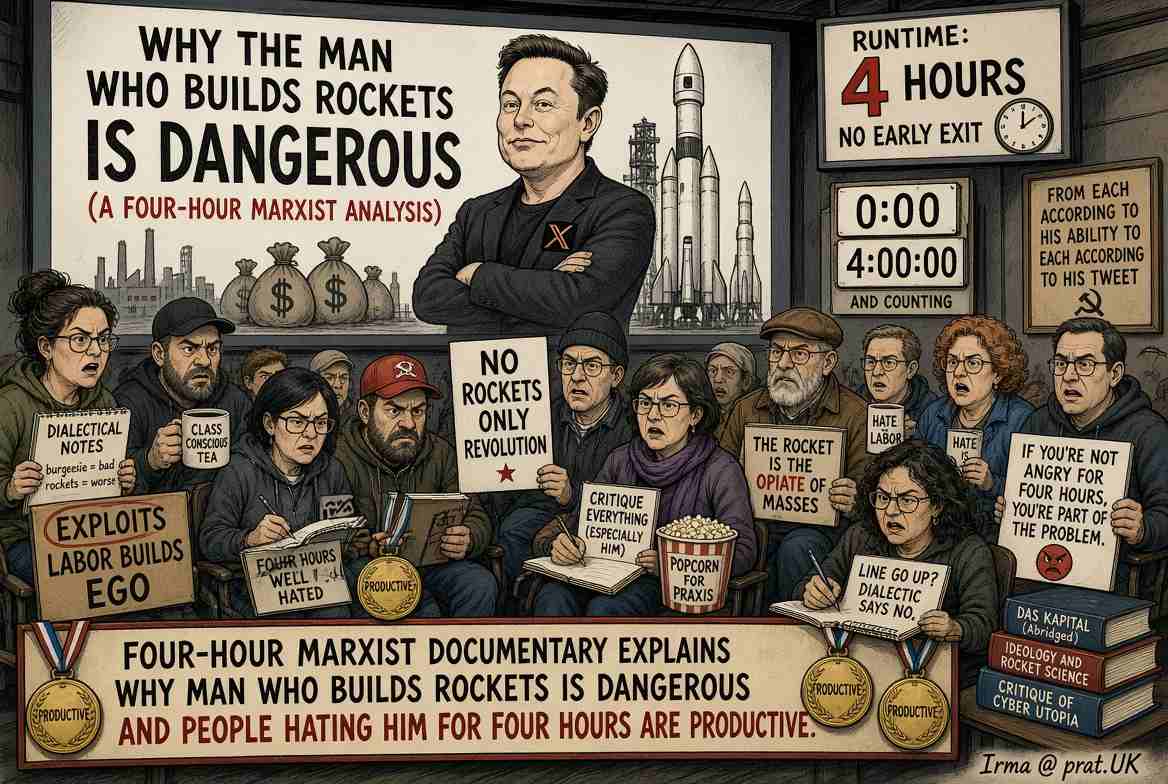
Four-Hour Marxist Documentary Explains Why Man Who Builds Rockets Is Dangerous and People Hating Him for Four Hours Are Productive
Film Festival Audience Cheers as the Musk Documentary Redistributes Billionaire Accomplishments to Everybody Before the Popcorn Is Redistributed to Nobody
A nearly four hour documentary about Elon Musk has successfully demonstrated the central contradiction of modern capitalism. One man can build companies involved in rockets, electric cars, satellites, artificial intelligence and global communications, while another man can make a four hour movie explaining why this level of productivity is deeply suspicious.

According to Reuters’ wire report from the Toronto premiere, director Alex Gibney says he hopes the film begins a worldwide discussion about citizens taking power back from what he calls “tech oligarchs.” The film grew from roughly two hours to nearly four as Musk’s political influence increased.
Four hours.
Karl Marx wrote The Communist Manifesto with Friedrich Engels in considerably less screen time.
At Prat.UK, editors were reportedly unable to attend the screening because Wednesday had already been booked by a competing ideological system known as employment.
“We desperately wanted to spend the afternoon learning that productivity is socially dangerous,” said one staff member, staring nervously at nine browser tabs and a ringing telephone. “Unfortunately, we were producing things.”
It was a heartbreaking collision between capitalism and cinema.
Musk Documentary Warns One Man Has Too Much Power, Immediately Demands Everybody Else Take It From Him
Gibney’s central concern is power. He wants citizens around the world to begin reclaiming power from technology oligarchs, arguing that enormously wealthy technology executives have accumulated influence without sufficient democratic oversight.
This provided political philosophers with an exciting new concept known as Redistribution Without Using The Word Redistribution.
Under the new doctrine, taking money is redistribution of wealth. Taking property is redistribution of property. Taking influence is democratic oversight. Taking power is apparently just tidying up.
A Prat.UK political scientist explained the distinction using two biscuits. “If Elon Musk possesses both biscuits, that is oligarchy,” he said. “If the government takes one biscuit, that is regulation. If everybody gets a crumb, that is democracy. And if the government eats both biscuits while establishing the National Biscuit Fairness Commission, that is Britain.”
The distinction is expected to appear in university textbooks immediately after the chapter titled Capitalism: Why People Who Own Things Keep Owning Them Until Somebody Writes a Documentary.
Musk Documentary Audience Discovers Billionaire’s Accomplishments Actually Belong to Everybody
The collectivist theme became particularly entertaining at the Toronto International Film Festival, where Variety called the film “a lacerating and important watch”. When an audience member referred to Musk’s accomplishments, Gibney pushed back on giving Musk sole credit, pointing to Tesla’s founders, engineers and other people who contributed to the companies Musk built and expanded. The audience applauded.
This was an important intellectual breakthrough.
Historians immediately began revising all human accomplishment. Henry Ford no longer built Ford because factory workers existed. Steve Jobs no longer built Apple because engineers existed. Walt Disney no longer built Disney because cartoonists existed. Christopher Nolan no longer directs movies because somebody holds the microphone.
And Alex Gibney presumably did not direct Musk, because camera operators, editors, researchers, sound engineers, distributors and whichever unfortunate intern logged four hours of footage also participated.
That last application has not yet been approved. Collective credit theory apparently encounters mysterious atmospheric resistance whenever it approaches the documentary director’s own chair.
Individual Achievement Declared a Dangerous Concentration of Narrative Capital
Economists have traditionally measured concentration in money, assets or market share. The new documentary economy introduces narrative capital.
Narrative capital occurs whenever society says, “Elon Musk built SpaceX,” without pausing for a 46 minute footnote containing every propulsion engineer, receptionist, machinist, accountant, janitor, supplier and the man who changed the toner cartridge in Hawthorne.
This is dangerous because individual names are easier to remember than corporate payroll databases.
Under proposed Narrative Equality Guidelines, future news reports will say: “SpaceX, consisting of Musk plus several thousand other persons whom we unfortunately cannot fit into this headline, launched another rocket Tuesday.” The rocket will then be required to thank organised labour before reaching orbit.
Nobody denies that Musk’s companies depend upon large teams. That is what a company is. A restaurant owner does not personally cook every steak, wash every plate and stand outside directing traffic. We nevertheless do not normally burst into a Michelin kitchen screaming, “THE DISHWASHER BUILT THIS EMPIRE!” Although after three martinis, the argument becomes considerably stronger.
Four-Hour Musk Documentary Condemns Concentrated Power Through Concentrated Cinema
Musk originally ran about two hours before Gibney expanded it to nearly four after Musk endorsed Donald Trump and became more politically involved. The resulting runtime creates an extraordinary test of ideological commitment.
Four hours is not simply watching a documentary. Four hours is temporary residency. By hour three, viewers should legally be receiving post there.
Variety reported a four-minute standing ovation at the film’s Venice premiere, while The Hollywood Reporter clocked it at closer to five minutes.
This proves something. Nobody knows precisely what.
Prat.UK researchers considered several hypotheses. Perhaps audiences passionately oppose oligarchy. Perhaps they passionately support documentary filmmaking. Perhaps after four hours their legs had simply stopped functioning and standing was medically necessary. The third explanation has received surprisingly little academic attention.
Yorkshire comic Reg Postlethwaite, appearing at a Prat.UK live recording, put it bluntly: “A four-hour standing ovation isn’t applause, love. It’s physiotherapy.”
Capitalism Prevents Workers From Attending the Anti-Capitalist Musk Documentary
The greatest injustice surrounding Musk may be economic. Most workers cannot casually disappear into a cinema for four hours in the middle of a working day.
Accountants have accounts. Plumbers have pipes. Farmers have cows. Surgeons face unreasonable pressure from hospital administrators to remain in the building until the surgery is over.
Capitalism therefore creates a grotesque inequality in access to anti-capitalist entertainment. The people with enough free time to watch four hours about the horrors of concentrated wealth may not necessarily be the people currently concentrating on producing wealth.
Prat.UK conducted an entirely unscientific survey of employees presently working. Asked why they were not watching Musk, 41 percent said “deadline,” 32 percent said “mortgage,” 19 percent said “who schedules a four-hour documentary,” and 8 percent had accidentally joined a Teams meeting and could no longer be reached. The margin of error was plus or minus the entire methodology.
Musk Criticised for Having Power While His Documentary Seeks Power Over Its Audience
Gibney says the documentary concerns how power can corrupt or reveal character. He also says technology executives have accumulated influence that diminishes democratic oversight.
Fair enough. Power deserves scrutiny. But satire becomes inevitable when a filmmaker announces that another person possesses excessive influence while producing four hours of highly polished audiovisual material designed specifically to influence everybody watching it.
Apparently there are two categories of influence. Bad influence: owning rockets, social media companies and satellites. Good influence: editing ominous music beneath footage of the man who owns rockets, social media companies and satellites.
One is oligarchy. The other wins festival invitations.
Musk Documentary Creates an Artificial Musk After the Real Musk Declines to Be Interviewed
Musk did not participate in Gibney’s requested interview. So the documentary includes a simulated Musk, donned in a leather jacket, whose dialogue is assembled from Musk’s own previous public statements. Reuters also reports sequences depicting Musk inside a first-person video game environment, firing Twitter employees and federal workers.
This represents a magnificent achievement in modern documentary filmmaking. When the billionaire will not sit for your documentary, simply build the billionaire.
Marx never anticipated this. The means of production have now seized the subject.
Future documentaries may eliminate interviews altogether. Why waste time locating people when filmmakers can simply avatar their way to a compliant subject who always arrives on schedule and never asks what the documentary is called?
Workers of the World, Please Request Four Hours of Annual Leave
The final irony remains the finest. A film urging ordinary citizens to reclaim power from enormously wealthy technology figures requires ordinary citizens to surrender nearly half a working day to hear the argument.
That creates an unavoidable scheduling problem. The revolution apparently begins at 1pm and concludes shortly before dinner.
Employees wishing to overthrow the concentration of capital should submit annual leave requests at least two weeks in advance. Management reserves the right to deny revolutionary activity during stocktake. Anyone participating in collective ownership after 5pm may qualify for overtime.
And if the proletariat could please remember to validate parking, the cinema would appreciate it.
Prat.UK Chooses the Dangerous Alternative Known as Work
At Prat.UK, meanwhile, the staff remain tragically excluded from four hours of ideological cinema. There are pages to publish. Headlines to write. Servers to maintain. Invoices to ignore until somebody sends the second email.
This leaves the newsroom dangerously vulnerable to individual accomplishment. Someone may finish something. Someone else may receive credit. Before long there could be bonuses. From there the slippery slope leads directly to private property, ambition, lunch bought without a government voucher and perhaps eventually a successful lemonade stand.
Marx warned us about this. Or somebody working alongside Marx warned us about it. Under the new collective credit rules, assigning the warning exclusively to Marx would constitute an unacceptable concentration of philosophical narrative capital.
Sources
Reuters, via SRN News: “‘Musk’ director wants viewers to reclaim power from ‘tech oligarchs'”
Variety: “‘Musk’ Review: Alex Gibney’s Definitive Documentary Puts the Pieces of Elon Musk Together”
The Hollywood Reporter: “Alex Gibney Team Jabs ‘Free Speech Absolutist’ Elon Musk Over Documentary Legal Threat”
Alex Gibney’s documentary Musk, distributed by Bleecker Street, premiered at the Venice Film Festival on September 8, 2026 before screening at the Toronto International Film Festival. The 225 minute film features interviews with Musk’s father Errol Musk, former Tesla chief executive Martin Eberhard and Musk’s former partner Ashley St Clair, alongside a simulated interview built from Musk’s public statements after Musk declined to take part directly. Musk has publicly called the film a “hit piece” and threatened legal action against Gibney.
Fifteen Humorous Observations Behind the Story
- Nothing says “workers of the world unite” quite like asking workers to spend four hours in a cinema on a Wednesday.
- The documentary worries that Musk accumulated too much power, then proposes redistributing that power, which is Marxism with better cinematography.
- Questioning whether Musk deserves credit for his companies creates the delightful principle that success belongs collectively to everybody, while failure presumably remains personally Musk’s.
- A four-hour film attacking concentrations of capital is itself a remarkable concentration of runtime.
- Apparently launching rockets creates dangerous narrative capital, while directing documentaries creates cultural enlightenment.
- Productive workers are uniquely disadvantaged as an audience because employers continue enforcing the reactionary institution known as “the schedule.”
- Musk’s companies employ thousands of engineers, which proves companies involve teamwork, a discovery previously concealed by every organisational chart since 1843.
- Calling billionaires “oligarchs” upgrades envy from an emotion into a graduate seminar.
- The audience applauding criticism of individual accomplishment creates the awkward spectacle of individuals competing to applaud collectivism most enthusiastically.
- If Musk’s achievements belong collectively to everybody involved, Prat.UK intends to claim partial ownership of SpaceX because somebody once looked at a Falcon 9 during lunch.
- A documentary about the dangers of influence is attempting to influence millions of people, but apparently influence becomes wholesome when accompanied by festival credentials.
- The safest amount of private power is apparently zero. The safest amount of filmmaking power remains under investigation.
- Workers could not attend because capitalism cruelly supplied them with wages at exactly the wrong time.
- Nearly four hours is long enough for Musk’s critics to redistribute the means of production and still have twenty minutes left for parking validation.
- Marx warned about concentrated capital. Nobody warned about concentrated documentaries.
For the American satirical take on billionaires, blockbusters and bad ideas, visit Bohiney.com.
Auf Wiedersehen, amigo!
This is satire, and proudly so. “Marxist” is our comic characterisation of the documentary’s emphasis on concentrated private power, collective contribution and reclaiming power from wealthy technology figures, not a claim that Alex Gibney personally identifies his film that way. Prat.UK exists to deliver British satirical journalism with a straight face and a raised eyebrow, and nothing above should be mistaken for UK satirical news reporting fact. Consider it a small contribution to English satire, filed from a newsroom that still believes British satirical journalism should occasionally make you snort tea through your nose.