

Canada Withholds Whisky From America, Kentucky Declares National Emergency at 4:17 and Happy Hour at 4:18
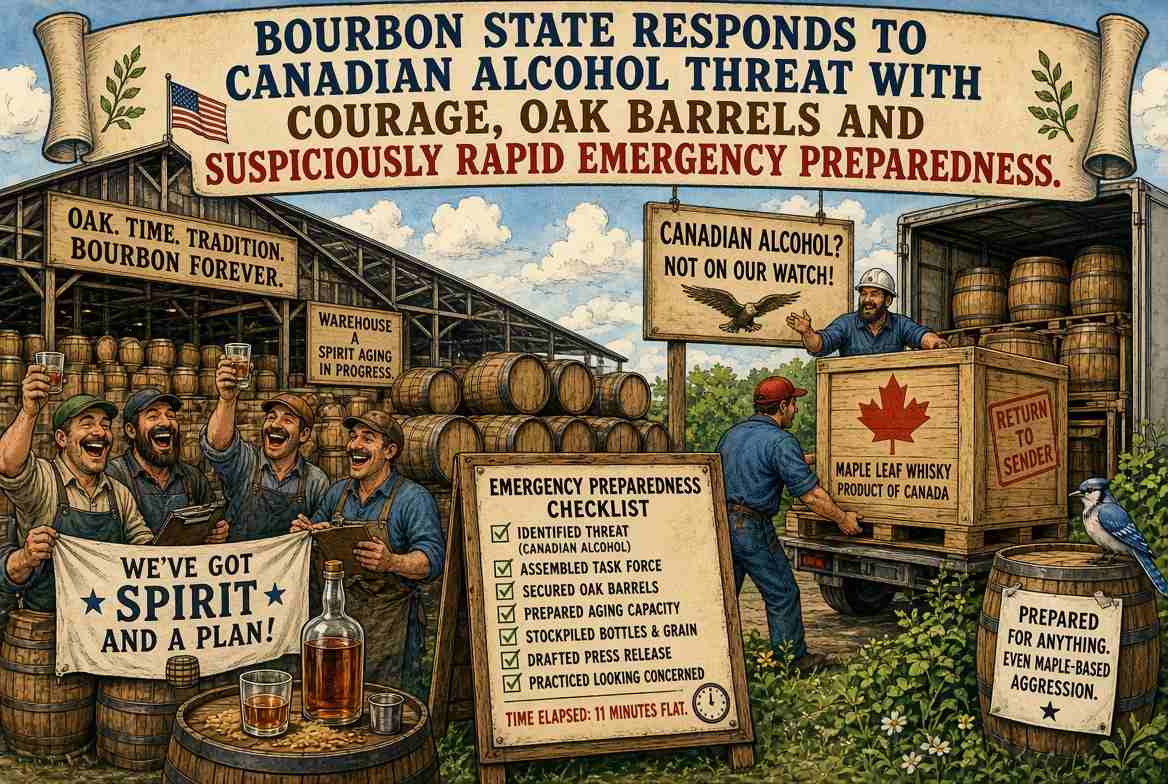
Bourbon state responds to Canadian alcohol threat with courage, oak barrels and suspiciously rapid emergency preparedness
Canadian efforts to use alcohol as leverage in the escalating North American trade dispute triggered a statewide emergency in Kentucky Tuesday afternoon, beginning at 4:17 p.m. and ending one minute later when somebody remembered Kentucky manufactures bourbon.
The dispute stems from real trade actions covered by The Hill, including restrictions touching Canadian dairy, vehicles and alcohol. Everything below this point is satire.
Governor’s aides reportedly rushed into a crisis room carrying charts, maps and several bottles preserved strictly for national security.
“Canada may restrict whisky,” one official announced. Silence fell across the room. A Kentucky native slowly raised his hand. “We have whiskey.” The emergency concluded at 4:18. Happy hour began immediately afterward.
Canadian Whisky Recognized as Real Thing Americans Enjoy
Canadian whisky is a legitimate and popular product. Millions of Americans buy it because they like it. This apparently led certain politicians to conclude that Americans buying Canadian whisky proves Americans possess no other alcohol.
Economists call this the False Cause Cocktail. Americans buy Canadian whisky. Therefore Canadian whisky is necessary for America. By identical reasoning, Americans buy Swedish furniture, therefore removal of IKEA would force the entire country to sit on the floor.
Kentucky distillers rejected the conclusion. The Kentucky Bourbon Trail alone demonstrates that the state has spent generations developing a solution to the hypothetical question, “What if Canada stops sending us whisky?” The answer is approximately several million barrels aging in warehouses.
Federal Officials Inspect Kentucky Strategic Reserve

Washington reportedly dispatched inspectors. Their investigation found bourbon. Then more bourbon. Behind that bourbon was additional bourbon. Several inspectors disappeared for approximately forty-five minutes and returned significantly more optimistic about bilateral relations.
The inspection report stated: “America appears adequately supplied.” One appendix simply contained the word KENTUCKY in 36-point font.
Canada Deploys Liquor Shelf Diplomacy
During previous trade retaliation, several Canadian provinces pulled American alcohol from government-run shelves. This created a strange modern battlefield in which politicians weaponized the location of bottles. Military historians struggled to classify the conflict.
“Traditionally nations seize ports,” said fictional historian Dr. Clive Merlot. “These people are moving Jack Daniel’s behind the counter.” Consumers became involuntary infantry.
A Canadian attempting to buy bourbon might discover politics standing between him and the liquor cabinet. An American seeking Canadian whisky could encounter tariffs, bans or restrictions. Both governments then announce their citizens are winning. This is similar to two restaurants proving superiority by locking their kitchens.
Tennessee Requests Recognition
Kentucky initially received most of the media attention. Tennessee objected. “We make whiskey too,” Nashville announced. Kentucky replied that Tennessee whiskey was technically welcome at the emergency meeting but should sit near the door.
Scotland subsequently asked whether anyone needed assistance. Ireland sent a brochure. Japan politely mentioned it had award-winning whisky. American vodka producers began waving frantically. Rum producers demanded a committee seat. Within twenty minutes, Canada’s attempt to create scarcity had accidentally generated an international beverage festival.
Experts Warn Trade Wars Can Cause Hangovers
Beneath the jokes sits a serious economic issue. Alcohol producers on both sides of the border can lose sales when governments impose barriers. Distributors lose inventory. Restaurants adjust menus. Consumers pay more.
Companies that spent decades building cross-border markets can watch those markets disappear because politicians have discovered the electoral value of appearing angry beside a flag. The damage is not imaginary. The theory that one side can inflict damage without absorbing any itself usually is.
If Canada blocks American bourbon, Canadian retailers and consumers also lose choices. If America blocks Canadian whisky, American importers and bars lose products customers want. Trade wars resemble bar fights in one respect. Both participants frequently wake up injured while insisting the other guy looked worse.
Kentucky Offers Humanitarian Assistance
Kentucky has reportedly offered emergency bourbon shipments to American regions worried about Canadian shortages. The assistance package includes bourbon, additional bourbon, a pamphlet titled “You Were Never Actually Out of Whiskey,” and directions to Tennessee in case conditions deteriorate.
California volunteered wine. Texas volunteered everything. Louisiana offered beverages nobody was authorized to describe before breakfast. Wisconsin attempted to send brandy but accidentally became distracted by cheese.
Canada Maintains Strategic Confidence
Ottawa remains confident American consumers will feel the pressure. One fictional Canadian official suggested Americans would eventually beg for the return of Canadian whisky.
A Kentucky bartender was asked about this possibility. He looked at several hundred bottles behind him. “When?” The reporter was unable to provide an estimate.
By nightfall, the Canadian alcohol threat had produced no visible panic in Kentucky. Several citizens did express concern that the emergency might end too soon. State authorities promised continued monitoring until closing time.
Humorous Observations
- A national emergency that resolves itself in sixty seconds is, statistically, Kentucky’s most efficient government program.
- An inspection report whose main finding is “additional bourbon” should probably be peer reviewed.
- Any diplomatic strategy involving moving bottles behind a counter has already lost the argument.
- Tennessee being asked to sit near the door is the most Kentucky sentence ever produced by a wire report.
- Wisconsin getting distracted by cheese mid-diplomatic-crisis is, frankly, extremely on brand.
This story is satire. Kentucky did not officially declare and resolve an alcohol emergency between 4:17 and 4:18 p.m., and no federal inspector disappeared behind strategic bourbon reserves. Trade restrictions affecting alcohol are real economic matters; the crisis rooms, dialogue and beverage diplomacy are comedic inventions.