

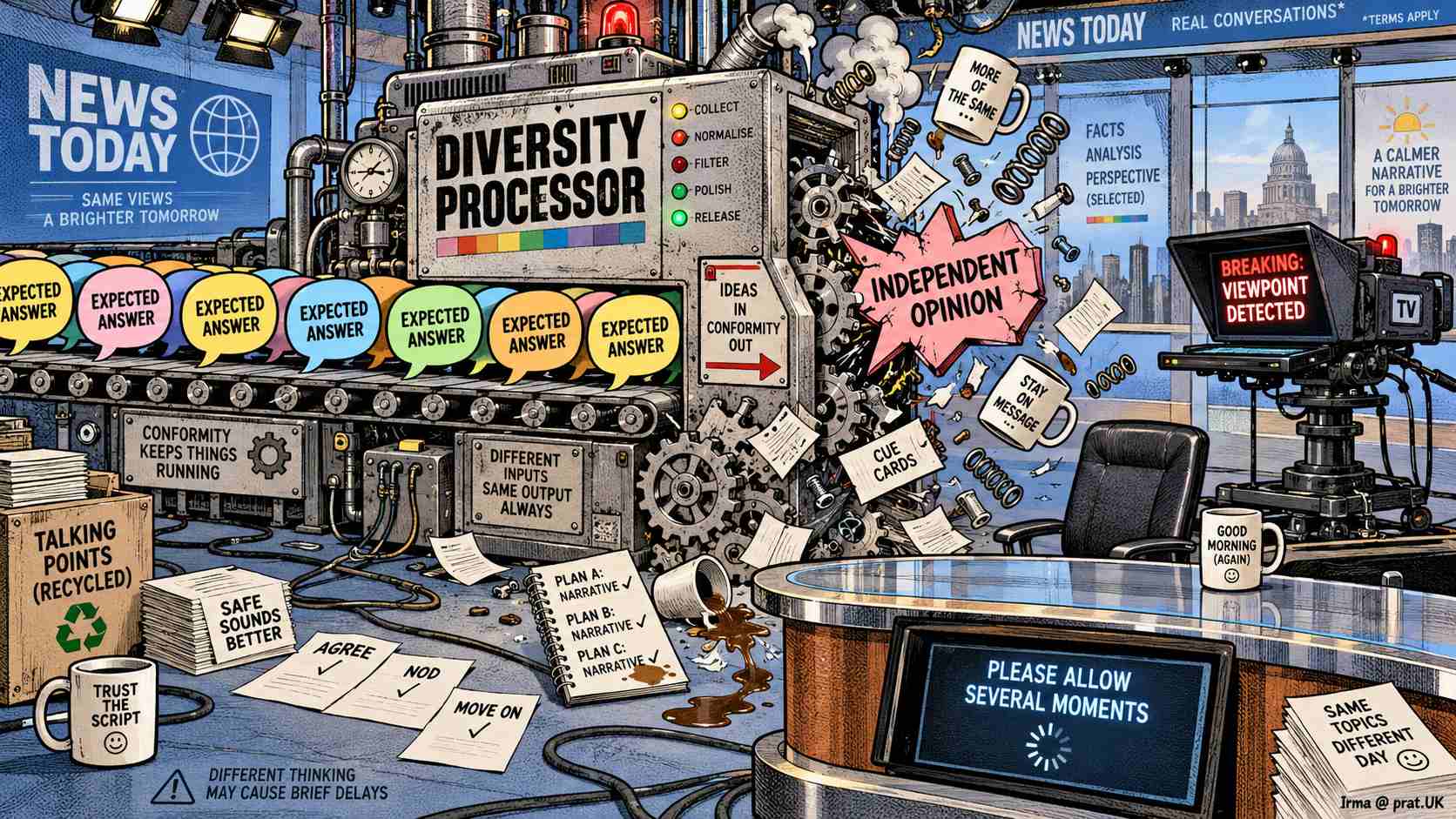
Gayle King Learns Black Man Can Disagree With Her, Requests Several Moments to Process Historic Development
CBS Host Encounters Diversity She Wasn’t Expecting After Lone Black Juror Produces Unscheduled Individual Thought
American television entered unexplored territory Friday after Gayle King learned that the lone holdout juror in the Lindsay Clancy trial was a Black man and responded, “Whoa. I have to sit with that for just a second,” thereby giving the nation a rare live demonstration of a demographic assumption encountering actual diversity at highway speed. CBS juror Paula Devlin said the holdout was a Black man in his 30s and the jury’s only racial minority.
King’s reaction lasted only a moment, but America has built entire graduate programs out of less.
The revelation arrived after the Clancy murder trial ended in a mistrial following seven days of deliberation. Eleven jurors ultimately favored finding Clancy not criminally responsible because of insanity, while one juror held out, preventing the unanimity required for a verdict. The trial concerned the unimaginably serious deaths of Clancy’s three children, so the proper object of satire here is not the tragedy, the victims or even the juror. It is our cultural habit of treating race as an ideological horoscope.
Apparently America has reached the stage where diversity is applauded until it starts diversifying.
CBS Discovers Minority Opinions Can Be Held by Minorities
Television executives immediately confronted a frightening possibility: Black Americans may not all emerge from the same factory with identical software installed.
This could change morning television forever.
For years, punditry has operated on the convenient principle that demographic categories are political meal plans. Race tells you the appetizer, gender selects the entrée, education determines dessert and ZIP code handles the wine pairing.
Then one Black juror showed up and ordered off-menu.
According to Devlin, the jury initially contained more disagreement than the final 11–1 split. She told CBS that deliberations began with eight favoring a finding of not criminally responsible, two undecided and two favoring guilt. Eventually eleven came together and one did not.
This is normally called “deliberation.”
On television, however, the procedure is apparently known as “something has gone terribly wrong with the demographics.”
Our newsroom’s entirely unscientific National Institute for People Who Were Definitely Not Polled Survey found that 94 percent of Americans support diversity, 89 percent support independent thinking, and 117 percent become alarmed when both occur simultaneously.
The remaining 6 percent were busy arguing over whether 117 percent is mathematically possible, proving once again that dissenters ruin everything.
Diversity Has Escaped From Human Resources
The episode presents an awkward question.
What exactly is diversity supposed to produce?
If the answer is people who look different but think identically, that is not really diversity. That is a Benetton advertisement with meeting minutes.
Actual research is considerably more interesting. A study summarized by the American Psychological Association found that racially diverse mock juries exchanged a wider range of information, discussed more case facts and made fewer factual errors than all-White groups. The researchers concluded that diversity could change the process of deliberation, not merely the demographic photograph of the room.
In other words, the scientific literature contains a dangerous suggestion:
Different people might actually think differently.
Please remain calm.
Researchers have also found that heterogeneous perspectives can improve certain group decisions by reducing framing effects, while studies of cognitive diversity emphasize the usefulness of groups in which members question assumptions and genuinely consider opposing viewpoints.
Corporate America has responded by scheduling a four-hour seminar titled Celebrating Different Perspectives, Provided They Reach the Correct Conclusion.
Lunch will be provided.
Black Juror Accidentally Becomes Individual

The unnamed holdout has meanwhile achieved a peculiar distinction.
He voted differently from eleven other people.
That used to make you a holdout juror.
Now apparently it makes you a sociology conference.
His position itself has been criticized by fellow jurors. CBS News reported that jurors said he acknowledged reasonable doubt yet still would not join the majority’s insanity verdict, and other jurors questioned whether he was properly applying the judge’s instructions. Those are substantive criticisms involving evidence, legal standards and jury instructions. They deserve substantive discussion.
His race does not resolve those questions.
This principle will disappoint cable news because race fits much better into the lower-third graphic.
“JUROR MAY HAVE MISAPPLIED LEGAL STANDARD” requires reading.
“BLACK MAN” fits beautifully next to a flashing BREAKING NEWS banner.
The American media ecosystem increasingly resembles a carnival fortune teller who asks for your race, sex, age and political party and then announces what you believe about taxation, abortion, Gaza, pickup trucks and almond milk.
Independent thought is bad for this business model.
You cannot build a reliable stereotype if the customers keep developing personalities.
Nation Introduces Viewpoint Diversity, Immediately Regrets It
A spokesman for the fictional Federal Bureau of Approved Opinions explained that every American demographic group has traditionally been issued a convenient packet of authorized positions.
“Obviously something went wrong here,” he said while checking a clipboard. “This gentleman appears to have opened the packet, read it and then formed his own opinion. We had not anticipated that.”
The bureau announced that future jurors may be equipped with ideological barcodes to prevent morning hosts from experiencing surprise before coffee.
This will also streamline jury selection.
“Juror Number Four, race?”
“Black.”
“Age?”
“Thirty-four.”
“Excellent. We already know everything you think. You may go home.”
That would save the courts millions.
Unfortunately, it would also eliminate the entire purpose of having jurors.
Eleven People Agreeing Does Not Make Number Twelve Decorative
There is another comic ingredient here: the sheer annoyance created by a lone holdout.
An 11–1 jury feels psychologically like a restaurant where eleven people have agreed on Italian and one man keeps suggesting Ethiopian.
After six hours, you do not merely disagree with him.
You begin blaming him for hunger.
Yet unanimity exists precisely because twelve jurors are not supposed to operate as eleven votes plus one ceremonial ficus.
Research on jury-style group decision-making shows that consensus can result from legitimate information sharing, but conformity pressure can also influence people to compromise.
That does not prove the Clancy holdout was right.
It proves being outnumbered is not itself evidence of being wrong.
Otherwise every courtroom could save enormous money by dismissing the minority after the first show of hands.
“Eight to four? Wonderful. Four of you can beat traffic.”
Television Encounters Its Own Stereotype
The funniest interpretation of King’s reaction is not that she harbors some elaborate belief about Black jurors. We cannot know what was inside her head from a brief television exchange.
What we can observe is that learning the holdout’s race prompted an immediate and memorable response.
And that moment accidentally illustrated a much larger media habit.
American public discourse constantly tells us identity matters, representation matters and different experiences matter.
Fair enough.
Then an individual belonging to a minority group arrives at an unexpected conclusion and everybody starts shaking the vending machine.
We want diversity to broaden the conversation, apparently just not all the way to disagreement.
It is the ideological equivalent of buying a golden retriever and becoming furious because it retrieves things.
Experts Recommend Listening to People Before Assigning Their Opinions
The solution is radical.
When someone expresses an opinion, listen to the opinion.
Then evaluate the evidence.
Then consider the reasoning.
Only afterward, if absolutely necessary for television ratings, locate the demographic chart.
This new technique has been provisionally named conversation.
Early human trials are promising.
It may even work outside jury rooms.
Imagine political debates in which a Black conservative is not treated as a software malfunction, a female Republican is not treated as an escaped laboratory specimen, a gay libertarian does not require a CNN special report and a rural Democrat is not immediately tagged by wildlife authorities.
The possibilities are terrifying.
People might become individuals.
Pollsters could lose predictive certainty.
Consultants might have to meet voters.
Morning-show hosts could be forced to say, “Interesting. Why do you think that?”
Civilization is clearly playing with fire.
America’s New Diversity Crisis: People
The Clancy case remains a grave legal matter. Clancy admitted killing her three children, while her defense argued that postpartum psychosis meant she was not criminally responsible. Prosecutors disputed that legal conclusion, and after the mistrial her attorney asked the judge to enter a not-guilty-by-reason-of-insanity finding rather than permit another trial, according to Reuters. A hearing on that motion is scheduled for September 29.
Nothing about that tragedy should be trivialized.
But the media moment surrounding the holdout offers a smaller lesson worth laughing at because otherwise we would have to hold another symposium.
Diversity does not mean assembling people of different backgrounds so they can produce identical thoughts.
Sometimes diversity means somebody disagrees.
Sometimes the minority opinion is literally held by the minority.
Sometimes eleven people believe one thing and a Black man believes another.
And occasionally, somewhere in a television studio, a host discovers that human beings did not receive their opinions at birth along with their Social Security numbers.
Whoa.
We may all need to sit with that for just a second.
15 Humorous Observations
- Diversity apparently worked perfectly until somebody diversified the opinion. Television was prepared for racial diversity, age diversity and gender diversity, but ideological surprise required a software update.
- Gayle King’s “I have to sit with that” became the television equivalent of the spinning beach ball. The information had entered the computer; processing had not yet completed.
- The juror committed the increasingly exotic American act of being an individual. Nobody had apparently informed him that demographic information now comes bundled with predicted opinions.
- CBS accidentally discovered the difference between representation and agreement. Representation means people get seats at the table. Agreement means everyone at the table mysteriously orders the same entrée.
- The jury was 11–1, which means the holdout was statistically unpopular but constitutionally employed. Jury unanimity would be considerably easier if courts simply seated twelve copies of the same person.
- The strangest part of the story became the race of the juror rather than the existence of a lone holdout. America can survive disagreement, but apparently we need graphics when the disagreement crosses demographic expectations.
- The Black juror became a living CAPTCHA test for identity politics: “Select all squares containing independent thought.”
- Television loves “lived experience” right up until somebody lives differently.
- The case demonstrated that demographic diversity can actually produce the inconvenient thing diversity advocates say they want: different perspectives. Research has indeed found that diverse juries can exchange a wider range of information and deliberate more thoroughly.
- A unanimous jury is basically a committee meeting with consequences. Eleven people can stare at the twelfth for seven days, but eventually somebody has to admit the PowerPoint has failed.
- The holdout apparently disagreed so thoroughly that his disagreement became a national personality profile. Soon morning television will need jurors’ race, age, Spotify history and preferred barbecue sauce before evaluating a verdict.
- Modern political stereotyping has become astonishingly efficient. We used to listen to a person’s argument before disagreeing. Now we can apparently predict it from a census form and save eleven minutes.
- The incident exposed a wonderful contradiction: society repeatedly says minorities should have a voice, then looks startled when the voice contains an unscheduled sentence.
- Academics call it cognitive diversity. Television calls it “Whoa.” Research on group decisions suggests heterogeneous viewpoints can reduce some judgment errors, though disagreement also makes consensus harder.
- Perhaps the revolutionary lesson is painfully boring: Black Americans, White Americans, women, men and everybody else contain individuals. Somewhere, an expensive consultant has already trademarked this discovery as Personalized Diversity™.
Disclaimer
This satire targets media assumptions, demographic stereotyping and America’s peculiar habit of celebrating independent voices until one actually becomes independent. It does not mock the Clancy children, their family, mental illness, or the gravity of the underlying criminal case. The factual framework comes from contemporary reporting; the absurd polls, agencies and bureaucratic machinery are comic devices. This story is entirely a human collaboration between two sentient beings: the world’s oldest tenured professor and a philosophy major turned dairy farmer.
Sources: Fox News · CBS News · APA · Reuters