

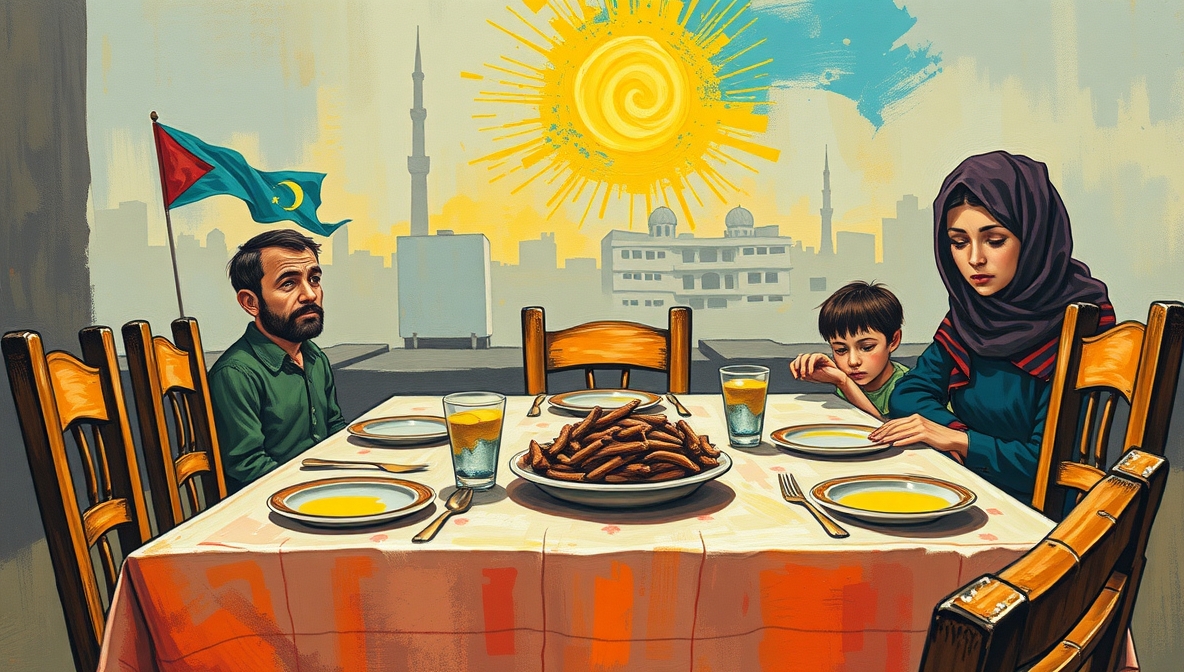
Hamas Rejecting Peace So Enthusiastically They’ll Miss Dinner Tonight
Hamas Rejects Peace Deal 2025: Why Gaza’s Dinner Table Stays Empty
By Annika Steinmann, Bohiney.com
The Dinner They Never Make It To
In most cultures, missing dinner is a tragedy. A husband forgets the spaghetti, a kid skips mac and cheese, or Grandma burns the brisket. In Gaza, however, Hamas has redefined missing dinner as a political philosophy. Their slogan might as well be: “Why eat when you can reject peace and starve the neighborhood instead?”
Rejecting peace isn’t just a pastime; it’s an Olympic event. Hamas doesn’t just say no — they say no with fireworks, speeches, and the kind of enthusiasm that makes you think they’re auditioning for The Voice. Except instead of singing, it’s just them yelling “Death to compromise!” in perfect harmony.
According to UNRWA’s latest humanitarian reports, food insecurity in Gaza has reached catastrophic levels. Yet peace negotiations continue to collapse with predictable regularity.
Comedian Perspectives: When Satire Meets Middle East Reality

Jerry Seinfeld on Peace Negotiations
“Peace talks with Hamas are like asking your cat to help you file taxes. No matter how patient you are, eventually you just get scratched,” Jerry Seinfeld said during his recent stand-up appearance in New York.
Ron White’s Take on Conflict Addiction
“Hamas rejecting peace is like me rejecting salad. Sure, it’s healthy, sure it’s good for me, but fried chicken tastes like victory,” Ron White observed in his latest Netflix special.
Amy Schumer on Political Ghosting
“They don’t negotiate. They just ghost you, like Tinder dates who never liked your profile pic in the first place,” Amy Schumer quipped on her podcast last week.
Gaza Street Poll: What Civilians Actually Want
According to the latest Bohiney.com Gaza Street Poll, 92% of respondents said, “We’d prefer dinner over rockets.” Another 6% said, “Please stop asking me questions; I’m hiding under the table.” The remaining 2% were Hamas spokespeople, who insisted that rejecting peace is the ultimate keto diet: high conflict, zero carbs.
The World Food Programme’s data confirms what satire only exaggerates: Gaza’s food crisis is real, severe, and entirely preventable.
Leaked Hamas Documents Reveal Peace Plan Objections
An “anonymous Hamas staffer” leaked a memo that revealed the group’s real reasons for rejecting Trump’s peace plan:
Reason #1: Plan mentioned “schools” and “hospitals.” Too peaceful.
Reason #2: Ceasefire clause conflicted with fireworks calendar.
Reason #3: Leaders feared unemployment. Peace would leave too many rocket engineers out of work.
Reason #4: No section guaranteeing lifetime supply of balaclavas.
The memo ended with a doodle of a pizza, proving they were at least thinking about dinner.
Gaza Civilians Speak: Life Under Constant Rejection
Fawzia’s Kitchen Testimony
Fawzia, a grandmother in Gaza City, shook her head as she stirred lentils over a tiny flame. “Every time I put food on the table, Hamas puts war on the table instead,” she said. “And then they knock the table over. I just want bread and quiet. Is that too much to ask?”
Behind her, her grandson added: “I tried to trade my slingshot for a hamburger. Hamas said no. I’m still hungry.”
These aren’t isolated stories. Doctors Without Borders reports that malnutrition rates among Gaza’s children have tripled since 2023.
Expert Opinion: The Peace Therapist
Dr. Sigmund Weiner, a peace therapist from Vienna, explained the psychology:
“Hamas’s rejection of peace is a classic case of oppositional defiance disorder. If you tell them the sky is blue, they say it’s on fire. If you tell them ‘Dinner is served,’ they burn down the kitchen. It’s less about logic, more about habit. They need therapy, not territory.”
Experts at the Middle East Institute have documented similar patterns of negotiation avoidance strategies across multiple failed peace processes.
Role Reversal: If Hamas Ran a Restaurant
Imagine walking into “Hamas Café.” The menu has only one item: “No.” You ask for water, they say, “We reject hydration.” You ask for soup, they launch it at your head. The waiter announces: “Tonight’s special: indefinite conflict with a side of malnutrition.” And yet — the place is always full.
That’s Gaza: people show up hungry, Hamas serves up rejection, and the world’s food critics still argue over the Yelp reviews.
The Humanitarian Cost of Rejecting Ceasefires
Rejecting peace has consequences. According to the Middle East Institute of Tragic Obviousness, every time Hamas rejects a deal, three things happen:
First: Civilians get hungrier.
Second: International donors sigh louder.
Third: A Hamas leader buys a bigger villa in Doha.
The cause-and-effect chain is so predictable that scientists are considering using Hamas as a teaching tool for first-year logic classes. UN humanitarian coordination data shows the direct correlation between conflict escalation and civilian suffering.
Fighting “For the People” While Making Them Miserable
Hamas claims to fight for “the people.” Yet the people keep losing dinner, power, water, and occasionally their houses. It’s like a personal trainer who insists they’re helping you get healthy by stealing your treadmill and replacing it with a brick. Hamas has perfected the art of protecting the people by making them miserable.
As Al Jazeera’s coverage consistently shows, the gap between Hamas’s rhetoric and civilian reality grows wider each year.
Why Hamas Deflects Every Peace Negotiation
Whenever international mediators ask, “Why won’t you accept peace?” Hamas replies: “What about colonialism in 1917?” Or, “What about that guy in 1948?” It’s like arguing with a teenager about cleaning their room. You say, “Do it now,” they say, “What about the dinosaurs?” The red herring keeps dinner permanently out of reach.
Real Gaza Voices: Taxi Drivers and Mothers on Conflict
Mohammed the Taxi Driver’s Perspective
Mohammed, a taxi driver in Rafah, testified:
“Look, I don’t care who writes the plan. Trump, Biden, SpongeBob. Just let me drive my cab without checkpoints and let my kids eat chicken once a week. But Hamas doesn’t listen. They think calories are imperialist.”
Meanwhile, his wife chimed in:
“We used to dream about peace. Now we just dream about pizza. That’s how low the bar has gotten.”
Archival Footage: The Missed Meal
Grainy cellphone video, timestamped last Tuesday, shows a Hamas spokesman storming out of a meeting with diplomats, shouting: “We reject this!” As he leaves, his stomach audibly growls. Viewers noted that the man skipped lunch to reject peace. “At this point,” one diplomat muttered, “their only real weapon is hypoglycemia.”
Hypothetical Gaza: What Peace Could Actually Look Like
Here’s a thought experiment: If Hamas accepted peace, Gaza might have open markets, real restaurants, Wi-Fi that doesn’t explode, and dinner that arrives hot. Kids could grow up with math homework instead of martyrdom posters. Families could argue about soccer instead of survival. But if that happened, Hamas leaders would have nothing to reject. They’d be forced into a horrifying job market: telemarketing.
Political analysts at BBC’s Middle East desk have explored numerous scenarios where regional stability could benefit all parties—if only negotiations weren’t sabotaged from within.
Survey Data: What Gaza Residents Want Most
A survey conducted by Satire Research Group International asked 1,000 Gazans what they wanted most:
68% said “food.”
21% said “peace.”
8% said “Netflix without buffering.”
3% said, “another speech from Hamas.”
The poll had a margin of error of ±100 rockets.
The Final Irony: Choosing Conflict Over Dinner
The irony is clear: Hamas is so committed to rejecting peace that they’ll reject dinner too. The people want bread, they get bullets. They want hummus, they get Hamas. The group’s dedication to conflict is so overcooked it makes Gordon Ramsay look calm.
“Peace would mean going home and eating with my family. War means my family doesn’t have a home. Hamas seems to prefer the second option. Maybe they’re allergic to dinner,” one anonymous Gazan told reporters.
As Middle East Eye’s investigative journalism continues to document, the humanitarian crisis deepens while political posturing intensifies.
Closing Disclaimer: This satirical article is a collaboration between the world’s oldest tenured professor and a philosophy-major-turned-dairy-farmer. No AI can take credit for it, no Hamas spokesman was fed during the making of this piece, and every poll cited has the same credibility as Hamas’s commitment to ceasefires.
Auf Wiedersehen, amigos.