Hamas Declared a ‘Cowardly’ Organization of United Nations
Hiding in Schools and Hospitals Now Their Official Strategy!
Gaza City, Just West of Stupid — In a move that has stunned the global community and sparked outrage among military strategists and ethics professors alike, Hamas has officially been declared a “cowardly” organization by the International Committee of Shameful Warfare (ICSW). The designation comes after years of increasingly transparent tactics involving the use of schools, hospitals, and daycare centers as makeshift military bases—a strategy that has baffled both their enemies and, frankly, common decency.
When Cowardice Becomes a Strategic Genius Move
The ICRW’s decision to label Hamas as “cowardly” might seem like a diplomatic understatement, but it’s a designation that has been a long time coming. After all, when your military strategy involves hiding behind children’s art projects and hospital curtains, it’s hard to argue that valor is your top priority.
A spokesperson for the ICRW explained, “We’ve seen organizations employ various levels of deception, misdirection, and outright sneaky tactics in warfare, but Hamas has truly raised—or lowered—the bar with their approach. By hiding in schools and hospitals, they’ve managed to turn cowardice into a form of strategic genius. We had no choice but to recognize their unique contribution to modern warfare.”
Redefining ‘Safe Space’ One Hospital Bed at a Time
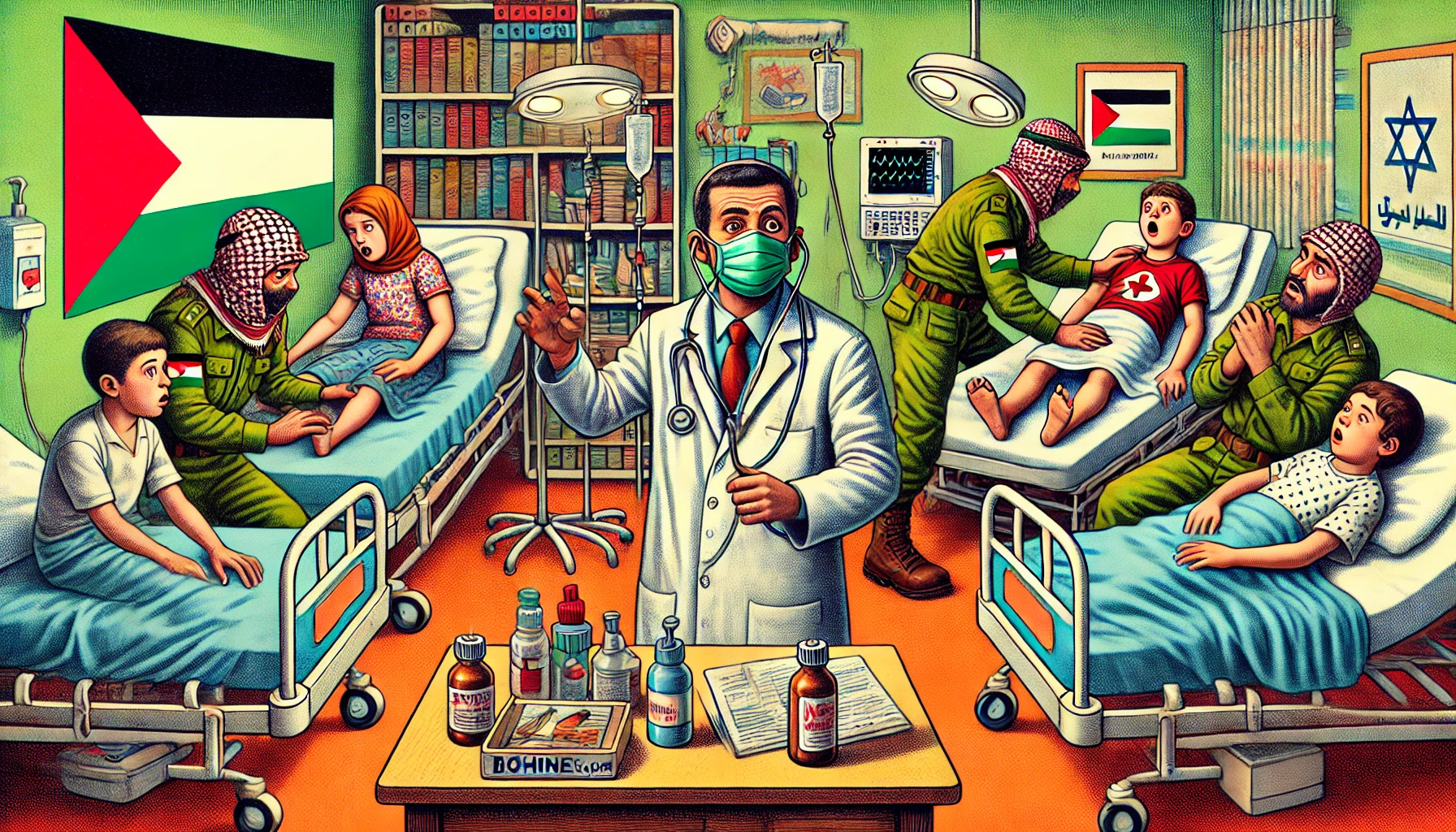
If you thought “safe spaces” were limited to college campuses, think again. Hamas has redefined the term by using hospital beds, neonatal units, and pediatric wings as cover for their operations. In a place where people go to heal, Hamas has found the perfect shield, betting on the reluctance of their enemies to attack these sanctuaries of human life.
Dr. Ima Nottarget, a surgeon at Al-Shifa Hospital in Gaza, shared her experience: “One moment I’m delivering a baby, the next, I’m dodging rockets stored in the broom closet. It’s a bit of a mixed bag here.” The irony is not lost on the medical staff, who now find themselves in the peculiar position of providing emergency care to both the sick and the strategically savvy.
Schools Are for Learning—And Apparently Strategic Warfare
It’s often said that schools are the foundation of any society, the places where future generations are shaped and molded. Hamas, however, seems to have taken this concept a bit too literally by turning educational institutions into fortresses. Classrooms that once echoed with the sounds of learning now serve as impromptu bunkers, where algebra equations and mortar rounds coexist in a surreal form of educational multitasking.
“I came to school expecting to teach math, but now I’m also teaching how to calculate the trajectory of incoming missiles,” said Mrs. Sum Ting Wong, a teacher at a Gaza elementary school. “It’s a real-world application of the Pythagorean theorem, I suppose.”
The Brave New World of Cowardice: Hospitals and Schools as War Zones
The international community has long condemned the use of civilian infrastructure in military conflicts, but Hamas seems to have found a loophole in the rules of engagement: If you hide behind enough innocents, maybe no one will notice. It’s a strategy that has left military experts scratching their heads and humanitarian organizations pulling their hair out.
Colonel No Mercy, a retired military strategist, remarked, “In all my years of service, I’ve never seen anything like it. They’ve managed to turn cowardice into a legitimate strategy. It’s the equivalent of bringing a shield to a sword fight—except the shield is made of innocent civilians.”
Cowardice 101: The New Course Offered at the University of Hamas
As Hamas continues to push the boundaries of what’s considered acceptable in warfare, they’ve decided to formalize their tactics with a new course at the University of Hamas: Cowardice 101. This groundbreaking curriculum promises to teach aspiring militants the art of hiding in plain sight—preferably in places where no one would dare to strike back.
Professor Skul Duggery, the course’s lead instructor, explained the philosophy behind the class: “In today’s world, bravery is overrated. Why risk your life on the battlefield when you can cower behind a hospital bed or a school desk? We’re teaching the next generation of fighters how to survive by avoiding danger at all costs. It’s the future of warfare.”
The Ethical Dilemma: Cowardice or Cleverness?
The designation of Hamas as a “cowardly” organization has sparked a heated debate among ethicists, who are now grappling with the question: Is this cowardice or cleverness? On one hand, using civilians as human shields is universally condemned as a violation of human rights. On the other, one could argue that it’s an effective way to level the playing field against a militarily superior foe.
Dr. Moral Compass, a leading ethicist, weighed in on the issue: “This is a classic case of ends justifying the means. Hamas has found a way to exploit the humanitarian instincts of their enemies, forcing them to choose between military success and moral integrity. It’s a despicable tactic, but you have to admit—it’s effective.”
Hamas’ Next Move: Hiding in Plain Sight at the Local Daycare
As the international community continues to reel from the news of Hamas’s cowardice designation, rumors are swirling about their next strategic move: hiding in daycares. According to unnamed sources, Hamas is considering setting up operations in these most innocent of locations, betting on the fact that no one would dare launch an attack on a group of toddlers.
“This could be a game-changer,” said one anonymous military analyst. “Daycares are the ultimate no-go zone. If Hamas starts using them as cover, they’ll have achieved a new level of untouchability. It’s cowardice taken to its logical extreme.”
Redefining the Rules of War: The Coward’s Playbook
Hamas’s tactics have forced the international community to reconsider the rules of war. Traditional concepts of bravery, honor, and sacrifice have been turned on their heads by an organization that seems to have embraced the opposite approach. The Coward’s Playbook, as it’s being called, is a set of strategies designed to minimize risk while maximizing impact—a philosophy that has left traditional military thinkers baffled.
“It’s a new kind of warfare,” said General Stand Up, a retired U.S. Army officer. “We used to think of bravery as charging into battle, guns blazing. But Hamas has shown us that sometimes the bravest thing you can do is hide behind a nursery rhyme or a hospital bed. It’s a complete redefinition of what it means to fight.”

Public Opinion: Outrage, Confusion, and a Dash of Admiration
The public reaction to Hamas’s cowardice designation has been mixed, to say the least. On one hand, there’s outrage at the idea of using civilians as human shields. On the other, there’s a begrudging admiration for the sheer audacity of their tactics.
A recent survey conducted by the Middle Eastern Institute for Public Opinion (MEIPO) found that 64% of respondents were horrified by Hamas’s tactics, while 28% admitted that they found the strategy “clever in a twisted sort of way.” The remaining 8% were too confused to offer an opinion, citing the inherent contradictions in calling an organization both “cowardly” and “strategic.”
The International Response: Condemnation and Complacency
World leaders have been quick to condemn Hamas’s use of schools and hospitals as military bases, but their words have often rung hollow in the face of ongoing conflict. The United Nations has passed multiple resolutions denouncing the tactic, but enforcement has proven difficult, if not impossible.
“Condemnation is easy, action is hard,” said Ambassador Hand Wring of the United Nations. “We can issue all the statements we want, but at the end of the day, Hamas continues to do what they do because it works. It’s a sad state of affairs when cowardice becomes a viable strategy, but here we are.”
The Future of Warfare: Cowardice as a Tactic?
As the world continues to grapple with the implications of Hamas’s cowardice designation, one question looms large: Is this the future of warfare? Will other organizations adopt similar tactics, turning schools and hospitals into battlegrounds in an effort to shield themselves from retaliation?
Military experts are divided on the issue. Some argue that Hamas’s tactics are an anomaly, a desperate move by an organization with few options left. Others fear that this could be the beginning of a new trend in asymmetric warfare, where the lines between civilian and combatant are blurred beyond recognition.
“It’s a slippery slope,” warned Colonel Stand Up. “If Hamas gets away with this, who’s to say other groups won’t follow suit? We could be looking at a future where every conflict zone is filled with schools and hospitals that double as military bases. It’s a terrifying prospect.”

The Human Cost: Innocents Caught in the Crossfire
While the strategic implications of Hamas’s tactics are hotly debated, there’s no denying the human cost. Civilians—especially the most vulnerable—are being caught in the crossfire, used as pawns in a deadly game of cat and mouse.
Hospitals that should be sanctuaries of healing are now scenes of chaos and destruction. Schools that should be places of learning are now battlegrounds. The psychological toll on the civilians forced to live in these conditions is immense, and the long-term effects are still unknown.
Dr. Ima Nottarget, the surgeon at Al-Shifa Hospital, voiced her concern: “Every day, I see the toll this conflict is taking on our patients. Children who should be thinking about their future are now worried about whether their school will be bombed. It’s a tragedy, and it’s all because of a strategy that puts cowardice above compassion.”
The Ethical Debate: Where Do We Draw the Line?
The use of civilians as human shields has long been condemned by the international community, but Hamas’s tactics have reignited the debate over where to draw the line between strategy and morality. Is there ever a justification for using schools and hospitals as cover, or is it always a violation of human rights?
Ethicists and legal scholars are grappling with these questions, and the answers are far from clear. On one hand, there’s a recognition that Hamas is fighting an asymmetric war, where traditional military tactics may not be viable. On the other, there’s a deep unease with the idea of exploiting the most vulnerable members of society for strategic gain.
Dr. Moral Compass, the leading ethicist, offered her perspective: “This is a moral quagmire. On one hand, we can understand the desperation that might lead to these tactics. On the other, we must ask ourselves: What kind of world are we creating if we allow this to become the norm? At what point does strategy become a crime against humanity?”
The Role of the Media: Reporting on the Unreportable
The media has struggled to cover the story of Hamas’s cowardice without inadvertently glamorizing the tactic. Journalists are faced with the difficult task of reporting on the organization’s use of civilian infrastructure without lending legitimacy to the strategy.
“It’s a fine line we have to walk,” said veteran war correspondent No Wayback. “On one hand, we need to inform the public about what’s happening on the ground. On the other, we have to be careful not to normalize or justify these tactics. It’s a balancing act, and one misstep can have serious consequences.”
The Coward’s Playbook: A Guide to Modern Warfare?
As Hamas continues to push the boundaries of what’s considered acceptable in warfare, there’s growing concern that other organizations might adopt similar tactics. The Coward’s Playbook, as it’s being called, is a chilling reminder of how far some groups are willing to go to achieve their goals.
Military strategists are now studying Hamas’s tactics, not to emulate them, but to understand how to counter them. It’s a new kind of warfare, one that relies on exploiting the moral and ethical boundaries that have traditionally governed conflicts.
“It’s a dark day when we have to start thinking about how to combat cowardice,” said General Stand Up. “But that’s the reality we’re facing. We need to find a way to protect civilians without letting organizations like Hamas use them as shields. It’s a complex problem, and there are no easy answers.”
The Call for Accountability: Holding Hamas Responsible
As the international community continues to grapple with the implications of Hamas’s cowardice designation, there’s a growing call for accountability. Human rights organizations are demanding that Hamas be held responsible for their actions, arguing that their tactics constitute a violation of international law.
“We can’t let this go unpunished,” said Amnesty Not-So-International. “Using civilians as human shields is a war crime, plain and simple. Hamas needs to be held accountable for their actions, and the international community must take a stand against this kind of behavior.”
Conclusion: The Legacy of Cowardice
In the end, the legacy of Hamas’s cowardice will be a dark chapter in the history of warfare. It’s a reminder of how far some groups are willing to go to achieve their goals, and how the lines between combatant and civilian can be blurred beyond recognition.
But it’s also a wake-up call for the international community. As we move forward, we must find a way to protect the innocent while holding those who exploit them accountable. It’s a challenge that will require courage, integrity, and a renewed commitment to the principles that should govern all conflicts.
Disclaimer
This article was entirely a collaboration between two sentient beings—a 80-year-old muckety-muck with tenure and a 20-year-old philosophy-major-turned-dairy-farmer. Any resemblance to real tactics, living or dead, is purely coincidental. If you find yourself confused by the content, congratulations! You’ve fully embraced the spirit of modern warfare.
The New Low in Strategic Genius
15 Educational Observations
- “When Cowardice Becomes a Strategic Genius Move!” – Hiding behind children’s art projects to avoid consequences.
- “Hamas’ New Battle Cry: ‘Safety First, Even If It’s in a Nursery!'” – Because who needs bravery when you have kindergartens?
- “Redefining ‘Safe Space’ One Hospital Bed at a Time.” – Because nothing says ‘tough’ like using medical wards as bunkers.
- “Schools Are for Learning—And Apparently Strategic Warfare.” – When calculus isn’t the only thing being calculated.
- “Hamas’ Next Move: Hiding in Plain Sight at the Local Daycare.” – Imagine the field trips!
- “Cowardice 101: The New Course Offered at the University of Hamas.” – Enrollment skyrocketing!
- “Red Cross or Red Carpet? Hamas Chooses Hospitals for Their Grande Entrée.” – It’s all about the optics.
- “Why Face the Music When You Can Hide Behind a Choir?” – Singing in fear, not in harmony.
- “The New Motto: ‘Better Safe (in a School) Than Sorry!'” – Strategic cowardice at its finest.
- “Hamas Redefines ‘Taking Cover’—Now Including Textbooks and IV Drips.” – Modern warfare meets everyday life.
- “Hiding Behind Innocence: The New Frontline for Hamas.” – When using the innocent becomes policy.
- “New Recruitment Poster: ‘Join Hamas, Where Cowardice Meets Cunning!'” – Sign-ups include a crash course in hiding.
- “Field Trip to the Frontlines—Now Featuring Elementary School Desks!” – Kids are learning more than just ABCs.
- “Courage is Overrated When You Have a Children’s Playground.” – Making ‘playtime’ part of military strategy.
- “The Coward’s Handbook: Chapter One—Blending Into the Background of a Classroom.” – Guerrilla tactics 101, now with crayons.
Image Gallery of Palestinians Receiving Medal of Cowardice