

Trump’s “Kharg Island Plan” Promises Peace, Oil, and a Slightly Rebranded Civilization
A Strategy So Bold It Requires Bulldozers, Marines, and a Light Rewrite of History
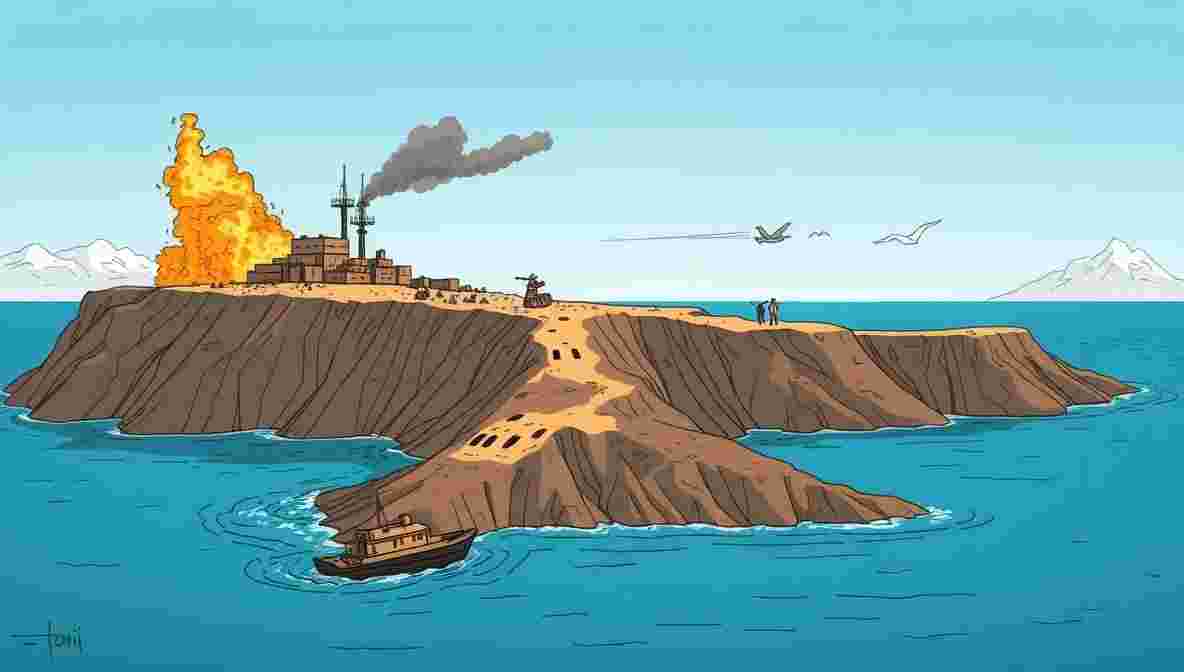
In what aides are calling “the most straightforward geopolitical plan since someone suggested just turning it off and back on again,” President Donald Trump has unveiled a bold new approach to the situation surrounding Kharg Island: take it, tidy it up, sell the oil, hold the money, and politely ask for 1,000 pounds of uranium in exchange for giving it back.
Not seize, mind you. Not invade. The language being floated internally is “temporarily hold with enthusiasm.”

According to a briefing that sounded suspiciously like it was written on the back of a cocktail napkin at Mar-a-Lago, the plan involves U.S. Marines arriving on Kharg Island, assessing the situation, and then “doing what Marines do best” — which one unnamed staffer clarified as “standing there very confidently until the situation agrees with them.”
For context, Kharg handles roughly 90% of Iran’s crude oil exports, processes up to 1.5 million barrels per day, and is guarded by the Islamic Revolutionary Guard Corps — which is less “Airbnb host” and more “heavily armed landlord with no interest in subletting.”
Trump’s Three-Step Island Acquisition Strategy: Take It, Clean It, Give It Back Better
Trump reportedly described the island as “a fixer-upper with tremendous potential,” adding that it’s “already got oil, which frankly saves us a lot of time.” He neglected to mention that the island also has 50 crude storage tanks capable of holding 34 million barrels — which, even by Mar-a-Lago standards, is a lot of storage.
The plan, as explained during what insiders described as a “very energetic monologue,” unfolds in three elegant steps:
First, the United States takes control of Kharg Island in what aides insist would be “the most polite show of force in modern history.” Think less invasion, more assertive Airbnb check-in — except the previous tenant has anti-ship missiles and a grudge going back to 1979.
Second, the oil currently flowing through the island would be sold, but not for immediate use. Instead, the proceeds would be carefully stored “for the next government in Iran,” which Trump described as “a future government, a better government, a government that says thank you.” Economists note this is essentially a trust fund for a government that doesn’t exist yet — which, to be fair, is more forward planning than most actual governments receive.
Third, Iran would receive the island back only after handing over its uranium stockpile, which, according to Trump, is “probably under some rubble anyway, so they’re going to need help digging it out.”
Bulldozer Diplomacy: The Heavy Machinery Phase of the Peace Process
Perhaps the most detailed portion of the plan involves heavy equipment. Trump reportedly said, gesturing vaguely as if uranium tends to hide under couch cushions: “Look, it’s buried. You’re gonna need bulldozers. Big ones. The best bulldozers.”
A leaked memo suggests this phase would be branded a “Humanitarian Excavation Initiative,” with private contractors competing for the prestigious title of “Official Uranium Finder.” One anonymous engineer described the operation as “less a military campaign and more a very aggressive home renovation show.”
“We go in, we clean things up, we find the uranium, we maybe install better lighting, and then we hand back the keys,” the engineer said. “It’s HGTV, but with geopolitics.”
Military analysts at Iran International noted soberly that any seizure of the island would require an amphibious assault, air superiority, and a land-holding force within 25 kilometers of the Iranian mainland. Trump noted this would require “tremendous guys” and “the best boats.”
Nation Rebranding: The Plan to Rename Iran “Persia” Because It Tests Better in Focus Groups
In a move that has left historians reaching for aspirin, the plan also includes a complete rebranding of the nation itself.
“The name Iran? It’s confusing,” Trump reportedly said. “We’re going back to Persia. It’s classic. It tested very well.”
Aides insist this is not erasing history but “streamlining it.” Focus groups conducted in a Palm Beach conference room found that “Persia” polled higher among respondents who described it as “fancier,” “more vintage,” and “something you’d order at a restaurant without fully understanding it.”
One consultant explained: “If you can rename a stadium, you can rename a country. It’s just sponsorship at scale.” The island itself was first called “The Orphan Pearl of the Persian Gulf” — which, in the new branding scheme, would presumably be renamed “Trump’s Gem” and monetized accordingly.
The Oil Trust Fund: Saving Iran’s Revenue for a Government That Hasn’t Been Hired Yet
Central to the plan is the idea that oil revenues from Kharg Island would not be used immediately but instead held in what Trump described as “a very safe account, maybe the safest account.”
When pressed for details, aides clarified the funds would be reserved for “the next Iranian government,” expected to arrive “any day now, really.” For perspective, Iran earned $53 billion in net oil export revenues in 2025, roughly 11% of its annual GDP. That is a considerable amount to leave on hold, particularly while the current government sits 25 kilometers away watching through binoculars.
“It’s essentially a trust fund for a government that doesn’t exist yet,” said one economist. “Which, to be fair, is more planning than most governments get.”
What America’s Comedians Are Saying About Kharg Island Policy
“They said it’s a temporary takeover. That’s like saying you’re temporarily eating someone else’s sandwich.” — Jerry Seinfeld
“Only in politics can you repossess an island like it missed three payments.” — Ron White
“Renaming a country mid-plan is wild. That’s like breaking up with someone and also changing their name on the birth certificate.” — Amy Schumer
“We’ve reached the point where geopolitics sounds like a real estate seminar.” — Jon Stewart
Situation Room Sources: Less War Council, More Aggressive Brainstorm
A source described as “someone who definitely wasn’t supposed to be in the room” said the discussion felt less like a war council and more like a brainstorming session that got dramatically out of hand.
“At one point, someone asked if Kharg Island could be turned into a resort after the uranium situation was resolved,” the source said. “There was serious discussion about golf.”
Another aide reportedly asked whether the bulldozers could be branded. No decision was reached, though “Trump Gold” was floated as a colorway.
Meanwhile, defense analysts pointed out that Iran has backup export terminals at Jask, Lavan, and Sirri, meaning a Kharg seizure, while economically devastating to Tehran, would not be a complete oil shutoff. This information was reportedly received at the brainstorm with polite indifference.
Public Opinion Polling: Strong Support Among People Who Just Learned Kharg Exists
A recent survey conducted by the Institute for Confident Opinions found that 62% of respondents support “doing something decisive about Kharg Island,” while 71% admitted they “just learned what Kharg Island is earlier this week.”
Meanwhile, 48% said they preferred the name “Persia,” citing reasons such as “it sounds expensive” and “it feels like a place that serves good food.”
Notably, Kharg Island has been called Iran’s “Forbidden Island” due to IRGC military controls restricting civilian access — which the same 71% of respondents agreed “sounds like it’s probably fine to just walk into.”
Geopolitical Expert Analysis: Remarkably Linear, Dangerously Optimistic
Dr. Leonard Voss, a geopolitical analyst who has spent decades studying Middle Eastern energy dynamics, described the plan as “remarkably linear.”
“It assumes that taking an island, selling its oil, rebranding a nation, and negotiating nuclear materials can all happen in a neat sequence,” Voss said. “History tends to be less cooperative.”
Analysts at CNBC noted that any seizure attempt would risk Iranian retaliation on Gulf Cooperation Council energy sites and could send oil prices — already approaching $120 a barrel — into genuinely frightening territory. This concern was acknowledged and then set aside to discuss resort amenities.
“It’s rare to see a proposal that attempts to solve everything at once,” Voss added. “Usually, we spread the confusion out over time.”
The Closing Pitch: Confidence Applied at Maximum Volume
In the end, the Kharg Island plan is less about traditional diplomacy and more about confidence applied at maximum volume.
Take the island. Sell the oil. Find the uranium. Rename the country. Hand it all back with a receipt.
Simple. Elegant. Slightly apocalyptic.
And if nothing else, it has accomplished one undeniable thing: everyone is now talking about Kharg Island like they’ve been studying it for years. Before this month, most Americans couldn’t have found Kharg Island on a map — a map of Kharg Island.
Which, in today’s information ecosystem, might be the real victory.
This story is satirical and represents a creative collaboration between two sentient beings: the world’s oldest tenured professor and a philosophy major turned dairy farmer. No bulldozers were harmed in the making of this policy. Any resemblance to actual geopolitical strategies is purely coincidental, mildly concerning, and best discussed over coffee. Auf Wiedersehen, amigo!
SOURCE