

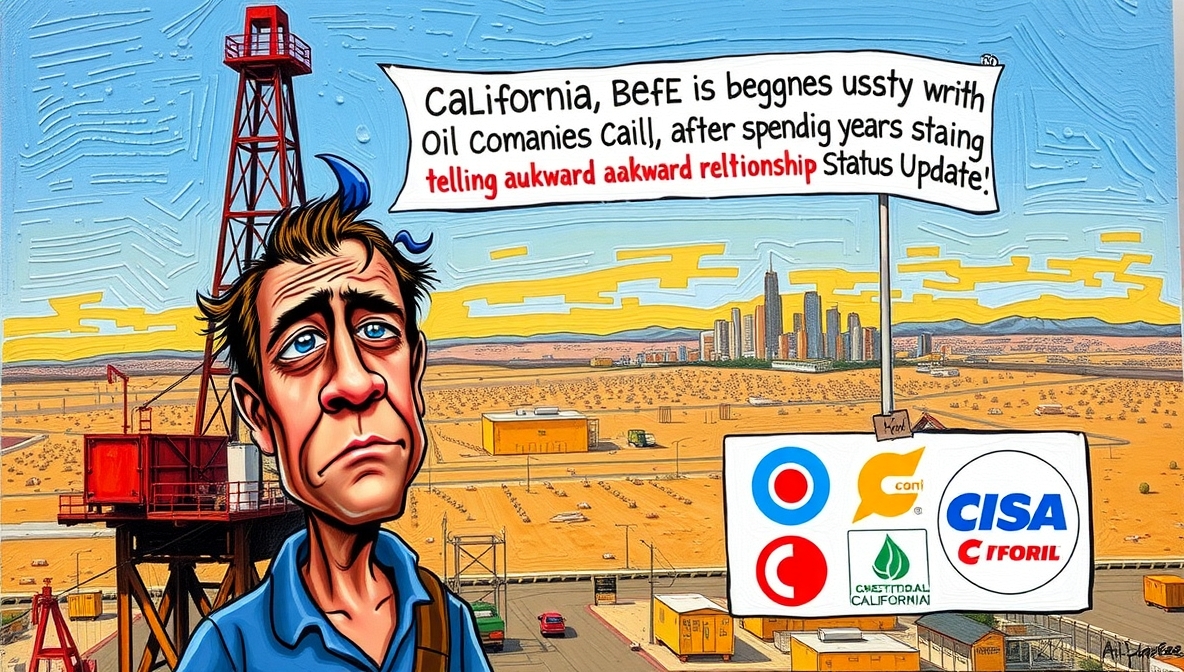
California Desperately Begs Oil Companies to Stay After Spending Years Telling Them to Leave
The Golden State’s Most Awkward Relationship Status Update
California’s relationship with Big Oil has officially entered its “it’s complicated” phase, making every divorced couple’s Facebook status look like a masterpiece of clarity. After years of aggressive climate policies designed to make the oil industry into a political boogeyman, Governor Gavin Newsom is now frantically texting oil executives at 2 AM asking if they want to grab coffee and “work things out.”
The irony is so thick you could refine it into premium unleaded. Phillips 66 announced in October that it would shut its Los Angeles facility by the end of 2025, followed by Valero declaring it would close its Benicia refinery next year, leaving California with the energy equivalent of a bad breakup—suddenly realizing you actually need what you spent years pushing away.
Jerry Seinfeld captured this perfectly in his 1998 special “I’m Telling You for the Last Time”: “Breaking up is like knocking over a Coke machine. You can’t do it in one push; you gotta rock it back and forth a few times, and then it goes over.” California has been rocking that oil industry machine for years, and now they’re shocked it’s finally tipping over.
The “We Can Still Be Friends” Energy Policy
After years of cracking down on California’s oil industry, Gavin Newsom is working on a deal with oil interests to avoid soaring gas prices. This is the policy equivalent of dumping someone via text message and then sliding into their DMs six months later asking if they want to split an Uber.
The state that once declared “this climate crisis is a fossil fuel crisis” is now nervously adjusting its collar and mumbling something about how they “can perform a muscular version of climate policy that doesn’t have to be so all-or-nothing.” It’s like watching someone who spent years lecturing about veganism suddenly caught sneaking into a steakhouse.
Dave Chappelle nailed this exact type of hypocrisy in his 2017 Netflix special “The Age of Spin”: “The worst thing to call somebody is crazy. It’s dismissive.” Well, California just spent years calling oil companies crazy for existing, and now they’re wondering why those companies are checking out of the relationship.
When Your Green Dreams Meet Red Gas Prices
The state’s ambitious climate goals are colliding with economic reality faster than a Tesla running out of charge on Highway 5. Climate, energy and affordability are like oil, water and sand, according to one expert—a poetic way of saying California’s energy policy has the coherence of a blender full of incompatible ingredients.
At a time when Californians are struggling with a cost-of-living crisis, these bills will likely result in massive price increases for gasoline, diesel, natural gas, electricity and consumer goods, warns the oil industry. But hey, at least future generations will have clean air to breathe while they’re living in their cars because they can’t afford rent.
Amy Schumer explored this exact kind of self-defeating logic in her 2017 special “The Leather Special,” observing how women often sabotage themselves: “I’m like every girl. I’ll be like, ‘I want a boyfriend,’ and then when I get a boyfriend, I’m like, ‘Get away from me.'” California’s relationship with the oil industry follows this same pattern.
The “Superfund” That Sounds Super Dumb
California’s latest brilliant idea? The Polluters Pay Climate Superfund Act of 2025 would make the world’s largest sources of greenhouse gases from fossil fuels financially responsible for the damage caused by wildfires, droughts and other events exacerbated by the warming climate. Because nothing says “please stay in our state” like retroactively billing companies for weather.
This is the legal equivalent of charging your restaurant customers extra because you don’t like how they chew their food. The logic is so circular, it could power a wind farm.
Bill Burr ranted about this exact kind of backwards thinking in his 2019 special “Paper Tiger”: “You know what’s wrong with this world? People want a guarantee.” California wants a guarantee that they can have their cake and eat it too—maintaining pristine environmental standards while somehow keeping energy affordable. That’s not policy; that’s wishful thinking with a legislative wrapper.
Labor Unions: The Unlikely Oil Industry Bodyguards
In a twist that would make M. Night Shyamalan jealous, Big Oil’s most influential allies in California’s Democratic-controlled Legislature – the unions that represent oil industry workers – led the opposition to climate lawsuits. When your environmental legislation gets killed by the same unions that historically vote Democrat, you might want to check if your policy compass is pointing toward reality.
Dozens of rank-and-file union members – pipefitters, boiler makers, painters, iron workers and others – took the mic to urge lawmakers to spike SB 222. Picture this: guys who look like they just stepped off a construction site, wearing safety glasses and union T-shirts, explaining basic economics to legislators who probably think “blue collar” is a fashion choice.
Ricky Gervais skewered this type of elite disconnect in his 2018 special “Humanity”: “The problem is, we’ve created a world where being offended means something. It doesn’t. Being offended is not an argument.” California lawmakers seem offended that basic economics applies to their environmental policies.
The Refinery Reality Check
This closure will affect approximately 600 employees and 300 contractors that currently work at the Los Angeles-area refinery, but who’s counting jobs when you’re saving the planet? California’s approach to energy policy resembles someone trying to lose weight by cutting off their legs—technically effective, but probably not the optimal strategy.
The state requires the production and sale of a unique blend of gasoline, known as California Reformulated Gasoline (CaRFG), which has stricter environmental standards than the federal blends used in most other states. It’s like ordering a custom sandwich that costs three times as much as a regular one, then complaining that the sandwich shop is too expensive.
Chris Rock addressed this type of self-created problem in his 2018 special “Tamborine”: “You can’t have everything you want. That’s not how life works. You get some stuff.” California wants clean air, cheap gas, no refineries, and energy independence. Pick two.
The Political Tightrope Act of 2028
The larger the gap between the price at the pump in California and in other states, the greater the liability it poses in a future presidential campaign for Newsom. Ah yes, the delicate art of presidential ambition meeting local reality. It’s like trying to impress a date by bragging about your expensive tastes while your credit card gets declined at dinner.
Newsom is caught between a commitment to climate action that is important to the left and a substantive problem that could hurt both the economy and individual voters. This is the political equivalent of being asked to choose between your mother and your wife—except in this case, your mother is environmental activists and your wife is every California driver filling up their tank.
Kevin Hart described this impossible situation in his 2016 special “What Now?”: “I realized that you can’t make everybody happy. You just can’t. But you can make them mad as hell.” California has mastered that second part.
The Cap-and-Trade Rebranding Shuffle
In a masterclass of political euphemism, the governor’s office has rebranded as “cap and invest” what used to be called cap-and-trade. Because apparently the word “trade” was too honest about what they’re actually doing—turning pollution into a commodity market that would make Wall Street jealous.
The program is a key source of revenue for the state’s environmental, climate and other priorities, which is government-speak for “we found a way to tax air and call it environmental progress.” It’s like charging people for breathing and calling it a “respiratory optimization fee.”
Tom Segura captured this type of bureaucratic nonsense in his 2020 special “Ball Hog”: “They always try to make things sound better than they are. ‘Downsizing’ sounds better than ‘firing people.’ ‘Enhanced interrogation’ sounds better than ‘torture.'” Cap-and-invest sounds better than cap-and-trade, which sounds better than “pollution tax.”
The Environmental Justice Irony
Environmental justice advocates remained staunchly against it, saying the program protects oil and gas companies while leaving nearby low-income communities to bear the health costs of pollution. So the policy designed to help poor communities is being opposed by the advocates for poor communities because it doesn’t actually help poor communities. This is policy inception—a problem within a problem within a problem.
The same communities that California claims to protect are the ones saying “There’s a lot of money left on the table” when it comes to actual environmental benefits. It’s like throwing a fundraiser for homeless people and keeping all the money for party planning.
Gabriel Iglesias explored this kind of good intentions gone wrong in his 2017 special “One Show Fits All”: “My mom always had the best intentions, but somehow everything she tried to help with made things worse.” California’s environmental policy follows the same maternal pattern.
The Economics of Environmental Virtue Signaling
Policymakers are trying to stave off a potential fuel-supply crunch while refineries look to close. This is the economic equivalent of burning down your house to kill a spider, then wondering why you’re suddenly homeless and the spider problem persists in the neighborhood.
The Western States Petroleum Association, which had pushed back early on, eventually settled into neutrality—the diplomatic equivalent of your ex-boyfriend saying “whatever” when you ask if you can still be friends. They’ve moved past anger into the acceptance stage of grief.
Jo Koy described this exact dynamic in his 2017 special “Live from Seattle”: “Filipino moms are passive-aggressive. They’ll never tell you they’re mad. They’ll just stop talking to you and let you figure it out.” Oil companies have entered the Filipino mom phase with California.
The “Year of Affordability” That Wasn’t
Assembly Speaker Robert Rivas’s early pledge to make 2025 the Legislature’s “year of affordability” is aging about as well as milk left in a hot car. When your “year of affordability” involves policies that critics say will result in massive price increases for gasoline, diesel, natural gas, electricity and consumer goods, you might want to revisit your definition of “affordable.”
This is like declaring “National Healthy Eating Week” and then serving deep-fried butter at every meal. The branding is ambitious; the execution is questionable.
Nate Bargatze addressed this type of misplaced optimism in his 2021 special “The Greatest Average American”: “I’m not good at a lot of things, but I’m really good at thinking I’m going to be good at things.” California’s energy policy operates on this same principle.
The Ultimate California Contradiction
California has managed to create the perfect storm of environmental policy: too aggressive for industry, too weak for environmentalists, too expensive for consumers, and too complicated for anyone to actually understand. It’s the Rube Goldberg machine of energy policy—an unnecessarily complex system designed to accomplish something that could have been done much more simply.
There are a lot of lawsuits pending, but so far, not a single court in the world has held fossil fuel companies financially responsible for greenhouse gas emissions. But hey, why let a perfect record of legal failure stop you from trying the same thing again?
Sarah Silverman summed up this type of stubborn illogic in her 2017 special “A Speck of Dust”: “I realize that I’m wrong about a lot of things, but I’m very confident about being wrong.” California has mastered confident wrongness in energy policy.
The Bottom Line: A State in Energy Denial
California’s oil policy is the equivalent of a person who goes to McDonald’s every day but lectures the cashier about healthy eating. The state that consumes the country’s second-largest gasoline after Texas is somehow shocked that oil companies want to be treated like legitimate businesses rather than environmental villains.
The reality is simple: you can’t regulate an industry out of existence and then expect it to stick around for your convenience. California is learning this lesson the hard way, one closed refinery and one price spike at a time.
Wanda Sykes captured this perfectly in her 2019 special “Not Normal”: “You can’t break up with somebody and then get mad when they start dating somebody else. That’s not how it works.” California broke up with Big Oil and is now furious that Texas is getting all the refinery investment.
The Golden State’s energy policy has all the coherence of a fever dream and all the sustainability of a house of cards in a windstorm. But at least they’re failing with style—and that’s very California indeed.
For more coverage of California’s energy contradictions, visit The Wall Street Journal for breaking news, and check out CalMatters for comprehensive California policy analysis.
IMAGE GALLERY
The Golden State’s Most Awkward Relationship Status Update
