

Scientists Announce Discovery of New Planet Made Entirely of Procrastination
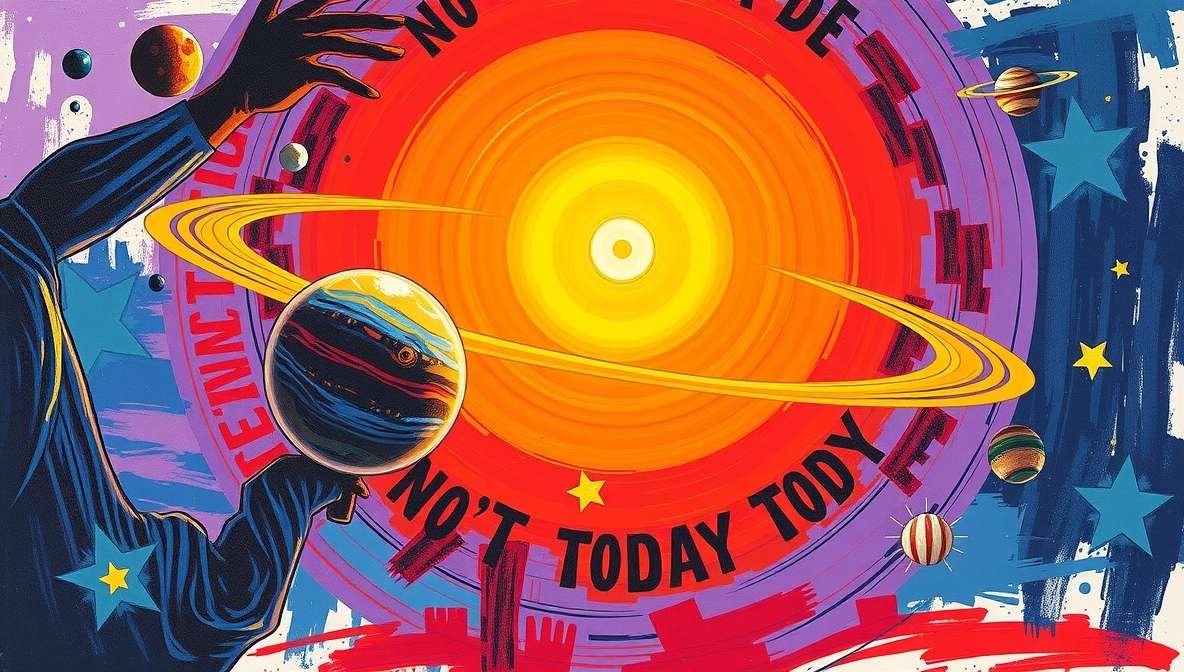
In what some are calling the greatest scientific breakthrough of the 21st century—or the laziest, depending on perspective—astronomers at the International Procrastination Observatory have officially discovered a planet composed entirely of procrastination. Tentatively named “Dilatoria,” this new celestial body is believed to orbit a star known locally as “Not Today.”
The Discovery That Changed Everything (Eventually)
Dr. Lionel Sloane, lead scientist, claims the planet is “90% maybe, 10% tomorrow, and zero action,” and could explain many of humanity’s persistent inefficiencies. “We always wondered why people never finished their projects on time,” Sloane said. “Turns out, the universe was just training them for Dilatoria.”
The discovery process itself took seventeen years longer than expected, with researchers admitting they “kept putting off the final calculations.” According to NASA’s exoplanet catalog, Dilatoria represents the first celestial body discovered through a combination of advanced telescopy and chronic deadline extensions.
The Real Science Behind Procrastination Behavior
Observers have noted that the planet seems to manifest a gravitational pull only strong enough to move tasks from one to-do list to another. “It’s mesmerizing,” said astrophysics student Ellie Nguyen. “I stared at my homework for three hours and somehow ended up scrolling Twitter. Clearly, the planet is affecting me already.”
Research from the American Psychological Association indicates that approximately 20% of adults identify as chronic procrastinators, though experts believe the actual number is higher—people just haven’t gotten around to admitting it yet. Studies in behavioral psychology suggest that procrastination isn’t laziness but rather a complex emotional regulation problem.
Scientific American has documented the neurological basis for task avoidance, showing that procrastination activates the same brain regions associated with immediate gratification and pain avoidance. Researchers now theorize that Dilatoria may be emitting low-frequency “tomorrow waves” that interfere with human motivation centers.
How Task Avoidance Affects Modern Productivity
A leaked memo from NASA suggested they considered naming the planet “Netflixia” but ultimately decided the irony was too perfect. Meanwhile, a survey of 1,200 college students revealed that 99% expressed a desire to move to Dilatoria, if only to avoid adult responsibilities.
According to Harvard Business Review, workplace procrastination costs American businesses an estimated $10,000 per employee annually in lost productivity. The discovery of Dilatoria provides humanity with something it desperately needed: an excuse with cosmic implications.
“We can now blame planetary alignment for missed deadlines,” explained workplace productivity consultant Marion Fletcher. “It’s essentially astrology, but for procrastinators with scientific credentials.”
College Students and the Procrastination Epidemic
The discovery has sparked philosophical debates as well. Dr. Hargrove, a sociology professor, mused, “If a planet exists purely to delay action, what does that say about free will? Probably nothing—we’ll get back to that tomorrow.”
Research from the National Institutes of Health shows that college students are particularly susceptible to procrastination, with 80-95% engaging in routine task avoidance. The existence of Dilatoria may explain why students consistently wait until 2 AM the night before a deadline to begin twelve-page research papers.
“The planet’s orbit aligns suspiciously with academic calendar deadlines,” noted Dr. Sloane. “Final exams week shows a 340% increase in Dilatoria’s gravitational effect on Earth, though this data is entirely speculative and probably made up.”
Tech Companies Capitalize on Cosmic Laziness
In an unexpected twist, tech companies are already developing apps that mimic Dilatoria’s effects, marketing them as “Productivity Resistance Tools.” Users report high satisfaction in achieving absolutely nothing efficiently.
Silicon Valley startup DelayTech has raised $47 million in venture capital for an app that literally does nothing but remind you to do things later. “We’re disrupting the productivity space by embracing the inevitable,” said founder Travis McKinney. “Why fight human nature when you can monetize it?”
Beta testers have praised the app’s intuitive interface, which consists primarily of a button labeled “Remind Me Tomorrow” that never actually sends reminders. The app currently holds a 4.8-star rating, though reviewers admit they’ve been meaning to leave more detailed feedback for months.
Astronomical Implications and Future Research
The International Astronomical Union has scheduled a vote on Dilatoria’s official planetary status for next year, though the meeting has been postponed seventeen times. When asked about the delay, IAU spokesperson Dr. Helena Vasquez replied, “We’re very busy. We’ll definitely get to it eventually.”
Telescopic observations reveal that Dilatoria’s surface appears to be covered in unfinished projects, abandoned New Year’s resolutions, and approximately 4.7 billion browser tabs people meant to read later. Spectroscopic analysis shows the atmosphere is composed primarily of good intentions and empty promises.
FAQ About Procrastination and Dilatoria
Q: Is procrastination a real problem? A: Yes. Chronic procrastination affects approximately 20% of adults and can lead to increased stress, missed opportunities, and hastily written satirical articles about fictional planets.
Q: What causes procrastination? A: Research suggests procrastination stems from emotional regulation issues, perfectionism, fear of failure, and possibly the gravitational pull of distant celestial bodies named after Latin words for “delay.”
Q: Can procrastination be overcome? A: Studies show that breaking tasks into smaller steps, using accountability partners, and avoiding discovery of procrastination-based planets can all help. We’ll write a full guide about this later.
