

It Isn’t Betting If You Call It Forecasting and Wear Loafers.
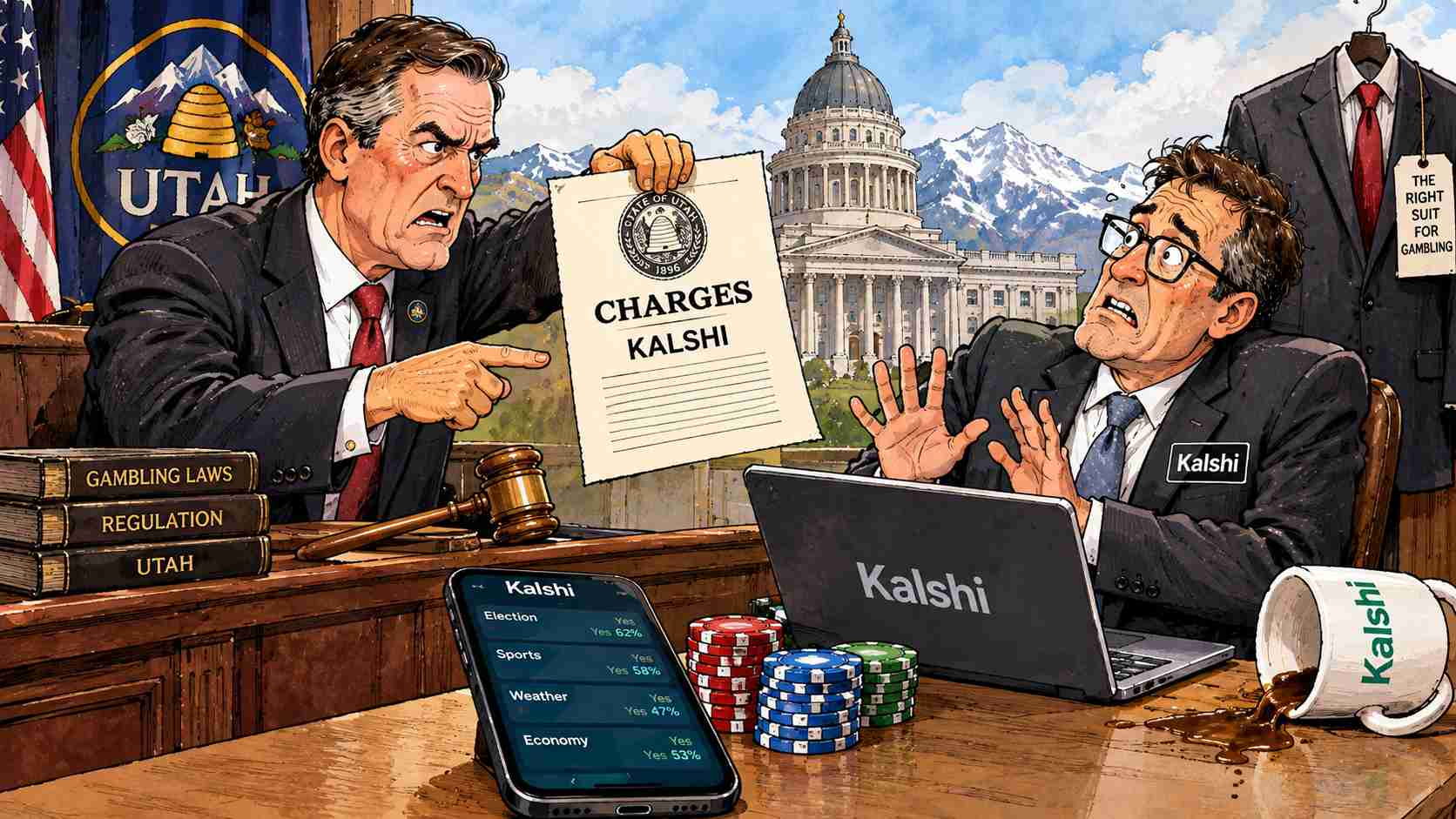
SALT LAKE CITY, Utah — Utah has filed criminal charges against prediction-market operator Kalshi and its co-founders over alleged unlawful gambling. America now has a legal dispute over whether wagering on a football game is gambling or an exciting contribution to the nation’s understanding of probability.
Utah’s Criminal Charges Against Kalshi, Explained

According to The Salt Lake Tribune, prosecutors filed fourteen charges, including thirteen felonies. An undercover investigator placed sporting-event wagers totaling $114.87 and lost $25.10. For once, the government demonstrated that it could investigate an industry while losing less money than the industry itself. The Utah Attorney General’s office has the filings, and the filings have the numbers.
The Undercover Report
An investigator’s report, quoted in the charging papers, describes the operation in careful detail. The agent opened an account, deposited funds, placed several wagers on sporting events and “observed the interface to be professional, responsive and, in the agent’s opinion, indistinguishable from a sportsbook with better fonts.” Page nine records that the agent’s final position was a loss of $25.10 and that the agent “has since stopped watching the Cowboys.”
Prediction Markets vs. Sports Betting: Who Regulates What?
Kalshi operates federally regulated event contracts and disputes state efforts to treat its business as ordinary gambling. The federal Commodity Futures Trading Commission has also challenged Utah’s position. In other words, two levels of government are debating who gets to regulate a man betting that the Cowboys will lose. It is the most American constitutional crisis since someone tried to define a sandwich.
What the Court Papers Argue
In a filing responding to the charges, lawyers for the company describe the contracts as “financial instruments tied to the occurrence of future events,” a phrase the state’s brief quotes back with the note, “So, a bet.” A footnote in the company’s reply adds that “a bet has a bookmaker, whereas this has a matching engine.” A second footnote in the state’s response says only, “Fine, a bet with a matching engine.”
The distinction between speculation and gambling has become a marvelous linguistic achievement. Put fifty dollars on a football game through a bookmaker and you’re a gambler. Put fifty dollars on a sports outcome through an interface full of charts and you’re providing liquidity to an information market. Put fifty dollars on the Cowboys and you’re simply ignoring all available evidence.
“This isn’t betting,” explained a financial analyst while nervously refreshing the fourth-quarter score. “It’s a binary probabilistic instrument.” His wife asked whether he had lost the rent money. “Only in the event that reality settles against my position,” he replied.
Why Changing the Vocabulary Doesn’t Change the Risk
Utah’s stance is rooted in its restrictive gambling laws. The state’s disagreement with Kalshi is real, and the ultimate legal answer is unsettled. The comedic opportunity lies in the broader American habit of making a questionable activity sound respectable by hiring a compliance officer and changing the nouns.
A casino offers chips. A fintech startup offers tokens. A casino lets you place bets. A trading platform lets you purchase exposure. At a casino, a guy named Larry tells you the odds. At a startup, a twenty-four-year-old wearing expensive sneakers explains a dashboard Larry could have operated blindfolded.
A Professor of Gaming Law Weighs In
“The test is generally whether you’re paying for a chance at something of value,” said a professor of gaming law, speaking from a hallway outside a lecture hall. “If it walks like a duck, and the duck has a Series C, courts will still ask about the duck.” She declined to say whether she had a position on the Cowboys.
The undercover agent’s $25.10 loss should become a required case study at the Treasury Department. Federal auditors spend billions identifying waste. Utah identified $25.10 immediately, recorded the evidence and apparently didn’t even need a congressional hearing.
One state investigator proposed resolving the dispute by requiring everyone to wear a tuxedo before making a prediction. That would not change the odds, but it would make bankruptcy considerably more elegant.
Consumers should understand a simple principle regardless of which regulator wins: changing an activity’s vocabulary does not eliminate financial risk. The app can call it a contract, a probability or a market signal. Your checking account will still call it missing money.
The final ruling may decide who has jurisdiction. It will not explain why Americans believe gambling becomes mathematics when the dealer starts using Greek letters.
5 Humorous Observations About Prediction Markets
- It’s not gambling, it’s “event contracts.” Great. I’m not drunk, I’m “hydrologically adjusted.” I’m not lost, I’m “exploring alternative routes.” Everybody’s got a thesaurus until the rent’s due.
- Twenty-five dollars and ten cents. The state of Utah brought fourteen charges over twenty-five bucks. That’s a pretty good deal when you think about it. In Vegas, that gets you one drink and a lecture.
- A guy in a hoodie explains the “market microstructure” and I nod like I understand. I don’t. I’m just trying to figure out why a guy named Brayden is allowed to touch my money.
- At a casino, the house always wins and everybody knows it. At least there’s honesty. At a startup, the house always wins and there’s a pizza party to celebrate the “alignment of incentives.”
- Nobody ever lost money on a prediction market and said, “I made a bad trade.” They say, “The market was wrong.” The market is never wrong. The market is just a very confident guy named Larry.