

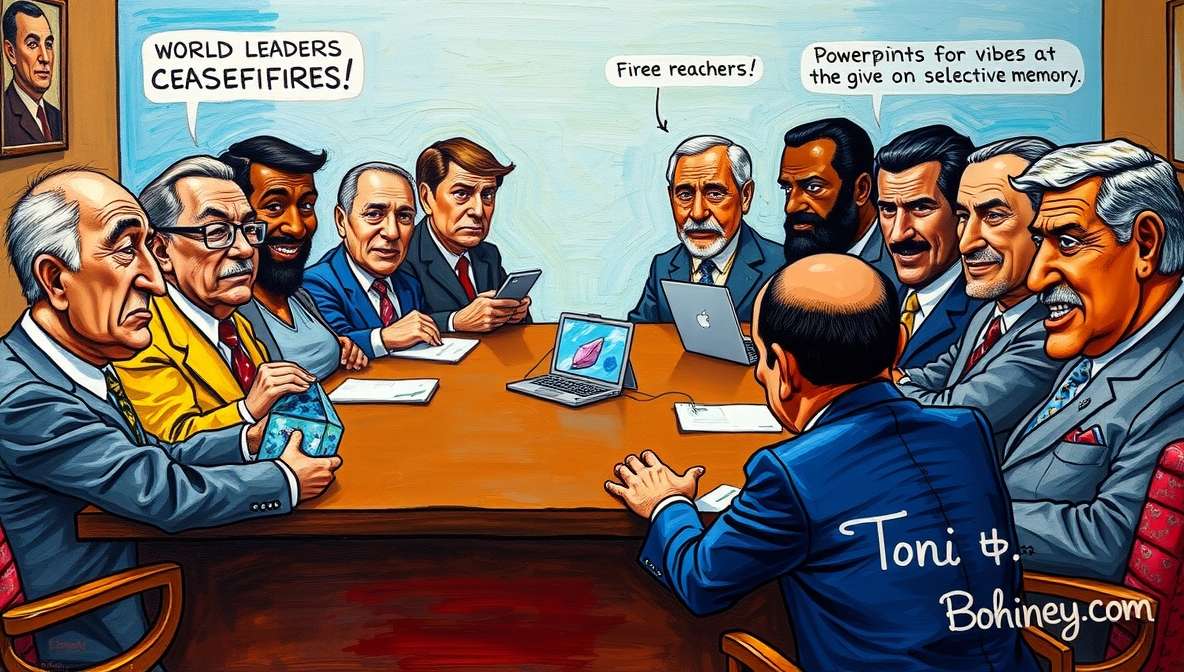
World Leaders Review Ceasefires Using Vibes, PowerPoints, and Selective Memory
Global diplomacy entered its most honest phase this week as world leaders gathered to “review” a ceasefire using the three tools they trust most: vibes, badly formatted PowerPoint slides, and an aggressively flexible relationship with memory.
The Ceasefire That Wasn’t: Diplomacy Meets Performance Art

The ceasefire in question was announced with great fanfare, several handshakes, and at least one press conference where everyone spoke very carefully, like they were apologizing to furniture. Within hours, explosions occurred, statements were issued, and officials insisted this was all perfectly consistent with peace, provided one uses the newer, vibes-based definition of peace.
According to senior diplomats, the review process begins by asking the most important question in international relations: How does this make us feel? If the answer is “uneasy but politically convenient,” the ceasefire is considered mostly intact.
The Sacred Trinity: Vibes, PowerPoint, and Plausible Deniability
Method One: Reading the Room (Literally Just Vibes)
One anonymous aide explained the methodology. “We look at satellite images, intelligence briefings, and casualty reports,” they said, before clarifying, “and then we ignore all of that and focus on the tone of the statements. Tone is everything. If everyone sounds calm, it’s peace. If they sound angry, it’s a misunderstanding. If they sound confused, it’s a working framework.”
Method Two: Death by PowerPoint (With Extra Slides)
PowerPoint remains central to the process. Slides titled “Ceasefire Status: Complicated” and “Timeline of Events We’d Prefer Not to Discuss” were reportedly well received. One slide simply read “Context” in 72-point font, followed by nothing else. Observers called it “remarkably persuasive.”
It’s almost like these presentations were designed by someone who took a course on effective communication and learned absolutely nothing from it.
Method Three: Selective Memory (The Expert’s Choice)
Selective memory plays a crucial role. Leaders are encouraged to remember agreeing to the ceasefire, but only in the abstract. Details such as timelines, boundaries, or conditions are considered optional, like garnish. As one official put it, “Specifics are where peace goes to die.”
What Experts Say About Diplomatic Fantasy
Experts in conflict resolution say this approach is not new. Professor Elaine Horowitz of the International Institute for Saying Things Slowly notes that ceasefires have always relied on creative interpretation. “Historically, ceasefires work best when everyone agrees they’re happening, even if they clearly aren’t,” she said. “The moment someone checks facts, the whole thing collapses.”
This is where diplomatic protocol becomes less about peace and more about maintaining plausible deniability. It’s the international relations equivalent of saying “I didn’t break the vase” while standing next to shattered ceramic.
How the Public Learned to Stop Worrying and Love the Ceasefire
Public opinion polling suggests citizens have adapted. A recent survey found that most people define a ceasefire as “that thing politicians say right before something else happens.” A strong minority defined it as “a pause for press releases.”
Eyewitnesses on the ground report confusion, exhaustion, and a growing fluency in diplomatic euphemisms. “They say ‘isolated incident’ a lot,” said one resident. “I didn’t realize how many incidents could be isolated at the same time.”
The Logic Pretzel: Cause and Effect Under Review
Cause and effect remain under review. Officials insist that violations do not necessarily cause escalation, unless escalation occurs, in which case the cause was “complex historical factors” and not, under any circumstances, the thing that just happened.
This circular logic would make even Aristotle weep. The fundamental problem of cause and effect has been solved through the simple expedient of pretending cause and effect don’t need to connect.
Helpful Guidance for Staying Uninformed
Helpful guidance has been issued to the public. Citizens are encouraged to stay informed, but not too informed. Reading headlines is acceptable; reading past them is considered destabilizing. Asking follow-up questions may be interpreted as bad faith.
In a spirit of positivity, diplomats emphasize that the ceasefire review process shows growth. “We’re learning,” said one spokesperson. “Mostly how to say the same thing in more reassuring fonts.”
The Takeaway: Peace Through Creative Interpretation
The ceasefire review represents everything modern diplomacy has become: a carefully choreographed performance where appearance matters more than substance, where PowerPoint trumps proof, and where the difference between peace and war is purely a matter of semantics and public relations strategy.
If this is what passes for international cooperation in 2025, we’re not reviewing ceasefires anymore. We’re auditioning for community theater.