

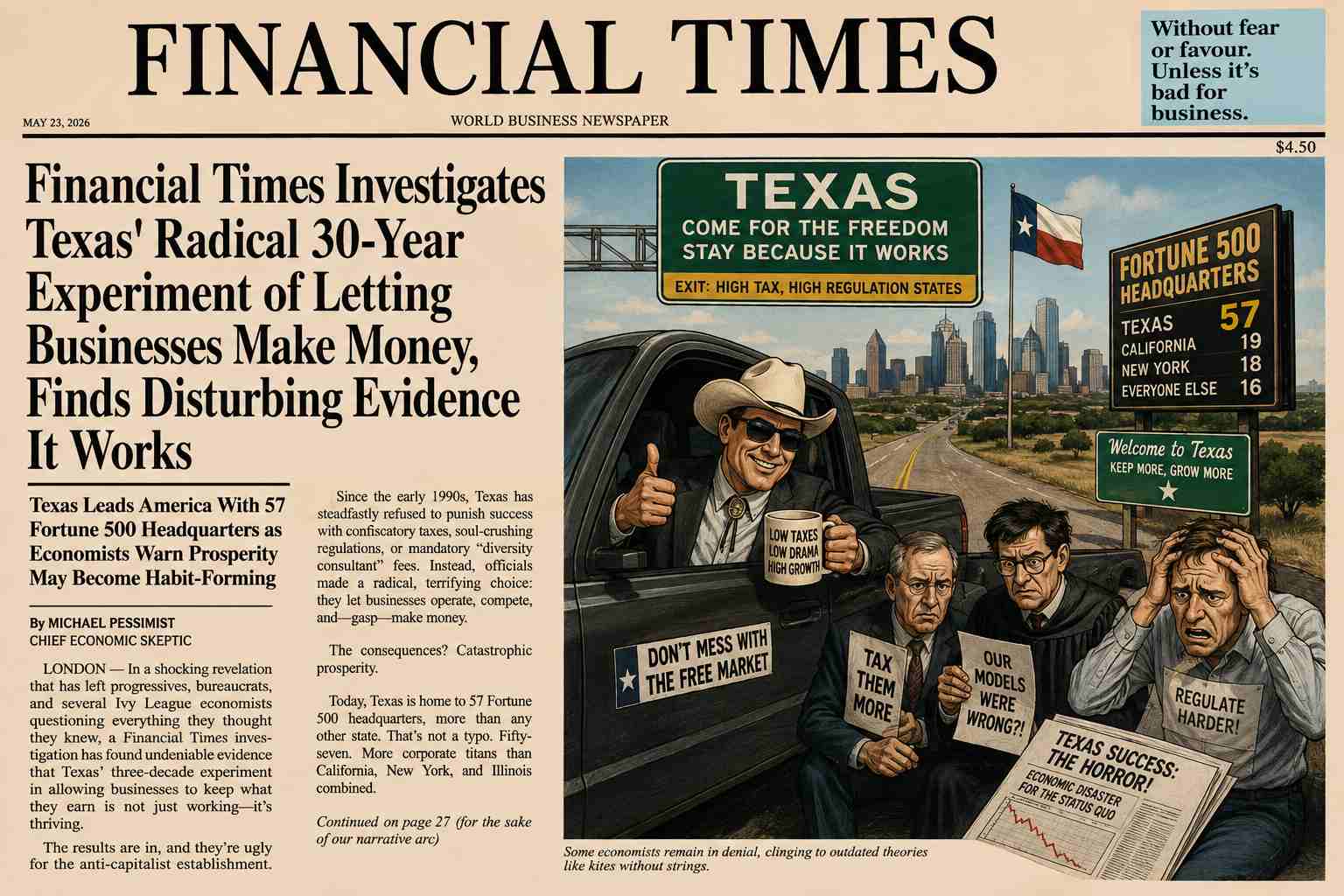
Financial Times Investigates Texas’ Radical 30-Year Experiment of Letting Businesses Make Money, Finds Disturbing Evidence It Works
Texas Leads America With 57 Fortune 500 Headquarters as Economists Warn Prosperity May Become Habit-Forming
The Financial Times has investigated a dangerous economic experiment underway in Texas, where state officials have spent several decades testing the radical proposition that businesses occasionally enjoy being permitted to remain in business.
The experiment, described by the FT as “the Texas experiment,” has involved low taxes, deregulation, management-friendly corporate rules, and an increasingly diversified economy that has attracted companies including Tesla, Hewlett Packard Enterprise, and Charles Schwab. More than 100 corporate headquarters have reportedly relocated to Texas since 2020.
Researchers initially believed the policy would collapse after businesses discovered Texas contained Republicans.
Instead, they found Dallas.
This has produced considerable confusion.
Texas now leads the United States with 57 Fortune 500 headquarters, whose combined revenues total roughly $2.8 trillion.
Economic experts are reportedly studying the results closely because 57 corporations represent a dangerously large sample size for something journalists would prefer to continue calling an experiment.
At 12 companies, you can call it anecdotal.
At 27, you can blame barbecue.
At 43, perhaps everyone likes the airport.
At 57, somebody eventually has to look at the tax code.
California Announces Emergency Tax on Companies Thinking About Leaving
California officials responded immediately by unveiling a proposed levy on corporations displaying “pre-relocation body language.”
Under the imaginary Corporate Emotional Departure Prevention Act, companies could be taxed for suspicious behaviors including looking at commercial property in Plano, searching “Austin office space” during working hours, owning a Buc-ee’s coffee mug, or asking an accountant whether Texas really has no personal state income tax.
Particularly suspicious CEOs would be required to surrender their boarding passes.
“We cannot allow corporations to escape California merely because another state offers them something they prefer,” explained an entirely satirical Sacramento official. “That would turn the American economy into some sort of marketplace.”
The official then visibly shuddered.
California has provided Texas with plenty of corporate immigrants already. Texas Comptroller data show that 157 California headquarters relocations landed in Texas between 2015 and 2024, far more than came from any other state. Those relocations announced thousands of jobs.
This is commonly explained by a sophisticated economic phenomenon known as leaving.
Economists define leaving as the process by which one packs one’s belongings in Place A and subsequently finds oneself in Place B.
For corporations, the process requires lawyers, accountants, relocation consultants, and approximately 8,000 PowerPoint slides.
For Texans, it requires saying, “Welcome. Don’t block the driveway.”
Economists Fear Success Could Become Habit-Forming for the Texas Economy
More disturbing is the possibility that Texas might become addicted to economic growth.
The state’s current-dollar GDP reached approximately $2.9 trillion in 2025, according to preliminary federal estimates cited by the governor’s office. Adjusted for inflation, Texas grew 2.5 percent in 2025, faster than the United States overall.
This raises troubling questions.
What if Texans become accustomed to employment?
What if companies begin expecting regulatory predictability?
What if entrepreneurs experience profits and recklessly decide to earn them again next quarter?
Once a population becomes dependent on prosperity, withdrawal can be brutal.
Symptoms reportedly include investment, payroll deposits, warehouse construction, and fathers buying unnecessarily enormous grills.
There is even demographic evidence of the problem.
Texas reached about 31.7 million residents in 2025, adding roughly 391,000 people during the year, more than any other state. California, meanwhile, was among five states whose populations declined over the same Census estimate period.
Apparently millions of Americans remain unaware that Texas is uninhabitable.
Someone really needs to tell them before they arrive.
Texas Introduces Terrifying Economic Theory Called “Being Nice to Customers”
The most controversial component of the Texas experiment involves something economists are calling the Customer Theory of Commerce.
According to the theory, when customers voluntarily give a business money, the business should attempt not to annoy them.
This is considered primitive economics.
Under the Texas model, businesses are encouraged to sell goods people want, hire employees, generate revenue, pay suppliers, and, under extreme circumstances, earn profits.
These profits may then be reinvested.
Economists emphasize that reinvestment can lead to additional employment, which can lead to more income, which can produce additional consumer spending.
At this point the process becomes extremely dangerous because somebody may open another Whataburger.
Texas officials further claim the state offers companies a predictable regulatory environment, extensive infrastructure, access to global markets, and no personal state income tax. The state also says it has more than 3.5 million small businesses and startups.
This differs substantially from the traditional bureaucratic theory of economic development:
Step one: regulate an activity.
Step two: tax the activity.
Step three: establish an economic development commission to determine why the activity disappeared.
Step four: subsidize a replacement activity.
Step five: regulate that.
Texas accidentally skipped several steps.
Scientists Discover Corporations May Possess Rudimentary Survival Instinct
Corporate migration has traditionally puzzled academics because corporations don’t migrate like birds.
Nobody has ever witnessed Exxon circling overhead in a V formation.
Nevertheless, companies move.
The Texas Economic Development office says more than 346 corporate headquarters have relocated to Texas since 2015.
Researchers have therefore proposed a controversial hypothesis:
Companies may possess rudimentary survival instincts.
For example, place one corporation in an environment with lower operating costs and predictable regulation.
Place another in a jurisdiction where its CEO wakes every morning wondering what the legislature discovered overnight.
Observe.
One corporation expands.
The other hires a vice president of Governmental Surprise Management.
After ten years, the first owns a campus in Dallas.
The second has issued a 63-page sustainability report explaining why its headquarters now occupies a campus in Dallas.
“Y’all Street” Threatens Ancient Wall Street Monopoly on Expensive Suits
Even finance has begun drifting toward Texas.
The state’s economic development office says Texas ranks first nationally in total financial services employment and points to the Texas Stock Exchange, NYSE Texas, Nasdaq Texas, and a new Nasdaq regional headquarters in Dallas as part of the emerging “Y’all Street.”
New Yorkers reacted cautiously after learning securities can apparently be traded outside Manhattan.
“This is unprecedented,” said a fictional Wall Street banker while standing inside a building Texas could reproduce for one-third the rent and include parking.
Dallas financiers attempted to reassure New York.
They promised to preserve essential Wall Street traditions including complicated derivatives, expensive lunches, and explaining ordinary arithmetic using the word “alpha.”
Cowboy hats remain optional.
Boots, however, dramatically improve quarterly earnings calls.
Texas Finally Discovers a Limit: Please Don’t Plug the Entire Internet Into Our Power Grid
The FT’s strongest complication concerns Texas’ booming AI data center industry.
Rapid construction of electricity-hungry data centers has created public concerns over power demand, utility costs, and development. Texas Republicans, including Governor Greg Abbott, have recently become more skeptical about the industry’s expansion.
This demonstrates an important distinction.
Texas is pro-business.
Texas is not necessarily pro “we bought 11,000 acres and require the electrical output of Luxembourg by Thursday.”
The state’s response could be summarized:
“We love economic development.”
“How much electricity do you need?”
“All of it.”
“Son, we’re gonna need another meeting.”
That isn’t anti-capitalism.
That’s checking the extension cord.
A UT poll cited by Reuters found only 30 percent of respondents supported having data centers in their local communities, illustrating the political tension now surrounding the boom.
Texans enjoy technology.
They simply prefer the refrigerator to remain involved.
Texas Experiment Enters Dangerous Phase Known as “Thirty Years of Evidence”
The intellectual problem facing critics is increasingly straightforward.
If Texas were attracting two companies, it could be dismissed as luck.
If businesses arrived for five years, it might be a trend.
But when headquarters, people, investment, and industries keep arriving over decades, the experiment becomes inconveniently difficult to distinguish from a strategy.
Texas doesn’t prove every regulation is bad.
It doesn’t prove every tax should disappear.
And it certainly doesn’t prove every development proposal should automatically receive a giant foam finger reading BUILD IT.
It demonstrates something considerably less ideological and therefore more irritating:
Incentives matter.
Businesses notice costs.
Executives notice taxes.
Workers notice opportunities.
Families notice housing.
Investors notice predictability.
And eventually everybody notices where everybody else is moving.
The Texas Comptroller estimates headquarters relocations between 2015 and 2024 alone added about $2.3 billion in Texas GDP and $1.6 billion in disposable personal income, including both direct and broader economic effects.
Thirty years into the experiment, Texas researchers are therefore preparing the most frightening possibility yet.
The experiment might have to be renamed.
Perhaps:
“Policy.”
California Requests Additional Time to Study the Results
California has reportedly rejected Texas’ findings pending another 30 years of research.
Sacramento officials stressed that the comparison remains scientifically invalid because Texas possesses oil, land, ports, universities, technology, manufacturing, finance, agriculture, aerospace, semiconductors, growing cities, and a large skilled workforce.
Texas responded that this certainly sounds unfair.
California then announced the creation of a 41-member Commission on Competitive Economic Competitiveness, which will investigate why companies prefer states competing for them.
The commission’s preliminary report is expected shortly after its members relocate to Austin.
Until then, Texas will continue performing its radical experiment.
A company arrives.
Someone hires people.
The employees buy things.
Other businesses sell those things.
Somebody makes money.
Government receives revenue.
The economy grows.
Another company notices.
And somewhere in London, an editor looks at 57 Fortune 500 headquarters and thoughtfully types:
“Experiment.”
Texans don’t mind.
They’ve always been comfortable letting other people do the labeling.
They’re busy doing the experiment.
15 Humorous Observations: The Dangerous Texas Experiment
- The Financial Times calls Texas an “experiment,” which is technically correct if the hypothesis was: What happens when government occasionally leaves the laboratory?
- Texas has 57 Fortune 500 headquarters, suggesting corporations have developed the disturbing ability to recognize favorable conditions without consulting an editorial board.
- California supplied 157 headquarters relocations to Texas from 2015 through 2024, creating the unusual migration pattern in which the company leaves California while its former parking space remains subject to environmental review.
- Texas has no personal state income tax, apparently because legislators forgot government is traditionally supposed to celebrate your success by asking for a percentage.
- The Texas economy reached roughly $2.9 trillion in 2025, proving cowboy boots do not automatically prevent macroeconomic development.
- Texas has attracted more than 346 corporate headquarters since 2015, suggesting CEOs keep confusing dangerously conservative economic policy with please bring the accounting department.
- The state has more than 3.5 million startups and small businesses, an alarming outbreak of people attempting to support themselves without first applying for a federal grant studying resilience.
- Texas offers predictable regulation, which sounds boring until you’ve run a company somewhere the rules occasionally reproduce overnight.
- California’s economic development strategy increasingly resembles a hotel manager standing in the parking lot shouting, “You’ll regret checking out!”
- Dallas is becoming “Y’all Street,” because apparently Wall Street needed cattle terminology and available office space.
- Texas politicians are now questioning some giant AI data centers, proving pro-business does not necessarily mean you may plug Belgium into an extension cord behind Waco.
- The most revolutionary Texas policy may simply be treating businesses as desirable rather than as unusually well-dressed defendants.
- Economists keep searching for sophisticated explanations for corporate migration while executives keep saying things like taxes, regulation, workers, and costs.
- If Texas succeeds for another 30 years, experts may be forced to downgrade the experiment to the humiliating scientific category of “result.”
- California’s nightmare isn’t that Texas is different. It’s that chief executives can apparently locate Interstate 10.
Satire Disclaimer: This article is satire. California has not actually imposed a tax on corporations for thinking about Texas, Sacramento has not deployed airport agents to confiscate Buc-ee’s mugs, and no economist has yet formally classified excessive profitability as habit-forming.
This story is entirely a human collaboration between two sentient beings: the world’s oldest tenured professor and a philosophy major turned dairy farmer, neither of whom has been authorized to explain why corporations apparently understand incentives faster than committees do.
For the underlying reporting, see the Financial Times feature. For headquarters and economic data, see the Texas Comptroller’s office and the Office of the Governor.