

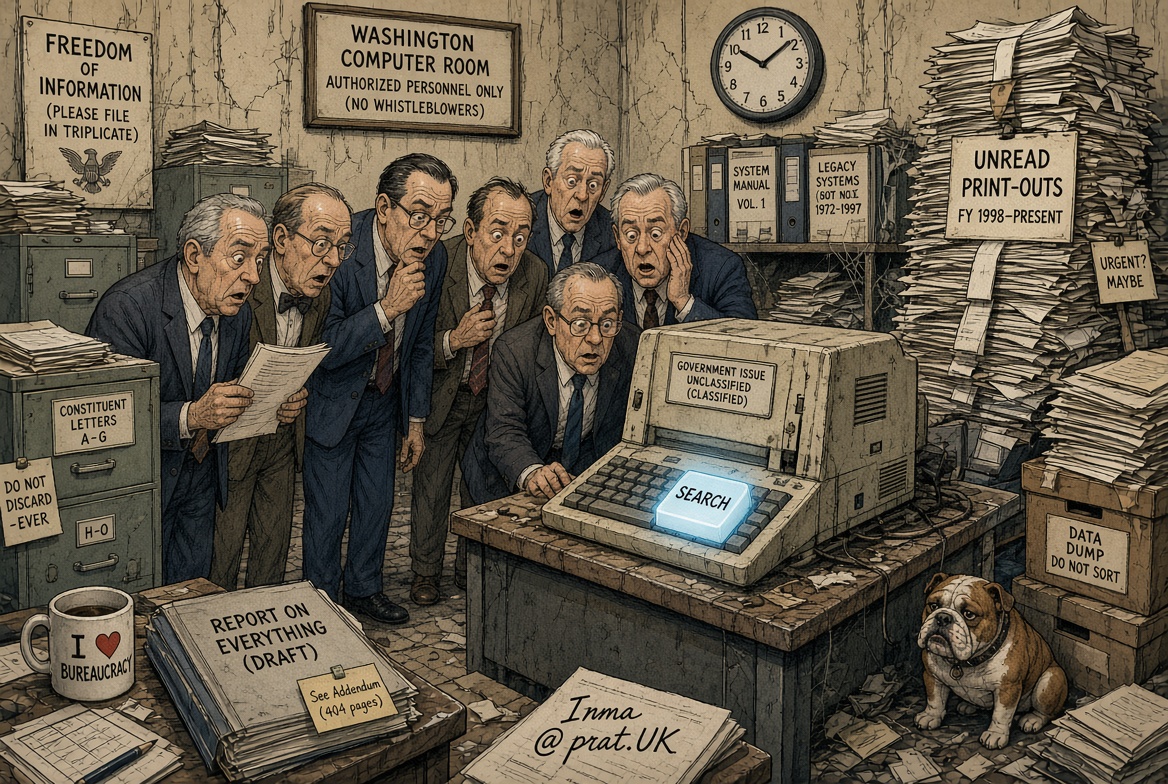
SAVE Database: Washington Discovers the Search Button
Nation Stunned as Federal Computers Discover They Can Retrieve Information Already Stored Inside Them
WASHINGTON — American technological leadership entered a breathtaking new era Friday when Washington discovered an election-security innovation so advanced that experts initially assumed it had arrived from the year 2187: checking whether somebody is eligible before accepting the person as eligible.
The breakthrough followed a September 25 Supreme Court order allowing the Trump administration, for now, to resume expanded use of the federal SAVE database while litigation continues. The system can help states check citizenship information associated with people on voter rolls, including through Social Security Administration data and bulk searches.
The development represents a historic departure from the traditional federal method of collecting enormous quantities of information and then behaving as though each agency buried its copy beneath a different pyramid.
Officials were reportedly astonished to discover that computers can do something called looking things up.
Until now, many Americans assumed the federal government’s main computer contained two buttons: SEND BENEFIT and PLEASE HOLD. There is apparently a third. It says SEARCH. Nobody knows how long it has been there.
Supreme Court Clears Expanded SAVE Database, Officials Shocked Social Security Numbers Have Another Use
For generations, Americans have regarded the Social Security number as one of the nation’s most versatile inventions.
You need one to work. You need one to file taxes. Banks want it. Doctors want it. Credit-card companies want it. Apartment complexes want it. Somebody operating a laptop from a basement 6,000 miles away apparently wants it very badly.
Every eighteen months, another corporation announces that your Social Security number may have been stolen, after which it generously provides twelve months of identity monitoring so you can watch somebody become you professionally.
Now Washington has discovered a startling alternative use: identifying people. This could change everything.
The Social Security number may finally graduate from America’s unofficial national identity-theft starter kit into a number that government agencies occasionally use to determine who somebody actually is.
Washington insiders were reportedly caught completely unprepared.
“Are you telling me,” said a weary election administrator, slowly removing his glasses, “that the number specifically assigned to this individual might help us determine information about this individual?”
Scientists nodded. “My God.” He sat down. Aides brought water.
Nine Mysterious Digits Discover Productive Employment
The underlying concept is almost aggressively ordinary.
Federal law generally prohibits noncitizens from voting in federal elections. States maintain voter-registration systems. The federal government maintains various records relating to citizenship and immigration status.
Someone eventually asked the dangerous question: Could we compare them?
Silence reportedly descended over Washington. A photocopier stopped mid-page. Three consultants fainted. A congressional committee immediately requested $11 million to study whether comparison was constitutional under the Federal Administrative Things That Nobody Has Tried Because Everyone Assumed Someone Else Was Doing It Act.
The expanded SAVE system lets participating officials perform bulk searches rather than checking records one at a time.
Bulk searches. There it is. America has entered the Space Age.
Previously, apparently, election verification risked resembling a 1950s detective movie.
“Johnson?” “Check the file.” Drawer opens. “Johnson, Johnson… Johnson…” “What about Rodriguez?” “That’s another cabinet.”
Now the computer can examine multiple records, a technology private companies discovered somewhere around the same time they realized they could send you advertisements for lawn furniture because you once stood near a patio.
America Invents the SAVE Database Version of Checking the Guest List
“Verification is America’s real national pastime,” said Ohio insurance salesman and weekend open-mic regular Denny Vantassel. “Baseball’s just what we do while we wait for the DMV line to move.”
Washington Discovers the SAVE Database Concept of Eligibility
The real comedy is the word eligible.
Government loves eligibility. Everything Washington does has eligibility requirements.
Want Social Security? Eligibility. Want Medicare? Eligibility. Want a passport? Eligibility. Want unemployment benefits? Eligibility. Want to import seventeen metric tons of Portuguese cheese through Baltimore? There is probably a form determining whether your cheese is eligible.
The federal government has spent decades perfecting the art of determining whether Americans qualify for things.
Then somebody mentioned elections and apparently everyone stared at the ceiling.
“Eligibility? Here?”
Yes. That’s normally what eligibility means.
A nightclub checks whether you’re old enough to enter. An airline checks whether you possess a ticket. A bank checks whether you have money before allowing you to purchase a yacht. Costco checks whether you belong to Costco with the intensity of airport security guarding plutonium.
Yet verifying voter records has somehow become technologically sophisticated enough to produce litigation reaching the Supreme Court.
Only government could turn check the list into constitutional opera.
Amazon Already Knew This Level of Tracking Was Possible
Private enterprise has set an unfair standard.
Amazon remembers a shower curtain you viewed for nine seconds in March 2019. Google knows that at 2:14 Tuesday afternoon you wondered whether raccoons can recognize individual humans. Your supermarket knows you switched mayonnaise brands. Netflix knows precisely when you stopped pretending you were going to finish that Scandinavian detective series.
Your phone can identify your face while you’re half asleep, in darkness, wearing reading glasses and questioning your life choices.
Meanwhile, government bureaucracy can possess your Social Security number, tax history, passport records and mailing address and still send a letter beginning: TO WHOM IT MAY CONCERN.
Apparently it concerns me. You mailed it to me.
Federal Government Leans on the SAVE Database to Identify Noncitizens on Voter Rolls
The SAVE program was originally used by government agencies to help determine eligibility for benefits, licenses and other government programs. The administration expanded its capabilities so election officials could perform broader citizenship-status checks.
Which raises an awkward question. If government databases already contain information useful for establishing eligibility, why does every government office greet citizens by asking them to provide information the government already has?
You walk into an office.
“Name?” “You know my name.” “Address?” “You mailed this appointment notice to my address.” “Social Security number?” “You issued it.” “Date of birth?” “You possess my birth certificate.” “Proof of identity?” “You issued my passport.” “Please provide supporting documentation.” YOU ARE THE DOCUMENTATION.
Government administration sometimes resembles visiting your mother and being asked to bring documentary evidence proving she is your mother.
“Mom, you were there.” “Yes, but I’ll need two forms of identification.”
Federal Computers Shocked to Discover They Already Contain the Data
The remarkable achievement here isn’t artificial intelligence. It isn’t quantum computing. It isn’t blockchain. It is Database A communicating with Database B.
This is the administrative equivalent of introducing two cousins who have attended the same Thanksgiving dinner for thirty years.
“SSA, have you met DHS?” “No.” “You’re both federal agencies.” “We work on different floors.”
For decades America has built databases with roughly the same philosophy medieval Europe used to build castles. Every department gets one. Put walls around it. Dig a moat. Do not tell neighboring departments where the drawbridge is.
The expanded verification program amounts to somebody standing between the castles yelling: “YOU TWO HAVE INFORMATION ABOUT THE SAME PEOPLE.”
Washington calls this modernization. Normal people call it Tuesday.
And Then the SAVE Database Discovers That Databases Can Be Wrong
There is one complication, because there is always one complication.
Critics of the expanded system argue that some Social Security citizenship information can be outdated, including records for people who later became naturalized citizens, creating a risk that eligible voters could be incorrectly flagged. Privacy advocates have also challenged the government’s use and sharing of the information. Those arguments helped produce the lower-court litigation that preceded the Supreme Court’s temporary order.
Which leads directly to Washington’s next revolutionary breakthrough: checking whether the information used for checking is itself correct.
This could become exhausting. First we verify the voter. Then we verify the verification. Then we verify the database used in the verification. Then someone creates the Federal Verification Verification Office.
It will employ 1,700 people. The building will occupy six acres outside Arlington. Its website will contain a button labeled VERIFY NOW. The button will not work. Visitors will be instructed to call an 800 number. The 800 number will tell them to visit the website. Civilization completes the circle.
Accuracy Becomes Strangely Fashionable
The sensible principle is almost suspiciously straightforward. If someone is legally eligible, the records should reflect that. If someone isn’t legally eligible, the records should reflect that. If the database is wrong, correct the database.
This philosophy threatens an enormous portion of Washington’s traditional employment structure, which depends heavily upon two agencies possessing contradictory information and a third agency existing to schedule a meeting about it.
Imagine government records being accurate. People might begin expecting other things. The DMV could know you already renewed your license. The IRS could stop requesting a document it received six weeks earlier. Medicare could stop sending seventeen envelopes explaining one doctor’s visit. The Postal Service might discover where you live while simultaneously delivering mail to where you live.
Dangerous expectations.
The National Department of Stuff the SAVE Database Already Knows
If the program survives its continuing legal challenges, Washington may need an entirely new bureaucracy to administer this terrifying age of information retrieval.
The Department of Stuff We Already Know seems inevitable. Its mission statement: “To coordinate existing government information with other existing government information for purposes of determining information already possessed by the government.”
Congress will appropriate $4.8 billion. The department will employ 13,000 people. After five years, the inspector general will discover that nobody remembers the password. A Senate hearing will follow.
“Secretary, when did you first discover the database could be searched?” “Senator, approximately 10:42 Monday morning.” “And what action did you take?” “We formed a working group.” “How many members?” “Forty-seven.” “What did the working group conclude?” “That we needed a task force.” “And the task force?” “Recommended a commission.”
America is back on familiar ground.
SAVE Database Technology Finally Reaches the Supermarket Loyalty Card Era
For all the fighting surrounding election administration, citizenship databases and federal-state authority, the comic foundation remains beautifully simple.
Modern American society is fantastically good at checking eligibility when somebody wants something.
Try entering an airport without the correct boarding pass. Try buying alcohol without proof of age. Try withdrawing $8,000 from a bank account with “Trust me, that’s definitely mine.” Try getting the senior discount at Denny’s while looking suspiciously moisturized.
Verification suddenly becomes civilization’s highest calling. The cashier will study your driver’s license as though determining succession to the Habsburg throne.
Government itself has now rediscovered the concept. Before accepting a record, check it. If information conflicts, investigate it. If the database is outdated, update it. If somebody qualifies, record that accurately. If somebody doesn’t qualify, record that accurately.
America has apparently spent several hundred billion dollars on information technology to rediscover the administrative principle used by nightclub doormen: check the list.
Washington Enters the SAVE Database Future
And so the United States marches courageously into a new technological age. Not flying cars. Not fusion power. Not colonies on Mars. A searchable database.
Future historians may divide American government into two periods: Before somebody noticed the search box. And after.
There will undoubtedly be further litigation. The Supreme Court’s September 25 action allows the revamped system to operate for now; it does not finally decide every underlying dispute.
But whatever ultimately happens in court, Washington has glimpsed the future. Somewhere inside America’s vast federal information infrastructure sits a computer containing information. And somebody has finally asked: “What if we used it?”
Silicon Valley, watch your back. The federal government has discovered Search. At this rate, by 2047 it could discover Save Changes.
Humorous Observations on Washington’s Search-Button Breakthrough
- Washington has discovered a stunning new election technology called checking.
- Social Security numbers apparently have another purpose besides appearing in data-breach apology letters.
- The federal government can locate a tax debt from 1997 but historically behaves as though determining anything else requires Indiana Jones.
- A database becomes controversial in Washington the moment somebody discovers the “Search” button.
- Government agencies possess enormous amounts of information while constantly asking citizens to bring them copies of information the government originally issued.
- Amazon can find the toaster you considered buying in 2014, but government identity verification still occasionally resembles a séance.
- Bureaucracy’s definition of innovation is allowing Computer A to speak with Computer B.
- Somewhere a federal IT employee has just whispered, “Wait, these numbers correspond to actual people?”
- SAVE originally helped agencies determine eligibility for government programs, making its name unusually literal by federal standards.
- The expanded system permits bulk checking rather than forcing officials to search records individually, introducing bureaucracy to the terrifying industrial concept of doing several things at once.
- Government databases can also contain outdated information, proving computers learned bureaucracy from their creators.
- Washington’s technological cycle is simple: collect data, lose track of data, rediscover data, hold hearings about data.
- Americans routinely surrender Social Security numbers to banks, employers and medical offices, but using government records for another government verification purpose somehow sounds like somebody invented teleportation.
- Every federal database eventually creates another federal office responsible for explaining why the first database disagrees with the second.
- The ultimate technological breakthrough would be a government computer that says, “We already have that information. You don’t need to enter it again.”
The Supreme Court’s September 25 order lets the Trump administration resume expanded use of the SAVE database while the underlying case, Department of Homeland Security v. League of Women Voters, continues through the courts. The Department of Homeland Security redesigned SAVE to pull in Social Security Administration data and allow bulk searches so states can check the citizenship status of registered voters. U.S. District Judge Sparkle Sooknanan had blocked the expanded version in June, ruling that the overhaul likely violated federal privacy and rulemaking law and could lead to eligible citizens being wrongly flagged. Voting-rights and privacy groups, including the League of Women Voters and the Electronic Privacy Information Center, are continuing to challenge the system in court even as it operates for now.
This story is a work of American satire. The Federal Verification Verification Office, the Department of Stuff We Already Know, the fainting consultants and the weary election administrator are products of American satirical journalism, not real government offices or officials. The underlying legal fight over the SAVE database, including the Supreme Court’s September 25 order, is real and ongoing.
Sources
- SCOTUSblog: Trump administration brings SAVE database dispute to the Supreme Court
- SCOTUSblog: Groups urge justices to leave in place ruling barring SAVE database use
- Ballotpedia: Federal judge blocks DHS from expanding SAVE database access for states
For the British take on bureaucratic absurdity, visit The London Prat.
Auf Wiedersehen, amigo!