

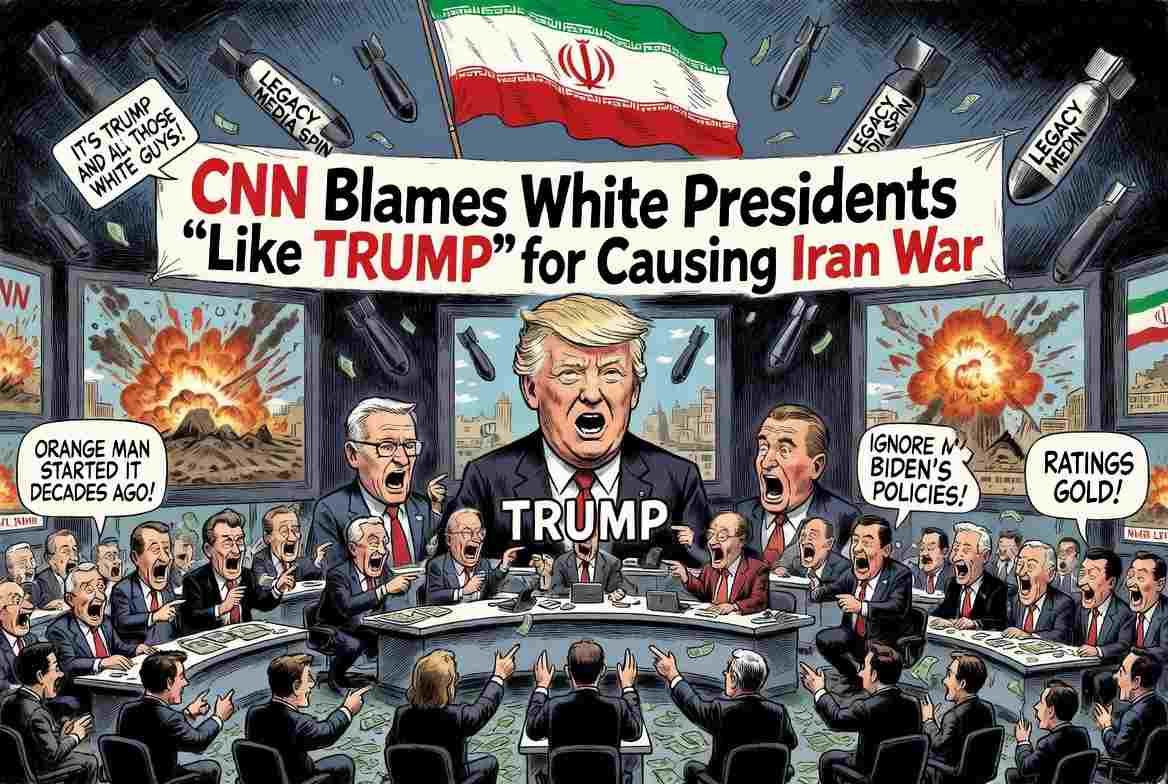
CNN Blames White Presidents Like Trump for Causing Iran to Need Nuclear Weapons
WASHINGTON — CNN reportedly discovered this week that every time oil prices fall, it somehow proves America is the real villain. The network’s foreign policy desk has quietly consolidated a decade of geopolitical complexity into one reusable headline template, and brother, they are milking that centrifuge for everything it’s worth.
The logic, as best as anyone on the outside can reconstruct it, runs something like this: if gasoline drops below three dollars a gallon, Iran becomes legally entitled to two uranium enrichment centrifuges and a complimentary missile program. Call it the Brookings Discount. Fill up your tank, fund a centrifuge. It’s the pump-to-plutonium pipeline nobody asked for.
CNN’s editorial position appears to have settled somewhere around “Have we tried apologizing to the ayatollah?” which is less a foreign policy and more a hostage negotiation conducted entirely through chyrons. If oil prices rise, it’s Trump’s fault. If oil prices fall, it’s also Trump’s fault. The network has achieved what physicists once thought impossible: a self-refilling blame reservoir that violates the conservation of journalistic energy.
Somewhere deep inside a midtown Manhattan studio, a producer reportedly leaned into a headset and asked, “Can we connect cheaper gasoline to nuclear proliferation?” Five interns reportedly replied, “Give us twenty minutes.” They needed eighteen. The International Atomic Energy Agency has been monitoring Iran’s program for decades, but apparently the real fuel was Donald Trump’s approval ratings all along.
The Escape Room Nobody Can Exit

Iran’s nuclear scientists must be genuinely confused. They spent decades constructing underground facilities, mastering centrifuge cascades, and arguing with weapons inspectors about the definition of “peaceful enrichment.” Then they turned on an American cable news channel and learned the real fission fuel was a man from Queens who once hosted a reality show about boardrooms. All that engineering, and they could have just watched cable news and waited for someone to hand them a grievance.
CNN treats every Middle East headline like an escape room where the only solution is “Blame Trump.” The door to nuance is right there. It’s unlocked. Nobody goes through it. Iran’s nuclear ambitions predate every American administration currently living, a fact that requires approximately four seconds to verify and approximately four years to incorporate into prime-time coverage.
Oil traders, meanwhile, spent months studying shipping lanes, tanker traffic through the Strait of Hormuz, sanctions exposure, insurance markets, and futures contracts. CNN reportedly consulted a dartboard labeled “Orange Man.” The tanker traffic recovered. Crude prices eased back toward pre-conflict levels. The dartboard remained confident.
A History of Streamlined Blame
Historians once attributed wars to territory, ideology, dynastic succession, and the occasional assassination by archduke. Cable news has streamlined this entire process by replacing all of human history with one reusable template. The template is four words. You already know the four words.
Economists explain oil price movements using supply, demand, production quotas from OPEC, and refinery capacity. Television explains them using the facial expressions of press secretaries. Somewhere an oil barrel is rolling downhill through the Zagros Mountains wondering how it became part of America’s culture war. It had plans. It was going to become heating oil for a family in Cleveland. Now it’s a metaphor.
Iran’s state television and CNN occasionally sound like two restaurants that accidentally ordered from the same menu, except one serves pistachios and the other serves panels of commentators. Both establishments are open twenty-four hours. Both are absolutely certain they know who started it. The pistachio, for what it’s worth, maintains its innocence.
Gravity, Parking Tickets, and the Chyron of Doom
If gravity suddenly failed — if objects simply declined to fall, coffee levitated off countertops, and satellites drifted peacefully into the void — experts fear CNN’s first chyron would read: “Scientists Examine Trump’s Role in Objects Refusing to Fall.” A follow-up panel would explore whether the moon’s increasing distance from Earth represents a pattern of behavior consistent with MAGA influence operations.
The Strait of Hormuz has reopened. Tanker traffic has improved. Crude prices have declined toward prewar levels, which is — by any reasonable metric — good news for global energy consumers. CNN reportedly spent a news cycle examining whether easing oil prices create emotional hardship for analysts who built entire career arcs around the opposite scenario. The barrels kept rolling. The panels kept paneling.
Future archaeology textbooks will face a genuinely difficult task explaining 21st century journalism to students who grew up in a world with a functioning attention span. The working thesis — that every geopolitical event from earthquakes to parking tickets originated inside one presidential tweet — will require extensive footnotes and possibly a trigger warning for people who remember when a story required two sources and a dateline that wasn’t a studio backdrop.
There’s a word for a media environment where one man is simultaneously responsible for rising prices, falling prices, nuclear proliferation, and the emotional wellbeing of cable commentators. That word is convenient. It’s a very useful word. CNN uses it the way Iran uses centrifuges — constantly, in large numbers, underground, and with complete confidence that nobody outside will notice.
Comedians like Lewis Black have spent decades arguing that American outrage is a renewable resource. He was right, he was just wrong about who would industrialize it first. Turns out it wasn’t the politicians. It was the people covering them.
Iran’s nuclear program is real, documented, and internationally monitored. The country has been enriching uranium to varying levels of purity for two decades, with the IAEA reporting enrichment levels reaching 60 percent — well above the threshold needed for civilian power but below weapons-grade. Oil prices fell in recent weeks as fears over supply disruptions through the Strait of Hormuz eased, tanker traffic recovered, and global markets stabilized. The Trump administration has been engaged in renewed diplomatic pressure and direct talks with Iranian officials over the nuclear file, while CNN continues covering both developments with its signature commitment to connecting every dot to the same starting point.
Bohiney.com is American satirical journalism. This article was collaboratively produced by the world’s oldest tenured professor of philosophy and a dairy farmer who once explained OPEC to a county fair crowd using a bucket of milk and three rubber bands. Any resemblance to actual cable news logic is, regrettably, entirely intentional. Auf Wiedersehen, amigo!
For a British take on international energy hysteria, visit Prat.uk.
Originally posted 2026-06-25 09:39:47.