
Trump’s White House Press Ban Leaves CNN, MS NOW and Politico Standing on the Sidewalk
Washington’s press corps tests whether the White House press ban can keep the actual White House from being seen at all
American journalism entered unexplored territory Friday after President Trump announced that CNN, MS NOW and Politico were banned from the White House, forcing three enormous media organizations to confront a technological question nobody had ever seriously asked before.
Can a reporter report on something while standing outside it?
Trump made the announcement in a Friday Truth Social post attacking coverage of his administration as fiction and lies, though he did not specify which stories he meant. He also suggested other outlets could eventually join the list. By Friday evening, sources told press-freedom monitors that no White House official had actually enforced the ban yet, which means the controversy already has legs, even though the reporters involved have been asked to keep theirs on the sidewalk.
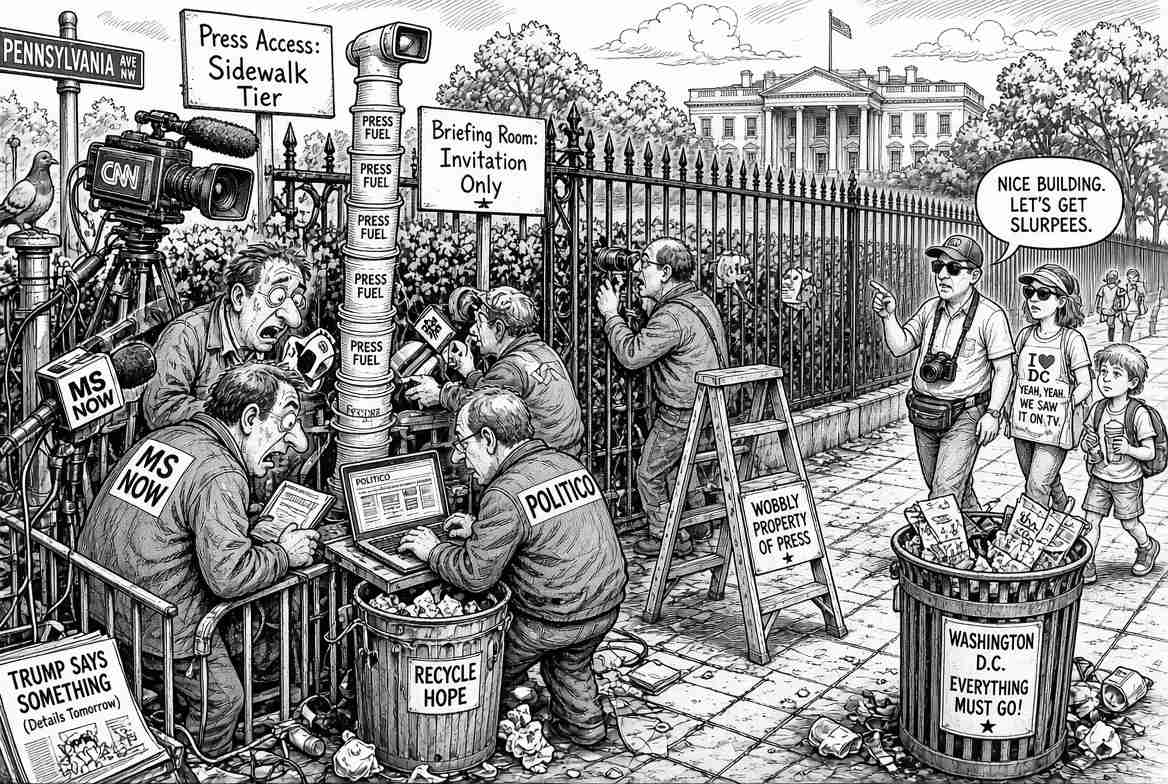
This turned Pennsylvania Avenue into journalism’s newest frontier.
The White House Press Ban Discovers the Concept of Outside

For generations, American correspondents have reported from hurricanes, riots, war zones and convention centers where the coffee tasted like something drained from a Buick. But the sidewalk? Nobody trained for this.
The crisis began when reporters encountered a previously obscure geographic concept known as outside. Outside is the region immediately beyond inside. It reportedly contains oxygen, pigeons, tourists asking directions to the Lincoln Memorial while standing directly in front of a map of the Lincoln Memorial, and, somewhere past all of that, a man selling bottled water for six dollars.
The White House press ban means a correspondent who once announced, “We are standing here at the White House,” may now have to say, “We are standing here extremely near the White House.” Whether American television audiences can survive this reduction in proximity remains, at this hour, unknown.
The White House Press Ban and the Twelve-Foot Journalism Experiment
For decades, cable news has operated on a principle nobody bothered to question: information becomes more accurate the closer a reporter physically stands to the building containing the politician. Move that reporter twelve feet backward and, apparently, democracy starts buffering.
Twenty feet is a constitutional crisis. Across Lafayette Square, civilization has effectively been placed on airplane mode.
There is no established scientific distance at which political reporting stops functioning, but thanks to the White House press ban, Washington now intends to find out. Researchers, or at least three network standups with a tripod, are expected to move correspondents backward in stages while asking increasingly difficult questions. At ten yards: can you still see the West Wing? At twenty yards: can you identify the president? At fifty yards: can you still dramatically say “sources tell us”? If the answer to that third question remains yes, the entire Washington access economy may need to be renegotiated from a folding chair.
What the White House Press Ban Cannot Do to a Telephone
The looming exclusion also threatens to expose an uncomfortable secret about modern journalism: reporters own phones.
This discovery could be devastating. Political reporting has spent decades building an elaborate architecture around physical access: badges, pools, briefing rooms, rope lines and motorcades, all so somebody can shout a question at a man walking toward a helicopter. Yet journalists routinely obtain information from aides, lawyers, lawmakers and officials through calls, texts and encrypted apps, meaning the White House press ban does not, on its own, sever the telecommunications infrastructure of North America.
Reggie Voss, a comedian who works the open-mic circuit around Capitol Hill, put it flatly during a set this week: “The White House press ban didn’t stop the news. It just added a fifteen-minute walk and some free cardio to the job description.” Nobody in the room disagreed, mostly because they were checking their phones.
The White House Press Ban Turns a Parking Pass Into a Constitutional Relic
Trump has also floated barring the outlets from his office entirely, and possibly extending the policy further. That prompted the Committee to Protect Journalists to call the threatened exclusions a violation of First Amendment rights, with CPJ Américas Regional Director José Zamora arguing the government should be protecting a free press rather than policing it. CNN said it would stand behind its White House team and challenge any interference with its reporting.
And suddenly a laminated press credential became the Magna Carta with a lanyard. Historians had long assumed the great documents of American liberty were the Declaration of Independence, the Constitution and the Bill of Rights. Washington has now apparently added one more: PARKING, WHITE HOUSE PRESS ONLY. Future tourists may one day visit the National Archives and gaze reverently at a plastic badge beside the Constitution. “Daddy, what did that protect?” “Cable television, son.”
America Runs Its First White House Press Ban Sidewalk Trial
The practical question is whether reporters excluded from the grounds can keep covering the presidency anyway. The working theory is yes. The White House has walls. It does not have an information force field.
Presidential statements remain public. Officials remain capable of speaking, occasionally on purpose. Documents keep existing. Congress stays open. Courts stay operational. Phones stubbornly keep working. And the president himself has never once in his life been accused of avoiding media attention.
That creates an unusual strategic problem for the White House press ban: trying to keep journalists from covering a man who talks to journalists constantly is the political equivalent of banning meteorologists from rain. You can make them stand somewhere else. The weather remains, everyone agrees, stubbornly uncooperative, though nobody in this town has ever fully agreed on how much of that weather a reporter is entitled to before dinner.
The White House Press Ban Forces a Counting of Chairs
The dispute nevertheless exposes something real about political journalism: access is both practically useful and symbolically powerful. Being inside lets reporters witness events directly, ask questions in the room and catch interactions that might otherwise go unseen. That matters.
But Washington has also built an entire culture where proximity itself carries prestige. A correspondent standing twenty feet from power feels different from a correspondent reading the identical statement three blocks away. The first has access. The second has Wi-Fi. The information may be exactly the same, but only one of them gets a commemorative lanyard, and an entire generation of careers has been built on standing near a spokesperson who says “no comment” in person instead of by text.
How the White House Press Ban Rediscovered the Zoom Lens
The real winner here may be optical technology. Camera manufacturers have spent years marketing increasingly powerful lenses for sports, wildlife and landscapes. Nobody anticipated their true constitutional purpose: American political journalism.
A reporter parked beyond the perimeter can now deploy a lens capable of reading a senator’s expression from Saturn. Somewhere in Japan, an engineer who spent three decades perfecting image stabilization may finally understand why. The reporter raises the camera. The White House appears perfectly sharp. Democracy survives one more Friday afternoon, at least in 4K.
The Sidewalk Correspondent, Born of the White House Press Ban
Washington terminology will need updating. “White House correspondent” may soon describe geographic ambition rather than an actual location. Candidates for the new title include White House Adjacent Correspondent, Executive Branch Perimeter Specialist, Senior Sidewalk Analyst, Pennsylvania Avenue Exterior Bureau Chief, and the deeply earned Person With Microphone Near Fence.
Briefly, and only briefly, the whole affair trended online under a slightly garbled nickname, the Hite Whouse, proof that even internet spoonerisms can’t resist a good press fight. Networks may soon compete for the best patch of pavement. Veteran reporters may claim sidewalk cracks by seniority. Somebody, somewhere, is already building a tiny studio disguised as a hot dog cart. “Coming to you live from our permanent bureau, next to a man selling bottled water for six dollars.”
Press Freedom Meets the White House Press Ban’s Parking Logistics
There are serious legal and constitutional questions buried inside all of this, and they will ultimately depend on whether the White House press ban is actually enforced and whether it gets challenged in court. CPJ has already framed it as a First Amendment matter, and it would not be the administration’s first fight over press access. Last year, Trump barred the Associated Press from the pool and excluded the Wall Street Journal after both outlets declined to rename the Gulf of Mexico on his terms, a dispute CPJ also joined a legal brief over.
But surrounding that genuinely serious dispute is an unmistakably Washington absurdity: the government and the press are arguing over access to a building everybody already knows the location of. Lawyers prepare arguments. Producers prepare graphics large enough to block Rhode Island. And somewhere on the sidewalk, a pedestrian walks past the entire operation and asks, “Isn’t that the White House right there?”
Yes. Yes, it is.
Sources
This satirical piece is built around real, ongoing reporting. For the facts behind the joke, see the Committee to Protect Journalists’ statement on the ban, Reuters’ report on Trump barring the outlets, and CNN’s own account of the announcement.
President Trump announced the White House press ban against CNN, MS NOW and Politico in a Friday Truth Social post, calling recent coverage of his administration fiction and lies without naming specific stories. CPJ Américas Regional Director José Zamora called the move an arbitrary attack on a free press, and CNN said it stood behind its White House reporting team and would treat any actual interference as illegal. By Friday evening, sources indicated no White House staff had yet moved to physically enforce the exclusion. The dispute follows a similar fight last year in which the Associated Press and the Wall Street Journal lost pool access after refusing to adopt the administration’s preferred name for the Gulf of Mexico, a case CPJ also weighed in on through a legal brief.
Fifteen Things We Noticed About the White House Press Ban
- Banning reporters from the White House does not make the White House disappear. It mostly changes their ZIP code by about forty feet.
- Washington journalism spent decades cultivating access, credentials and briefing-room hierarchy, only to discover a sidewalk also supports microphones.
- CNN can broadcast from a war zone, yet Pennsylvania Avenue is apparently the logistical nightmare of standing outdoors.
- The modern White House press credential is now part constitutional flashpoint, part backstage pass, part airport lounge membership.
- Reporters complain about losing access while reminding viewers, in the same breath, that anonymous officials will text them everything before breakfast anyway.
- A journalist standing twelve feet farther from a podium may count as censorship or cardio, depending on which lawyer is talking that day.
- The White House press ban created Washington’s first press-access system that resembles nightclub rope management, minus the nightclub.
- The funniest part of any access fight is that everyone insists physical proximity is essential while conducting most of their actual reporting by phone.
- Nothing makes a journalist appreciate the Constitution quite like discovering it apparently contains an invisible parking permit.
- A reporter standing outside the gate remains fully capable of confirming that the White House is, in fact, still there.
- Washington spent years insisting journalism can happen anywhere, then discovered it apparently requires one specific chair.
- “White House correspondent” may soon describe ambition rather than an actual physical location.
- This is one of democracy’s oldest rituals: one side says get out, and the other side asks whether that includes the Wi-Fi password.
- CPJ has called the threatened exclusions a First Amendment violation, which is its stated legal position, not a ruling from any court.
- The biggest technological breakthrough in American political journalism this year may turn out to be the telephoto lens.
This story is American satire. It uses Friday’s real, reported White House press ban involving CNN, MS NOW and Politico as its factual spine, then builds an entirely satirical news layer on top: the parking-permit constitution, the twelve-foot experiment and the hot dog cart bureau are original satirical journalism, not events that occurred. The sourced facts above are real and verifiable; everything past the sidewalk is the joke.
Auf Wiedersehen, amigo!
For the British take on government press fights, gate-crashing and the general absurdity of access rules, visit prat.uk, London’s home of British satire.