

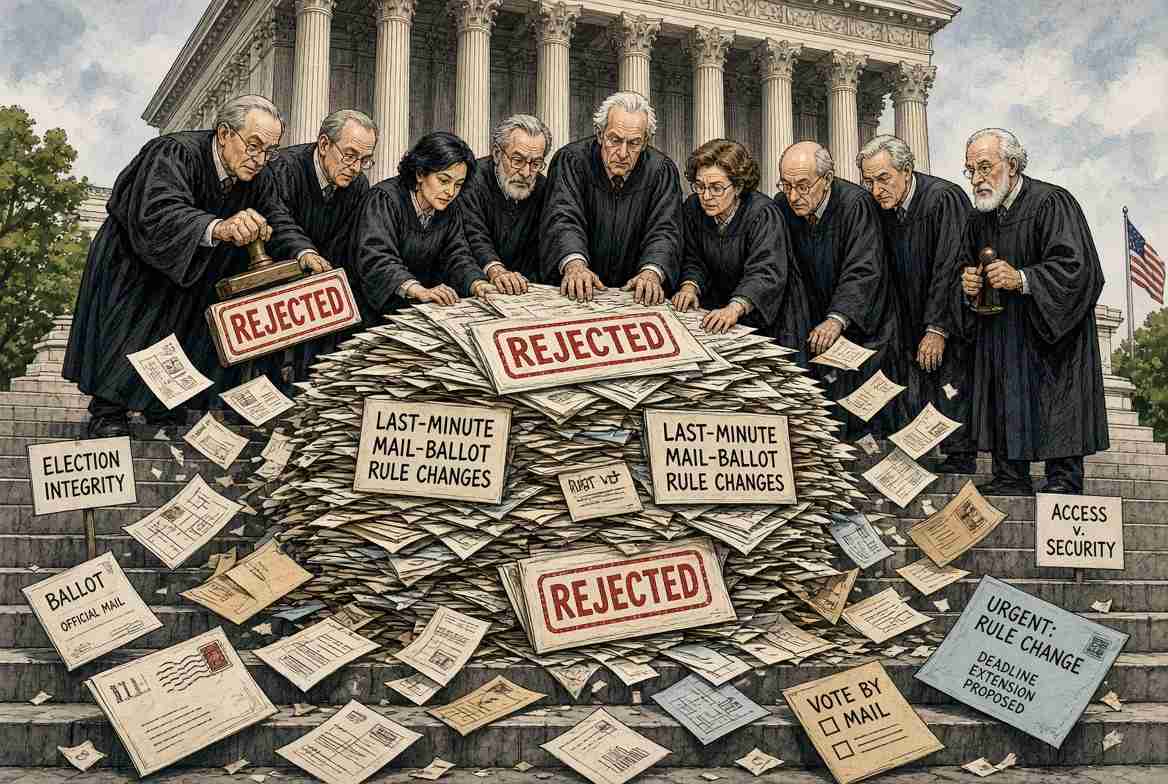
Supreme Court Blocks Last-Minute Mail-Ballot Rules, Postal Service Returns to Traditional Election Role of Losing Something Else
America once again asks the mailman to carry democracy without bending the envelope
WASHINGTON — The Supreme Court has temporarily kept new federal ballot-mail requirements from taking effect immediately before the 2026 election, proving once again that nothing makes Americans appreciate the Postal Service quite like asking it to transport something more important than a mattress coupon.
The dispute concerns Postal Service rules requiring federal ballot mail to meet new envelope-design, barcode and voter-information requirements. A lower court blocked those requirements, and the Supreme Court declined to immediately let them take effect while litigation continues. The order does not finally resolve the legality of the rules themselves.
A Procedural Order, Reclassified as Armageddon
That distinction is important. It is also destined to disappear on television. By dinner, one network will announce SUPREME COURT SAVES DEMOCRACY while another announces SUPREME COURT DESTROYS ELECTION SECURITY, and somewhere a justice will whisper, “We literally issued a procedural order.” Nuance, like the third-class mail it resembles, rarely arrives on time.
Mail voting occupies a unique position in American politics because it combines three institutions everyone distrusts: elections, government databases and the post office. The miracle is that stamps remain neutral.
Your Ballot Now Requires Heathrow-Level Clearance

The proposed rules involve specialized markings, scannable envelopes and data submitted through a Postal Service portal. Apparently voting by mail has finally reached the stage where your ballot needs approximately the same technological sophistication as checking into an international airport. “Did you scan the barcode?” “Yes.” “Upload the voter information?” “Yes.” “Use the approved envelope?” “Yes.” “Excellent. Your democracy is Group C. Please wait until called.”
Supporters of stricter ballot procedures argue that standardized systems can improve security and administration, a position often echoed by groups like the Heritage Foundation. Opponents argue that major new requirements imposed close to an election can cause confusion and interfere with existing state procedures, a concern the Brennan Center has raised repeatedly. Both concerns are understandable, which is unfortunate because understandable concerns are terrible for cable news. The ideal political dispute requires one side to be Stalin and the other side to be Batman. Instead, this dispute involves election administrators arguing about envelope specifications. Try selling that movie.
Fifty States, One Group Project, No Instruction Sheet
America’s election system is already staggeringly decentralized. Thousands of local jurisdictions administer voting under varying state laws while federal rules overlap in certain areas. Somehow the country has turned choosing a president into the world’s largest group project, with fifty states, several territories, thousands of officials and one voter in Arizona who forgot where he put the instruction sheet.
The Postal Service, meanwhile, finds itself dragged into constitutional litigation because apparently delivering catalogs and birthday cards was insufficiently stressful. Postal employees historically lived by a simple philosophy: “Neither snow nor rain nor heat…” Nobody mentioned nationwide injunctions.
The Eternal Loop of Election Reform
The deeper absurdity is that every election reform creates the same cycle. One group demands more safeguards. Another warns the safeguards could prevent legitimate votes. Judges intervene. Politicians accuse judges of intervening. Lawyers produce documents. The public searches Google for “Can I just vote normally?” Election officials then release a seventeen-page FAQ explaining that “normally” depends on your jurisdiction — a phrase that could double as America’s unofficial motto.
The Supreme Court’s current action leaves the broader legal fight unresolved, which means lawyers can continue doing what lawyers do best: converting punctuation into billable hours. Until courts decide the merits, election administrators must prepare under existing rules while watching litigation develop.
That sounds complicated. Fortunately, Americans have a flawless backup system. On Election Day, approximately 160 million people will independently ask: “Where do I vote again?”
Satire. This piece is built around real reported events; the quotations, dialogue and figures are comic invention.