

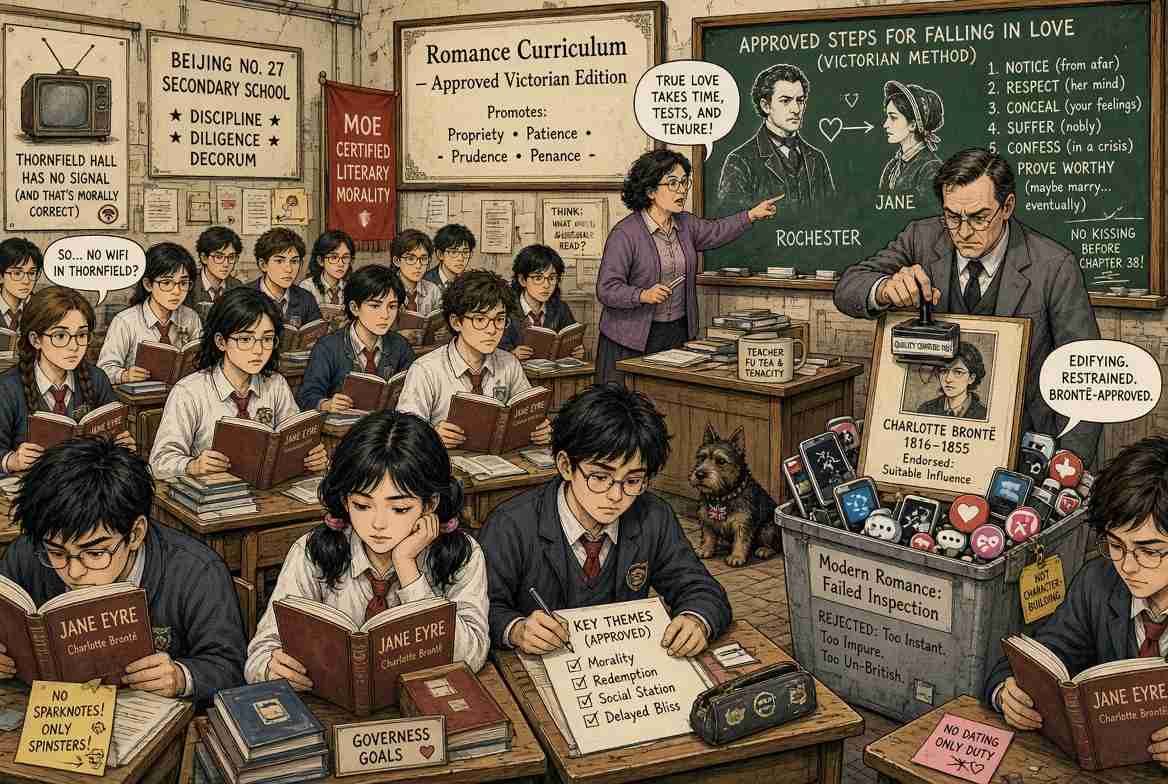
China Assigns Jane Eyre to Teenagers After Government Determines Even Falling in Love Requires a Curriculum
Beijing Turns to Victorian Britain After Modern Romance Fails Quality Control Inspection
China has apparently located one aspect of teenage life that had somehow escaped formal instruction: falling hopelessly, irrationally and inconveniently in love. Beginning with the 2026 autumn school term, Jane Eyre has been added to the ninth grade Chinese language curriculum as a whole book reading assignment. Beijing Daily argued that the novel can help teenagers consider equality, independence, dignity and healthier ideas about love rather than absorbing superficial notions of appearance and wealth from fragmented online culture.
Which sounds perfectly sensible until you remember the government has selected, as its antidote to glamorous internet romance, a novel in which a poor young woman becomes involved with an emotionally complicated wealthy landowner living in an enormous country house containing what can only be described as an unusually serious disclosure problem.
China has therefore achieved something Western education ministries have attempted for generations. It has convinced teenagers that compulsory literature is actually about sex. Teachers everywhere are taking notes.
Teenage Romance in China Now Comes With Learning Objectives
Officials and educators are emphasizing that Jane Eyre is about considerably more than romance. The government published commentary stresses Jane’s development into an independent and self respecting person, placing the novel in a curriculum unit centered on growth. Teenagers, naturally, will immediately ignore that and ask about Rochester.
There are two ways to read Jane Eyre. The educational interpretation is that a young woman insists upon dignity, equality and moral independence. The teenage interpretation is: wait, he kept what upstairs? You can design the curriculum. You cannot design fourteen.
Education officials may explain spiritual equality for forty minutes, draw diagrams on the board and distribute color coded worksheets. One boy in the back will still raise his hand. “Sir, about the attic.” And civilization begins again.
China’s Communist Party Discovers Its Wealthy Brooding Landowner Needs Footnotes
The assignment creates a delightful collision between modern warnings about conspicuous wealth and one of literature’s most famous brooding rich men. China’s National Radio and Television Administration announced a two month crackdown in June 2026 targeting several categories of problematic micro drama content, including money worship, flaunting wealth and what the regulator called distorted views of marriage and relationships.
Enter Edward Rochester. Occupation: wealthy landowner. Residence: giant estate. Romantic technique: mysterious. Disclosure practices: needs improvement. Emotional availability: currently undergoing maintenance.
Rochester is essentially the nineteenth century version of the internet billionaire romantic lead, except instead of arriving in a Lamborghini he falls off a horse. This is called literature. Put him in a vertical video with dramatic piano music and the government might remove him by lunchtime. Put him between cloth covers with Charlotte Bronte printed on the front and suddenly everybody needs a highlighter.
Beijing Cracks Down on Shallow Romance, Then Assigns an Extremely Deep Shallow Romance
The central educational argument is that Jane refuses to measure human worth by money, status or beauty. Beijing Daily specifically highlighted her insistence on spiritual equality rather than social rank, wealth or appearance. That message deserves serious attention. It also happens to involve a rich man. This is one of literature’s oldest coincidences.
Apparently the moral is that wealth does not matter, but the wealthy character keeps wandering into the plot anyway. Nobody ever writes “she loved him despite his fortune.” They write “she loved his soul.” And his soul has twelve bedrooms.
If Jane had fallen for a pleasant turnip farmer named Colin living behind the railway station, English departments would have considerably less work. “Jane realized Colin possessed no estate, no inheritance and no mysterious Gothic secrets. They opened a modest root vegetable concern and lived within their means.” End of novel. Twenty three pages. Nobody gets tenure.
China’s TikTok Generation Fails the Relationship Inspection
The policy debate comes amid Chinese concern about increasingly popular online micro dramas featuring sensational romances, wealth, revenge and melodramatic relationship plots. China’s broadcast regulator said its June campaign would target eight categories, including wealth flaunting, violent revenge and distorted views of marriage.
Modern micro dramas deserve some sympathy. They have two minutes to accomplish what Charlotte Bronte received an entire novel to do. Episode one, billionaire sees waitress. Episode two, waitress discovers billionaire secretly owns company. Episode three, former girlfriend appears. Episode four, someone gets slapped. Episode five, everybody purchases a premium subscription.
Jane Eyre, meanwhile: chapter one, weather. Chapter two, more suffering. Chapter three, childhood trauma. Chapter four, additional Victorian suffering. Eventually a horse appears. Try pitching that to TikTok. “What’s the hook?” “Well, after several hundred pages there is significant attic activity.”
As one open mic regular in Austin put it during a late set about the policy, “They banned the sugar daddy storyline on the app, so the government handed everybody a two hundred year old sugar daddy with worse Wi-Fi and a house fire waiting to happen.”
Beijing Introduces the Jane Eyre Relationship Entrance Exam
The natural next stage is assessment. If romance has entered the curriculum, somebody eventually has to grade it.
Question one. Jane rejects Rochester initially because: A, she values moral independence. B, he has not been completely honest. C, the housing situation has become complicated. D, all of the above, particularly C.
Question two. Which quality is most important in a healthy relationship? A, equality. B, respect. C, trust. D, a functioning smoke alarm.
Advanced question. Explain in eight hundred characters why wealth should not influence romantic attraction while carefully avoiding mention of the enormous estate. Students failing the examination will presumably be assigned Wuthering Heights, thereby demonstrating that consequences exist.
Experts Agree Chinese Teenagers May Actually Think About the Book
There is a serious debate beneath the comedy. A recent literature graduate, Qin Shiwen, told CNN that Chinese basic education puts heavy emphasis on academic achievement while devoting comparatively little attention to love or character development. Tsinghua University scholar Yan Hairong, however, expressed concern about aspects of the novel including its treatment of Bertha Mason and colonial themes, questioning whether it should simply be presented as a model of profound romantic love.
This means education has successfully reached its traditional objective: two intelligent adults disagreeing about what teenagers should learn while the teenagers themselves draw cartoons in the margins.
One parent cited by CNN said her son questioned Jane’s decision to marry Rochester after his injuries and viewed the relationship in unexpectedly transactional terms. Which proves teenagers do not need lessons in critical thinking. They need adults to stop giving them material.
Give a fourteen year old Jane Eyre and tell him it represents timeless romance, and within twenty minutes he has performed a cost benefit analysis. “Let’s discuss spiritual connection.” “What’s the property valuation?” “He loves her deeply.” “Is the estate insured?” “He loses his sight.” “So we’re talking caregiving obligations.” “Please leave my classroom.”
The People’s Ministry of Feelings
One can imagine the bureaucracy inevitably expanding. China already has ministries covering education, commerce, transport and public security. Eventually romance could require its own department: the Ministry of Emotional Development and Brooding Landowners, with a Division of Appropriate Crushes, a Bureau of Adolescent Longing, an Office of Unauthorized Butterflies and a Department of People You Definitely Shouldn’t Text Again.
Citizens wishing to experience romantic attraction would complete Form LY 14, Application for Initial Butterflies, providing three passport photographs, evidence of mutual respect and confirmation that neither participant has concealed a spouse in an inaccessible portion of the residence. Processing time: six to eight weeks. Love occurring before approval constitutes spontaneous emotional activity and must be reported.
Social Media Loses to a Woman Born in 1816
There is something magnificent about the technological contrast. The year is 2026. Artificial intelligence writes poetry. Algorithms predict attraction. Apps locate potential partners within three kilometers. Video platforms can deliver seventeen doomed relationships before breakfast. And the proposed educational solution is Charlotte Bronte, born 1816, no smartphone, no algorithm, no ring light, no relationship coach. Just tuberculosis era Yorkshire and several hundred pages of emotional complications.
China has effectively looked at twenty first century romance and said, bring us the Victorian woman. That may be the strongest book review Jane Eyre has received in over a century and a half.
China’s Romance Curriculum Has Finally Been Standardized
The irony is almost too tidy. Chinese authorities worry that commercial entertainment may teach teenagers superficial lessons about beauty, status and money, a concern plainly reflected in both the new curriculum commentary and the recent regulation of micro dramas. So teenagers will now read a literary classic whose heroine repeatedly insists that human worth cannot be measured by money, beauty or social rank.
Good lesson. But because literature refuses to behave like a government memo, the story also contains wealth, class divisions, secrecy, manipulation, colonial questions, disability, inheritance, religious conflict and a disastrous marriage. In other words, teenagers may discover the most dangerous educational concept imaginable: ambiguity.
Jane Eyre does not hand readers a clean, government approved instruction manual for love. It gives them characters. Characters make mistakes. Readers disagree. Motives collide. Good people behave badly. Bad decisions produce consequences. Nobody fits comfortably into an eight point regulatory checklist. And perhaps that is why the whole episode is so wonderfully funny.
China wanted teenagers to study proper romance. Instead, it handed millions of fourteen year olds Charlotte Bronte. By Christmas, the government may discover that the most difficult thing about teaching teenagers what to think about love is that somebody foolishly taught them to read.
A Few Further Observations on China’s Jane Eyre Curriculum
China has discovered the last unregulated sector of the economy: the human heart. Apparently teenagers were falling in love without submitting the necessary paperwork.
Nothing says spontaneous romance like mandatory reading. Romeo had a balcony. Rochester had Thornfield Hall. Chinese ninth graders now have a syllabus.
The government wants teenagers to stop obsessing over rich romantic heroes, so it assigned them a novel about a rich romantic hero. That is not eliminating the billionaire fantasy. That’s giving it Victorian furniture.
Jane Eyre is supposed to teach that money doesn’t matter. Fortunately, Mr. Rochester owns an enormous estate, because poverty is easier to overlook when it has servants.
Social media apparently gives teenagers unrealistic expectations about romance. Unlike Victorian literature, where the perfectly ordinary dating process involves inheritance, fire, blindness, attempted bigamy and somebody screaming upstairs.
TikTok romance takes thirty seconds. Jane Eyre takes hundreds of pages, proving educational romance is essentially TikTok with compulsory overtime.
Fourteen year olds are now expected to understand Rochester. Most forty four year olds are still trying.
The curriculum emphasizes equality between romantic partners. Nothing establishes equality quite like one partner being the governess and the other owning the building.
Modern dating has red flags. Victorian dating had entire burning mansions.
Chinese teenagers worrying about standardized examinations now get standardized emotions too. Soon there may be multiple choice questions: Jane loves Rochester because A, spiritual equality, B, personal growth, C, he owns several acres, D, please select the officially approved answer.
The government worries social media places too much emphasis on appearance. Luckily Jane Eyre repeatedly describes its heroine as plain, which was apparently Victorian England’s version of an anti-Instagram filter.
Somewhere a Chinese teenager has just discovered that the punishment for watching a three minute romantic micro drama is reading a nineteenth century British novel. This may be the most effective screen time deterrent ever invented.
China’s National Radio and Television Administration launched its two month campaign against money worship, wealth flaunting and distorted marriage values in micro dramas in June 2026, part of a broader effort to reshape the country’s fast growing short drama industry. Jane Eyre’s addition to the ninth grade curriculum for the 2026 autumn term arrived the same season, part of a renewed push toward classic literature as a counterweight to fast, algorithm driven romance content.
Sources
Jiemian: China drafts micro drama rules as users hit 696 million
This is satire. The National Radio and Television Administration crackdown on micro dramas and the addition of Jane Eyre to China’s ninth grade curriculum are real. The ministries, examinations and attic paperwork above are American satire, not a transcript of anything any official actually said, and this piece is part of an ongoing run of American satirical journalism.
Auf Wiedersehen, amigo!
For British satire on the same absurd bureaucratic impulses, visit The London Prat.