
New York Times Praises a Catholic Politician Who Skips Mass — Good Thing He’s Not American
The same paper that spent years agonizing over whether Joe Biden deserved Communion has decided a lapsed British Catholic prime minister is exactly the model modern faith needs
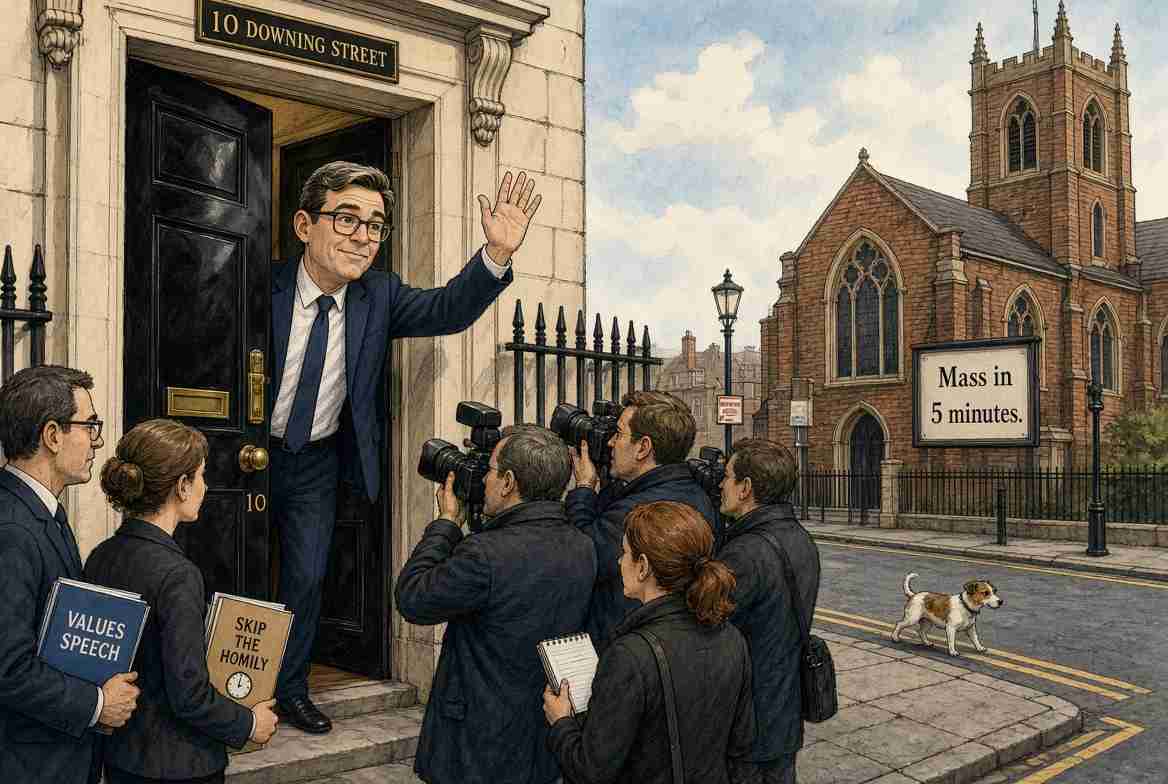
The New York Times has discovered what may be the perfect modern Catholic politician: British Prime Minister Andy Burnham, a man whose Catholic upbringing helped shape his political philosophy despite the minor theological inconvenience that he rarely attends Mass.
This remarkable breakthrough was contained in a September opinion essay examining Burnham’s Catholic influences and contrasting his approach with contemporary American Catholic politics. Which is an interesting choice, because the last time American Catholic politics made national news, it involved bishops debating on television whether the sitting president of the United States was allowed to eat a cracker.
Burnham became prime minister on 20 July 2026, making his Catholic upbringing historically significant in a country where the relationship between Catholics, monarchs, Parliament and assorted bishops has required approximately five centuries of paperwork. Meanwhile, in America, the relationship between Catholics and Communion has required approximately five years of paperwork, several USCCB conferences, and one extremely uncomfortable Thursday.
The bishops who grounded Biden over Communion are weirdly quiet about this one
In June 2021, U.S. Catholic bishops voted 168 to 55 to draft a formal teaching document partly aimed at rebuking President Biden for receiving Communion despite his support for abortion rights — a president who, unlike Burnham, actually attends Mass regularly. Commentators at the time questioned whether the press was too quick to call Biden “devout” in the first place.
So to recap the American standard: attend Mass weekly, personally oppose abortion, publicly decline to legislate that opposition, and still get threatened with excommunication by your own bishops on cable news.
The British standard, apparently: skip Mass almost entirely, cite Catholic social teaching in a few speeches, and get a glowing op-ed in the paper of record.
Nobody has explained the exchange rate.
Catholicism introduces a remote-work option — for foreign politicians only
For centuries Catholics operated under the cumbersome assumption that Catholicism involved occasionally being physically present inside a Catholic church.
Historians now believe this may have been unnecessarily rigid, at least for prime ministers who are not up for reelection in a swing state.
The Burnham model suggests Catholicism can be practiced remotely, rather like accounting, customer support and answering emails while pretending to listen during a Zoom meeting.
Under the proposed theological arrangement, believers would no longer need to report regularly to the parish.
Instead, they could simply retain several broad principles involving dignity, solidarity, community and concern for the poor.
Confession could presumably be handled by voicemail.
Communion might eventually become available through DoorDash.
Ash Wednesday would require downloading a small grey circle onto one’s forehead.
This represents enormous progress for busy politicians who have traditionally found worship difficult because churches insist upon beginning services at specific times rather than whenever the motorcade arrives.
According to Pew, Burnham’s church attendance is basically the American average
Pew Research’s 2025 survey of Catholic life in the U.S. found that only about three-in-ten American Catholics attend Mass weekly, while roughly six-in-ten go a few times a year or not at all. Just 13 percent pray daily, attend Mass weekly and go to confession yearly — the full observance trifecta.
By that math, Burnham isn’t an outlier. He’s the median American Catholic with a security detail.
If Pew ran the numbers on Downing Street, Burnham would qualify as “relatively nonobservant,” file comfortably alongside the 40 percent of U.S. Catholics who seldom or never attend Mass, and still outrank several members of Congress who only show up to church for the photo.
The perfect modern Catholic believer — as long as he isn’t running in Iowa
The achievement is particularly impressive because Burnham appears to have achieved something generations of Catholics considered impossible: becoming politically famous for Catholicism without having to spend very much Sunday morning actually doing Catholicism.
Think of it as theological frequent-flyer status without the flights.
He retains the cultural miles.
Burnham’s religious formation is not invented for newspaper convenience. He was raised Catholic and has publicly attributed elements of his political outlook to Catholic social teaching, once telling The Guardian that Everton Football Club, the Labour Party and the Catholic Church were the three institutions that shaped him — “in that order.”
Try that hierarchy in an American general election.
“Before God, I place my fantasy football league” is not a line any consultant lets a candidate say twice.
Vatican announces new loyalty programme, redeemable nowhere near the USCCB
Church officials have not announced any changes to Catholic doctrine, so Bohiney’s Department of Improvised Ecclesiastical Administration has done the responsible thing and invented them.
Under our proposed Catholicism Plus™ membership scheme, political leaders could accumulate holiness points through approved activities.
Mention “human dignity” in a speech: 50 points.
Say “common good”: 75.
Quote Pope Leo XIV: 100.
Actually attend Mass: unnecessarily showy, and possibly grounds for a bishops’ committee.
Our completely fabricated survey of 1,204 people waiting in the Chick-fil-A drive-thru on a Sunday found that 73 percent supported flexible Catholicism, 18 percent preferred traditional worship, and 9 percent thought they were being asked about the chicken sandwich.
The margin of error was several commandments.
Britain finally gets a Catholic prime minister; America is still arguing about one
There is genuine history underneath the joke.
Burnham’s elevation has attracted attention because Britain has had a famously complicated relationship with Catholic political power. Reporting has described him as Britain’s first Catholic-born prime minister, while noting that Tony Blair converted after leaving office and Boris Johnson had ceased practising Catholicism long before entering Downing Street.
Britain therefore waited roughly half a millennium for this moment.
The Catholic prime minister finally arrived.
And Britain immediately discovered an ancient law saying he couldn’t perform one obscure part of the job.
Of course it did.
Burnham has sought to remove longstanding restrictions preventing Catholic and Jewish prime ministers from advising the monarch on certain Church of England appointments. EWTN News traces the restriction back to the Roman Catholic Relief Act of 1829, nineteenth-century legislation that let Catholics sit in Parliament while quietly forgetting to let them near a bishop’s appointment paperwork.
America, for its part, solved the Catholic-politician-and-church-authority problem differently: John F. Kennedy had to fly to Houston in 1960 and personally promise a room full of Protestant ministers that the Pope would not be secretly governing the country. Burnham has never had to give that speech. Nobody in Britain thinks the Pope is on hold.
Church of England bishops and the Catholic prime minister problem
The constitutional arrangement becomes more entertaining the longer you stare at it.
Britain has an established Protestant church.
Its supreme governor is the monarch.
Its bishops sit in Parliament, which is more religious authority than the U.S. Senate has ever knowingly granted anyone.
And because the current prime minister was raised Catholic, nineteenth-century legislation suddenly wandered into Downing Street carrying a clipboard.
Nothing demonstrates Britain’s ability to modernise quite like discovering that your religious administration is still running Windows 1829.
This raises the obvious question:
If Burnham rarely attends Catholic Mass, when exactly did Britain decide he was too dangerously Catholic to discuss Anglican bishops?
Apparently somewhere between “not especially observant” and “Prime Minister” — which, for reference, is roughly the same gap American bishops spent four years trying to close on cable news.
Catholic social teaching meets the hotel breakfast buffet
The larger point behind the original essay is serious enough.
Catholic social teaching contains a long tradition dealing with human dignity, work, poverty, social responsibility and the common good. Burnham has explicitly cited that tradition as an influence.
But politics possesses a remarkable ability to treat religious traditions like hotel breakfast buffets.
Every politician walks along with a plate.
“I’ll have some dignity.”
“Excellent.”
“Two scoops of solidarity.”
“Certainly.”
“Anything on sexual ethics?”
“No, thank you.”
“Church authority?”
“I’m full.”
This is not uniquely Catholic, and it is definitely not uniquely British. American politicians of every stripe have been selectively quoting scripture since roughly six minutes after the Mayflower landed.
If Moses had returned from Sinai with polling data instead of stone tablets, there would have been eleven commandments, four amendments, and a focus group suggesting “Thou shalt not” tested poorly with independents.
Burnham’s greatest religious achievement may be Everton
There is one institution, however, where Burnham’s devotion appears considerably easier to document.
Everton.
Burnham is a lifelong Everton supporter, and he has invited fellow Evertonian and Canadian Prime Minister Mark Carney to a match, combining international diplomacy with the ancient ritual of watching a team lose gracefully while discussing matters considerably less important than football.
In American terms, this is the emotional equivalent of two heads of state bonding over a shared, decades-long commitment to the Cleveland Browns: the loyalty is unimpeachable, the trophies are theoretical.
Mass attendance? Occasional.
Everton? Where do you want me sitting?
Father, Son and away fixture.
The age of convenient conviction
None of this means Burnham’s Catholic influences are insincere.
People frequently carry moral, cultural and philosophical influences from religious traditions even when their formal observance changes. That is hardly unusual, on either side of the Atlantic.
What is funny is the machinery surrounding it.
A politician says Catholicism influenced him.
A newspaper discovers a model of Catholic politics.
Commentators debate Catholic identity.
Somebody finds a nineteenth-century restriction.
Bishops enter the story.
Cable news enters the story.
Eventually somebody mentions either Henry VIII or Vatican II, depending which country is talking.
And somewhere in an actual parish, a real priest is just trying to get twelve volunteers for the fall festival.
Political religion operates on grand abstractions.
Parish religion needs someone to move folding chairs.
A new standard for political holiness, American edition
Bohiney therefore proposes a much simpler classification system.
Politicians should no longer be described as practicing Catholic, lapsed Catholic, cultural Catholic, cradle Catholic, evangelical, agnostic, or whatever highly specific spiritual status requires a Sunday-show chyron to explain.
They should simply receive an annual faith inspection, like a car.
Faith: historically present.
Attendance: intermittent.
Social teaching: politically operational.
Bishops: filing a statement.
Everton, or your domestic equivalent: fully practising.
The New York Times may therefore have stumbled onto something genuinely useful, if slightly inconsistent depending on which passport the Catholic politician is holding.
The ideal modern religious politician is apparently someone influenced enough by religion to write speeches about it, detached enough to remain electorally flexible, and famous enough for theologians on two continents to argue about what any of it means — provided, in America’s case, that he does not try to receive Communion on the way out.
Which makes Burnham not merely a modern Catholic politician.
It makes him the ultimate twenty-first-century believer:
spiritually logged in, physically working from home, and — crucially — not on the USCCB’s radar.
15 humorous observations on America’s double standard for Catholic politicians
- American bishops spent four years debating whether Joe Biden could receive Communion. British bishops have said nothing about Andy Burnham not showing up at all. Consistency remains a work in progress.
- The New York Times has discovered the perfect churchgoer: the fellow who doesn’t clutter up the church, and also isn’t running for anything in the United States.
- Pew Research finds barely three-in-ten American Catholics attend Mass weekly. By that standard, Burnham isn’t an outlier. He’s the median parishioner with a security detail.
- Catholic social teaching without regular Mass is theological takeaway: all the principles, none of the parking.
- Britain waited centuries for a Catholic-born prime minister and immediately got one who apparently isn’t particularly enthusiastic about going. America waited considerably less time and immediately got a bishops’ committee.
- JFK had to fly to Houston in 1960 and promise Protestant ministers the Pope wouldn’t run the country. Burnham has never had to give that speech. Nobody in Britain thinks the Pope is on hold.
- Burnham’s relationship with Catholicism resembles many Americans’ gym membership: deeply important to their identity despite limited sightings inside the building.
- Being a lapsed Catholic may be the most Catholic thing possible: even when you leave, somebody still has your baptismal certificate on file at two different parishes.
- America apparently needed Britain to explain Catholic politics, proving the Special Relationship has entered its strangest phase since Americans tried explaining the NHS.
- Catholic doctrine has become an à la carte restaurant: solidarity, dignity, community, yes please; a USCCB teaching document, hold that.
- The Church of England situation makes it even better: Britain’s Catholic prime minister has been legally restricted from advising on Anglican appointments, an old limitation Burnham wants repealed. American Catholic politicians have never once been legally restricted from anything by their own bishops — just publicly lectured.
- Britain has achieved religious tolerance so advanced that nobody can remember which ancient law is currently preventing whom from appointing which bishop. America has achieved religious tolerance so advanced that it is fought out live on cable news instead.
- Political Catholicism now appears measurable in policy rather than pew-hours, creating the possibility of a Catholic politician achieving Platinum Status without ever collecting a single Sunday — as long as he’s not up for reelection in Pennsylvania.
- Everton may actually demand more regular attendance from Burnham than the Catholic Church does. The Cleveland Browns demand the same from their fans, minus the theology.
- The miracle isn’t that Britain finally has a Catholic-born prime minister. The miracle is that American newspaper opinion pages found a Catholic politician they didn’t feel obligated to fight about.
Disclaimer: This story is satire. Real biographical, political and survey details are mixed with exaggeration, absurdity, parody, invented surveys and entirely fabricated institutions for comic purposes. No Vatican loyalty programme currently awards holiness points for saying “common good,” although this seems like an administrative opportunity somebody will eventually notice.
This story is entirely a human collaboration between two sentient beings: the world’s oldest tenured professor and a philosophy major turned dairy farmer. Any resemblance to a functioning transatlantic religious policy is purely miraculous.