

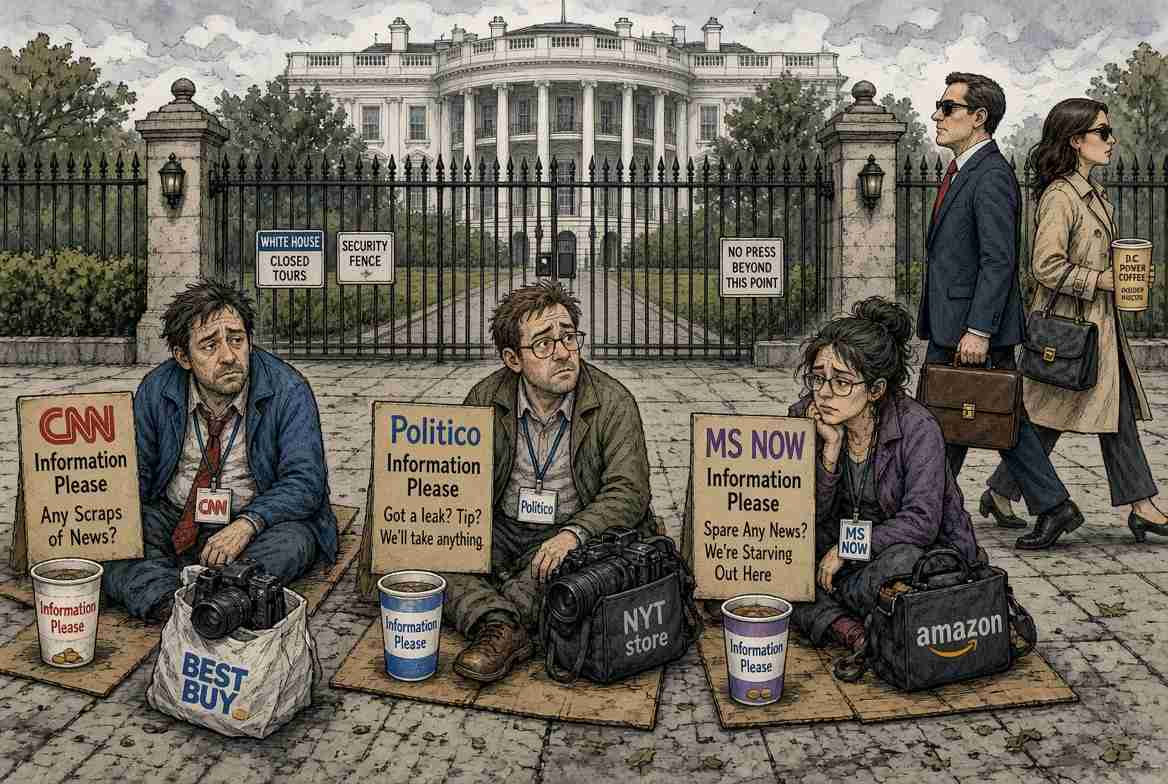
CNN, Politico Sue to Get Back Into the Building They Got Kicked Out Of, Demand Taxpayers Fund Their Feelings
Media outlets that spent a decade calling the president illegitimate are now suing because he won’t let them stand in his driveway
WASHINGTON — CNN, MS NOW and Politico filed a lawsuit Monday demanding restored access to the White House grounds, marking the first time in recorded history that a group of professional fact-checkers filed a document arguing the facts should bend around them.
The outlets claim their exclusion violates the First Amendment. The Trump administration, which has spent years watching these same organizations run wall-to-wall coverage built on anonymous sources, discredited dossiers and breathless “sources say” panic, responded with the same energy a landlord uses on a tenant who hasn’t paid rent since the Obama administration: you’re free to leave a strongly worded letter, but you’re still not getting the key back.
The First Amendment Doesn’t Guarantee a Parking Spot

Here is what the lawsuit conveniently skips: the First Amendment protects the right to publish, broadcast, print and scream into a camera. It does not guarantee any specific reporter a hall pass onto federal property, a chair in the briefing room, or a front-row seat to photograph the president’s tie. CNN is not banned from reporting on the White House. CNN is banned from loitering inside it. Those are different things, though you’d never know it listening to the network’s own legal analysts, several of whom appear to have skipped the chapter of law school covering “access” versus “speech.”
Journalists insist government officials cannot punish outlets for unfavorable coverage. Fair enough — except unfavorable coverage isn’t really the complaint here. Years of coverage built around Russia collusion theories that collapsed, a laptop story dismissed as disinformation until it wasn’t, and headline after headline predicting democracy’s final hour every time the president held a press conference — that’s not “unfavorable.” That’s a track record. At some point, credibility is a résumé item, and these outlets have been quietly padding theirs with retractions.
Reporters Who Cried Wolf, Then Sued the Farmer
This means the federal judiciary has now been asked to settle a dispute that boils down to: does a homeowner get to decide who’s allowed inside the house after years of guests trashing the furniture and telling the neighbors the homeowner burned it down himself? Lawyers, naturally, love this question, because a dispute over access rules can be billed in six-minute increments indefinitely, and nobody bills like a media conglomerate’s outside counsel.
Notice, too, the sudden solidarity. Networks that spend twenty-four hours a day trying to steal each other’s ratings have linked arms over “press freedom” — which is a beautiful principle, right up until you remember these same outlets have spent years cheering when conservative voices got deplatformed, demonetized or quietly throttled by the very tech platforms they partner with. Press freedom, it turns out, is a value these networks discovered exactly the moment it applied to them.
No Driveway, No Segment — And That’s the Real Complaint
Television journalism is especially exposed here because television needs a backdrop. Without White House grounds access, a correspondent can’t stand in front of the North Portico looking serious while a Marine walks past to add gravitas. The lawsuit isn’t really about democracy. It’s about b-roll. Remove the White House lawn and you remove the free scenery that makes a network segment feel important instead of what it actually is: a guy reading a press release out loud with better lighting.
Ordinary Americans, for their part, are not exactly rallying to the barricades over this one. Years of watching legacy outlets treat every administration statement as either a national emergency or a coordinated lie has left plenty of voters entirely unmoved by the idea that CNN’s access to the driveway is the hill democracy dies on.
Banning the Networks Only Feeds the Networks
Here’s the part the White House press corps won’t say out loud: banning these outlets from the grounds doesn’t silence them — it hands them a martyrdom narrative they’ll milk for weeks. CNN doesn’t go quiet. CNN runs the story CNN BANNED FROM WHITE HOUSE on a loop, turning a access dispute into seventeen hours of programming, three panels, and at least one segment where a legal analyst explains why this is “unprecedented,” a word these networks have used so often it has stopped meaning anything.
Every restriction becomes content. Every lawsuit becomes a fundraising email. Every op-ed condemning the ban becomes a subscription pitch. Somewhere in a Politico newsroom, a headline is already being drafted with the word “chilling” in it, right above the paywall.
What a Federal Court Actually Has to Decide
The case now proceeds through federal court, where judges will have to separate legitimate security and access management — which the executive branch is well within its authority to set — from retaliation based on viewpoint. That’s a real legal distinction, and it deserves a serious hearing. What it doesn’t deserve is the cable-news treatment it’s about to get, reduced to two boxes on a split screen marked AMERICA SAVED and AMERICA DESTROYED, populated by seven guests, none of whom will finish a sentence before the commercial break.
Somewhere in Washington, a federal judge is going to read several hundred pages of outraged briefs over who gets to stand in a driveway, and quietly wonder whether veterinary school was still accepting applications.
Satire. This piece is built around real reported events; the characterizations, quotations and comic framing are the author’s own commentary.