

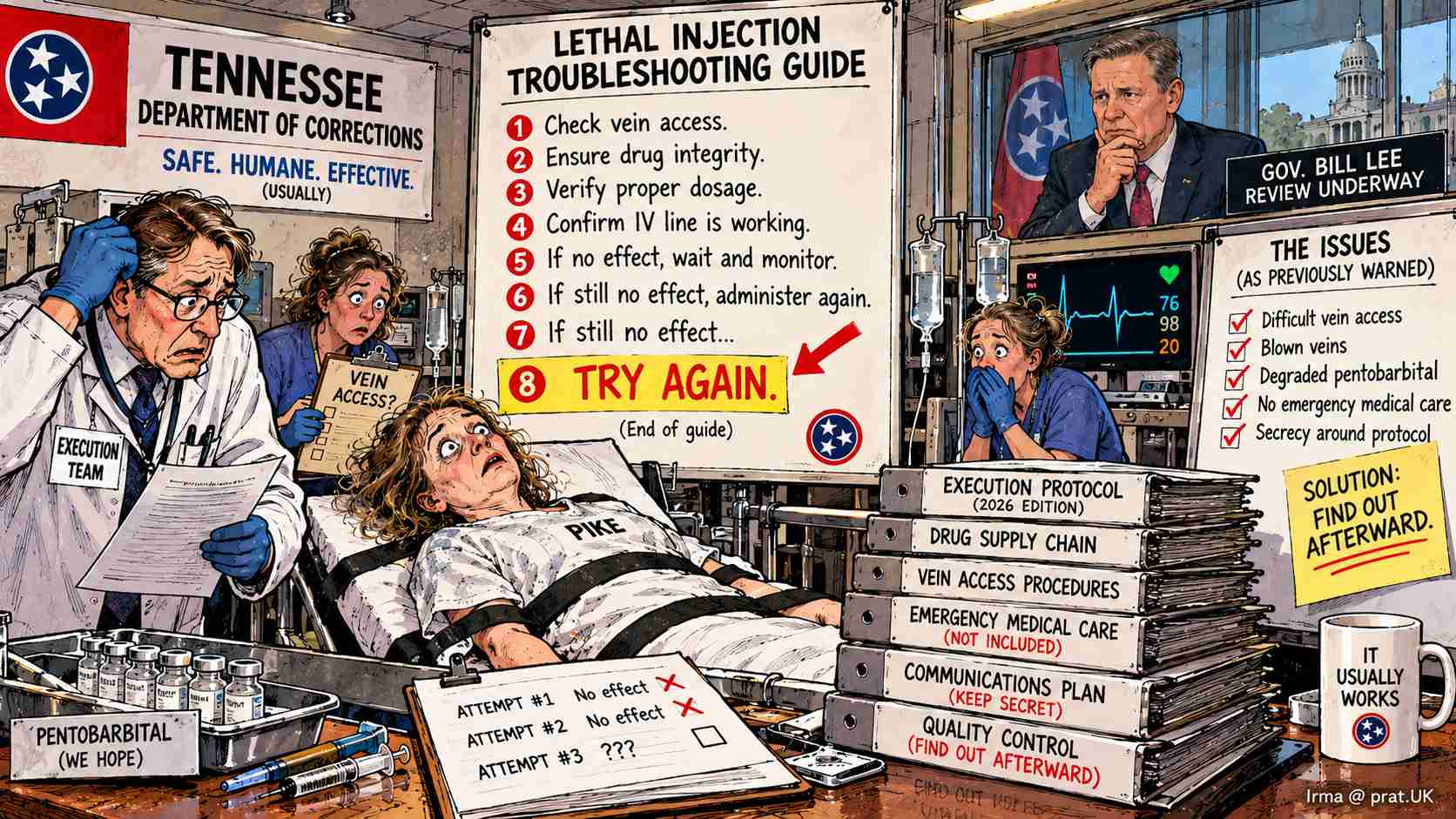
Tennessee Discovers Execution Protocol Has Troubleshooting Guide That Ends at ‘Try Again’
Pike’s lawyers warned about vein access, drug integrity, emergency care and secrecy. Tennessee responded with the traditional government quality-control technique: finding out afterward.
The underlying facts are serious: Christa Pike survived Tennessee’s September 30 execution attempt after two administrations of pentobarbital, was hospitalized, and Gov. Bill Lee halted the state’s remaining 2026 execution while ordering an outside review. Exactly why the execution failed remains under investigation. The satire below targets institutional procedure, and the observations that close the piece collect the comic pressure points underneath the story.
State Assures Public Everything Went According to Protocol Except the Result
NASHVILLE, Tennessee — There are bad days in government, and then there are days when an institution attempts to execute somebody and finishes the evening by calling an ambulance.
Tennessee achieved the latter Wednesday.
Christa Pike, 50, remained alive after the state administered two rounds of pentobarbital during an execution attempt at Riverbend Maximum Security Institution. Witnesses reported that she remained conscious for part of the process, complained about her arm, later could be heard snoring, and ultimately was transported for medical treatment. She was reported Thursday to be in critical condition receiving life-saving care.
This is not usually how executions are diagrammed.
Normally, the arrow marked LETHAL INJECTION does not curve around the page and terminate at HOSPITAL.
Pike had been sentenced to death for the brutal 1995 murder of 19-year-old Colleen Slemmer, whose mother, May Martinez, traveled to witness the execution after waiting decades for the sentence to be carried out. Martinez described Wednesday’s events as a “mess” and said the family initially received little information about what had happened.
That human reality deserves remembering because bureaucratic catastrophe has a remarkable ability to produce suffering in every direction.
But the bureaucratic portion is extraordinary.
Pike’s attorneys had raised concerns about problems including vascular access, the condition of the pentobarbital supply, emergency medical arrangements and the secrecy surrounding Tennessee’s execution process. Afterward, they said those concerns had been vindicated. The precise cause of the failure, however, has not yet been established, and Gov. Lee has ordered an investigation.
In other words, the lawyers handed the state a list labeled:
THINGS WE ARE WORRIED MAY GO WRONG.
The evening then apparently unfolded with all the suspense of somebody reading that list aloud.
Christa Pike Execution Failure: Government Confirms Protocol Was Followed, Accidentally Making Everyone More Nervous
The Tennessee Department of Correction said it followed the state’s established execution protocol.
Wonderful.
Because nothing restores public confidence after an unprecedented procedural disaster quite like announcing:
“Good news. That was the system functioning normally.”
If a waiter sets your table on fire and says, “Sir, I followed the recipe exactly,” your next question is not about the waiter.
It’s about the cookbook.
Tennessee’s protocol provides for another set of drugs if the condemned prisoner remains alive after the first administration. But the published description apparently does not specify what happens if the person remains alive after the second.
That seems like a small omission.
Rather like an airline safety manual containing:
ENGINE ONE FAILURE: consult page 47.
ENGINE TWO FAILURE: consult page 89.
BOTH ENGINES FAILURE: Thank you for choosing Delta.
Apparently nobody anticipated reaching Level Two of the Lethal Injection Loyalty Program.
Dose one doesn’t work?
Dose two.
Dose two doesn’t work?
Well, at that point everybody looks around the room hoping someone brought the expanded edition.
Lethal Injection Gone Wrong: The Emergency Room Experiences an Extremely Confusing Referral
Consider the conceptual journey.
The state restrains a prisoner.
The state administers drugs intended to cause death.
The person remains alive.
Medical professionals are summoned.
Their assignment is now to preserve the life that another branch of the same state spent the previous hour attempting to end.
That is not merely bureaucracy.
That is bureaucracy achieving quantum mechanics.
The prisoner is simultaneously patient and condemned inmate until somebody opens the curtain.
Somewhere in Nashville, an emergency-room admission form must have briefly confronted the hardest checkbox in medical history:
Reason for visit:
Accident.
Illness.
Workplace injury.
State unable to complete previous appointment.
According to the AP, efforts to revive and transport Pike began after officials determined the execution had failed. Reuters subsequently reported that she was receiving life-saving medical treatment.
The phrase life-saving medical treatment after lethal injection belongs in the Smithsonian Museum of Government Contradictions.
Put it beside agricultural subsidies for not farming and committees created to reduce committees.
Tennessee Execution Problems Have a History: Tennessee Has Been Here Before, Which Somehow Doesn’t Help
Wednesday’s failure did not occur in a vacuum.
In May, Tennessee abandoned the planned execution of Tony Carruthers after officials were unable to obtain suitable intravenous access. And in 2022, Gov. Lee halted the execution of Oscar Smith after problems involving required testing of execution drugs led to a broader investigation.
So difficult IV access was not a hypothetical concern dreamed up by attorneys after three espresso martinis.
Tennessee had recently encountered precisely that type of problem.
This makes the situation resemble a man whose basement flooded last year assuring you that this year’s flood could not possibly have been anticipated because he had replaced the carpet.
Government learns from experience in much the same way a Labrador learns from a screen door.
There is recognition.
There is determination.
There is another tremendous noise.
Execution Secrecy Laws: Secrecy Remains One of Government’s Most Reliable Products
Then there is the secrecy issue.
Execution procedures frequently involve confidentiality surrounding drug sources, personnel and operational details. Defenders argue that secrecy can protect suppliers and participants; critics argue that it obstructs meaningful scrutiny of procedures involving enormous constitutional and ethical stakes.
Wednesday offered the debate an unusual visual aid.
When government says, “Trust us, but we cannot tell you exactly what we’re doing,” the sales pitch depends heavily upon the thing actually working.
Secrecy plus success looks mysterious.
Secrecy plus failure looks like the warranty department has disconnected its phone.
Imagine taking your car to a mechanic.
“What did you install?”
“Confidential.”
“Who installed it?”
“Confidential.”
“Was it tested?”
“We have procedures.”
“My transmission just fell onto Interstate 40.”
“We have initiated an independent review.”
Government officials love independent reviews because the review arrives after the event carrying the one piece of equipment government can always locate immediately:
a clipboard.
Gov. Bill Lee Orders Third-Party Review of Tennessee Executions
Gov. Lee called Wednesday’s events “deeply disturbing,” paused the remaining execution scheduled for 2026 and ordered a comprehensive third-party examination.
That is the appropriate administrative sequence after something catastrophic:
First, stop.
Second, investigate.
Third, discover that seventeen people had previously written memoranda beginning with the words “We have concerns.”
Government investigations sometimes resemble archaeology conducted on paperwork.
Researchers carefully brush dust from an email dated six months earlier:
PLEASE ADDRESS IV ACCESS BEFORE NEXT EXECUTION.
“Remarkable,” whispers the investigator.
“They possessed written language.”
Death Row Lawyers Vindicated: ‘We Take No Pleasure in Being Right’
Pike’s lawyers said they took no pleasure in having their concerns confirmed.
That phrase deserves attention.
Because being right about a preventable catastrophe is the worst form of vindication.
Nobody wants to win that argument.
You want the government to respond beforehand:
“Excellent point. We fixed it.”
You do not want officials responding afterward:
“Excellent point. Would you like to testify before the commission?”
A warning is supposed to prevent the investigation.
It should not become the investigation’s table of contents.
Did Tennessee Follow Its Execution Protocol? The Most Government Sentence Ever Spoken
The Department of Correction’s position that it followed its established protocol may ultimately become the central question.
Because there are only two broad possibilities.
Either the protocol was not properly executed.
Or it was.
Neither is comforting.
If officials deviated from safeguards, investigators need to determine how.
If officials followed them and still produced an unprecedented failure requiring emergency hospitalization, investigators have an entirely different problem.
That distinction matters far more than the political shouting that inevitably follows.
The mechanism failed.
The reasons matter.
And the state now has to determine whether Wednesday represented equipment failure, pharmaceutical problems, vascular-access problems, procedural failure, some combination of those factors, or something else entirely.
Until the investigation is completed, claims about the precise cause should remain claims rather than conclusions.
But satire is entitled to notice one thing already.
A government program designed to provide the most absolute outcome imaginable produced confusion, emergency litigation, an ambulance, hospitalization, suspended future operations and a third-party investigation.
That is not finality.
That’s a Comcast installation.
Helpful Advice for Government Agencies Planning Absolutely Irreversible Activities
Perhaps Tennessee’s review can introduce a revolutionary administrative doctrine:
When lawyers repeatedly warn that something may go catastrophically wrong, investigate before doing the irreversible thing.
This principle could potentially spread.
Bridges could be inspected before collapsing.
Computer backups could be tested before servers explode.
Fire extinguishers could be purchased before the building starts glowing orange.
And execution protocols could contain instructions extending beyond:
Step 1: Administer drugs.
Step 2: If unsuccessful, administer more drugs.
Step 3: This page intentionally left blank.
The state wanted certainty.
The lawyers predicted uncertainty.
Wednesday delivered uncertainty strapped to a gurney.
Nobody needs to enjoy being right about that.
But somebody should probably read the warnings next time.
15 Humorous Observations on Tennessee’s Failed Execution
- Tennessee apparently had a contingency plan for the first lethal dose failing: another lethal dose. After that, the manual seems to become a choose-your-own-adventure novel.
- Pike’s lawyers warned about difficult IV access, and the state demonstrated its disagreement by having trouble with precisely the thing they warned about.
- Nothing inspires confidence like officials announcing that they followed the protocol immediately after the protocol produced the opposite of its intended result.
- Government secrecy is wonderfully efficient. Nobody can explain what went wrong because almost nobody was allowed to know how it was supposed to go right.
- If an execution ends with an ambulance arriving to save the condemned person, somebody has misunderstood the assignment.
- Tennessee has accidentally created lethal injection with complimentary emergency medicine.
- Lawyers complained beforehand about inadequate medical safeguards. Afterward, Pike needed hospital care. This is less “I told you so” than “Please consult Exhibit A.”
- The protocol apparently anticipated the possibility that dose one might fail. That is not reassuring. That is a recipe containing the instruction, “If kitchen catches fire, repeat Step Four.”
- A government procedure intended to produce absolute finality somehow ended with lawyers filing more motions.
- The state says it followed every step. This introduces the unsettling possibility that the steps are the problem.
- Bureaucracies love checklists because checklists transform catastrophe into something that can be initialed.
- Tennessee’s execution procedure may now be the only government program where the emergency backup plan is performed by people whose job is to reverse the work of the original team.
- The phrase “third-party review” is government language for “someone without our fingerprints needs to look at this.”
- The execution chamber became the rare workplace where failure meant the customer was transported somewhere with better medical equipment.
- The deepest irony is that an institution attempting to demonstrate the certainty of punishment produced an evening defined almost entirely by uncertainty.
Disclaimer
This is satire addressing the reported execution procedure, government administration and the extraordinary events surrounding Tennessee’s failed September 30, 2026 execution attempt. The murder of Colleen Slemmer, the suffering of her family and Pike’s present medical condition are serious matters; the jokes target institutional procedure and bureaucratic failure rather than the victim.
This story is entirely a human collaboration between two sentient beings: the world’s oldest tenured professor and a philosophy major turned dairy farmer. Any resemblance to a functioning government protocol should be investigated by an independent third party.
SOURCE: Yahoo News report on the Christa Pike execution attempt