

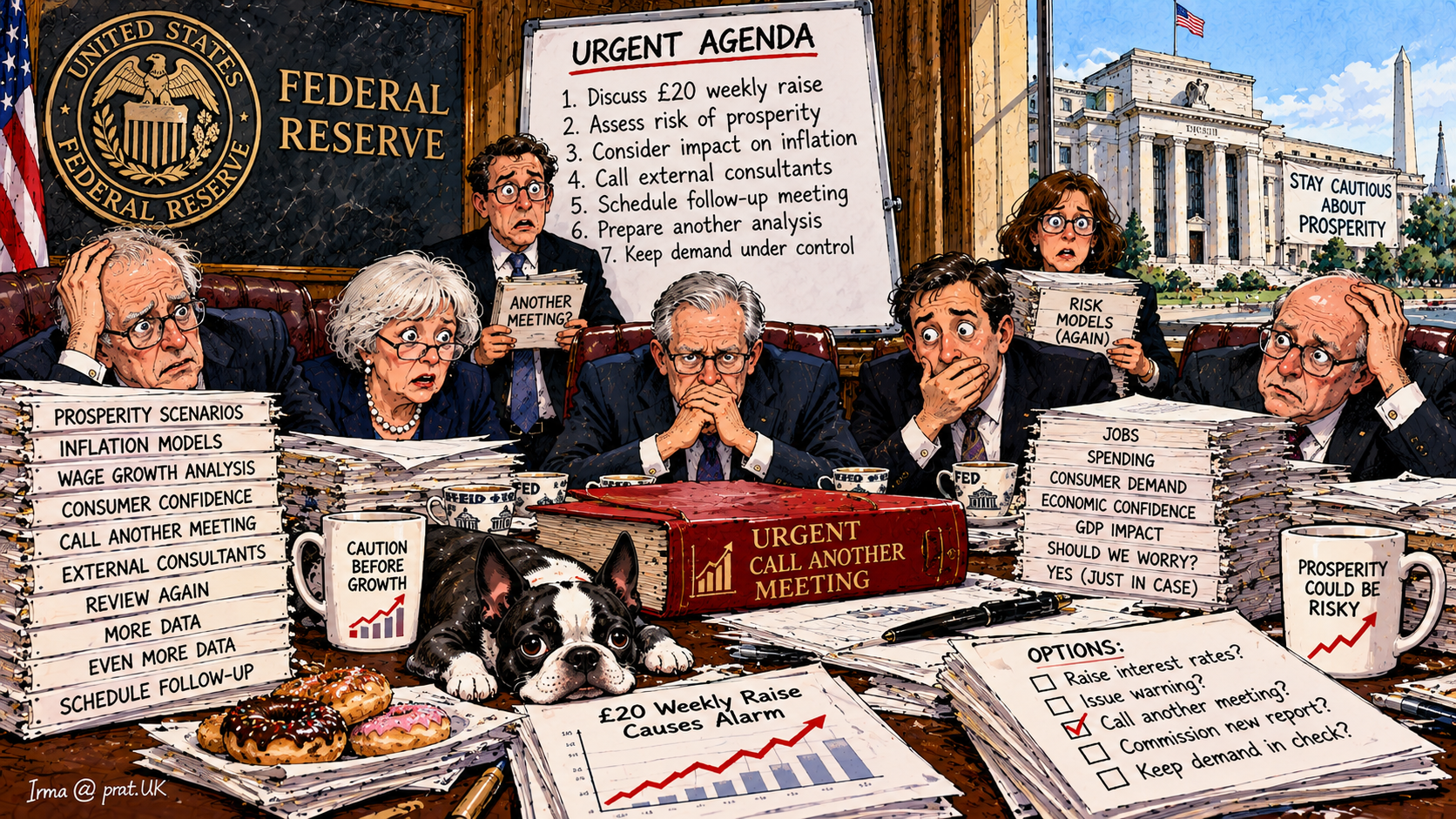
Federal Reserve Fears Prosperity
A $20 weekly raise has economists calling meetings.
WASHINGTON, October 24, 2026 — The Federal Reserve has identified a potentially catastrophic threat to the American economy: ordinary working people receiving enough money to improve their lives.
After years of inflation, expensive energy, punishing mortgage rates and declining purchasing power, the country’s monetary authorities are increasingly concerned that workers might demand compensation for the inconvenience of becoming poorer.
According to the Bureau of Labor Statistics, consumer prices rose 3.7% over the 12 months through September, well above the Fed’s 2% target. Gasoline alone jumped 9.1% in a single month.
For workers, that means every paycheck buys a little less than the last one.
For central bankers, it means the disturbing possibility that somebody in Dayton might ask for a raise to cover it.
The Fed’s latest concerns suggest America has built an extraordinary system in which higher prices are an unfortunate international development, but higher wages threaten to become a domestic emergency.
Why the Federal Reserve Worries About US Wage Growth
The immediate controversy concerns the relationship between wages and inflation.
Fed officials have a standard way of describing this. Pay increases that outrun productivity, they explain, can become a risk to the inflation outlook.
The statement raises an obvious question.
What percentage of a pay increase would allow an American worker to buy groceries without making a central banker nervous?
Two percent? One percent? A laminated thank-you note from management?
Perhaps employers should distribute certificates announcing that employees have contributed to monetary stability by remaining poor.
The underlying economic problem is legitimate. Wage increases unsupported by productivity gains can contribute to persistent inflation, particularly when businesses raise prices to cover labor costs.
But the public presentation remains spectacular.
The price of gas goes up because of disruptions to international energy supplies.
The cost of trucking food rises.
Household utility bills increase.
A warehouse employee asks for enough additional money to cover these expenses.
Suddenly, the warehouse employee becomes the principal suspect in a national inflation investigation.
The Fed cannot drill additional oil, reopen shipping routes or negotiate peace in the Middle East.
It can, however, make borrowing more expensive for a guy in Columbus who wants to replace his water heater.
And that is the beautiful simplicity of modern monetary policy.
FOMC Holds the Federal Funds Rate at 3.50% to 3.75% as Prosperity Stays Suspect
At its July meeting, the 12-member Federal Open Market Committee voted 9–3 to keep the federal funds rate at 3.50% to 3.75%. Beth Hammack, Neel Kashkari and Lorie Logan each wanted a quarter-point hike.
The next interest-rate decision is scheduled for October 28.
Chair Kevin Warsh has declined to say which way it will go.
Officially, the committee is assessing inflation risks.
In practice, it resembles a temperance committee attempting to determine how much happiness the working class can safely consume.
A worker receives a pay raise.
“Most unfortunate.”
A worker buys a new television.
“Troubling demand pressures.”
A worker announces plans for a family vacation.
“Emergency meeting. Bring the charts.”
The Fed’s central dilemma is that America’s economy needs growth, investment and consumer confidence, but additional spending can also feed inflation if supply cannot keep pace.
In practice, the distinction between encouraging prosperity and restraining it has become so complicated that the Fed employs hundreds of PhD economists to explain why people must not enjoy too much of the prosperity everybody claims to be pursuing.
Ordinary people once believed economic success meant becoming wealthier.
Economists have since developed a more sophisticated arrangement: economic success means becoming wealthier at precisely the speed economists consider acceptable.
Exceed the approved speed limit, and the Fed may raise interest rates until your credit card balance persuades you to reconsider.
US Inflation Hits 3.7%: Are Workers Just Trying to Keep Up?
America’s annual consumer price inflation reached 3.7% in September 2026, up from 3.4% in August and above analyst forecasts. Core inflation, which strips out food and energy, came in at 2.6%.
Energy prices, particularly gasoline, have been the main driver.
This creates an intriguing sequence.
Energy becomes more expensive because of international conflict.
Businesses increase prices to reflect higher costs.
Workers ask for higher pay to compensate for those prices.
The Fed worries that wage increases might encourage businesses to raise prices again.
What Is a Second-Round Effect?
Economists call this a second-round effect.
It is a useful technical description, although it sounds suspiciously like the second round of an argument in which the working population has been instructed not to answer back.
The first round involves somebody increasing the cost of everything.
The second round involves workers requesting enough money to continue buying things.
The authorities are particularly concerned about the second round.
Apparently, the correct response to economic hardship is to absorb it quietly, preferably while producing more goods and services.
A fictional Treasury training manual could simplify the strategy considerably:
“Rising prices are complicated. Rising wages are dangerous. Rising taxes are necessary. Rising public dissatisfaction requires additional communications funding.”
No wonder economics is difficult to teach.
The public keeps insisting on including itself in the equations.
Is a 3.5% Raise Too Much for the Fed?
The Fed’s official position is that the 2% inflation goal is not negotiable. At Jackson Hole, Warsh described it as a “firm, fixed target.”
The concern reflects the relationship between wages, productivity and businesses’ pricing decisions, all tracked in the Employment Cost Index.
However, the language creates a wonderful spectacle.
How a 3.5% Raise Adds Up
A person earning $30,000 asks for a 3.5% increase.
That amounts to $1,050 a year before taxes.
Roughly $20 a week.
Twenty dollars!
Apparently, the financial architecture of the United States is so delicately balanced that giving somebody an extra $20 each week requires extensive modeling, a symposium in Wyoming and the possibility of higher borrowing costs for millions of people.
Meanwhile, the economy routinely absorbs enormous changes in energy prices, tariffs, government borrowing and international financial markets.
But Kevin receiving $20 extra is where the experts draw the line.
Kevin should have thought about monetary stability before asking to replace his work boots.
Is the American Economy Too Resilient for the Fed?
Even more astonishing is the possibility that the economy may be holding up better than the Fed would like.
Payrolls rose by 162,000 in August, according to the Bureau of Labor Statistics, and unemployment sits at 4.1%.
To an ordinary citizen, a job market that keeps adding jobs sounds encouraging.
To a monetary policymaker worried about persistent inflation, it can suggest that interest rates are not sufficiently restrictive.
This produces a remarkable new definition of success.
If businesses collapse, economic weakness is concerning.
If businesses survive, economic resilience may be concerning.
If consumers stop spending, demand is weak.
If consumers continue spending, inflationary pressure may persist.
The economy must therefore occupy an extraordinarily precise condition between doing too well and doing too badly.
Somewhere there exists a perfect American economy in which businesses make profits without raising prices, workers receive wages without spending them and consumers confidently buy absolutely nothing.
The Federal Reserve has spent considerable effort trying to identify that sweet spot.
It might be easier to find a parking space at the Pentagon.
Do Higher Interest Rates Fix the Cost of Living?
The most entertaining aspect of monetary policy remains its principal instrument.
When inflation becomes excessive, the Fed can raise interest rates to cool demand and restrain price pressures.
Higher borrowing costs can discourage spending and investment.
But they can also make life immediately more expensive for households carrying credit card debt, financing a car or shopping for a mortgage.
For somebody already struggling with rising bills, this can sound like a doctor treating a broken ankle by breaking the other one.
“Your problem is that expenses are too high.”
“Correct.”
“We have therefore decided to increase your monthly payments.”
“Will that make me wealthier?”
“No, but you should become considerably less enthusiastic about spending money.”
It is not that interest-rate policy has no economic justification. Controlling inflation protects purchasing power over time, especially for people with limited savings.
The comedy lies in the brutal mechanics.
The Fed cannot directly eliminate an international energy shortage, so it attempts to restrain domestic demand sufficiently to prevent the shock from spreading into other prices.
The household ends up paying more for borrowing because somebody thousands of miles away made oil more expensive.
And the central banker gets to call it a carefully calibrated response.
US Productivity and Pay: Work Harder, Earn Less, Stay Grateful
The deeper contradiction concerns productivity.
America needs higher productivity, greater private investment, technological innovation and stronger long-term economic growth.
Higher productivity can support rising wages without necessarily generating equivalent inflationary pressure.
This is the genuine route toward sustainable prosperity.
Yet the national conversation is dominated by managing the consequences of weak growth rather than removing the obstacles to stronger growth.
Workers are told to upgrade their skills, work more efficiently, embrace technology and improve output.
When they request higher wages, the discussion immediately returns to inflation.
The nation seems to want workers who behave like ambitious entrepreneurs but accept compensation like extremely patient monks.
It wants them to produce more, consume less, save more, borrow less and somehow stimulate economic growth without engaging in any economically disruptive activity.
Meanwhile, Washington continues to collect taxes, announce programs and promise that prosperity will eventually arrive.
A reasonable worker might ask whether the ultimate objective is prosperity itself or the endless professional management of its absence.
Inflation vs Prosperity: The Fed Promises Both, Eventually
There is an important distinction between inflation and prosperity.
Inflation is a sustained rise in the general price level.
Prosperity means people enjoying greater real purchasing power, economic security and opportunities.
The two are not identical. Higher wages supported by better productivity can improve living standards without causing a lasting inflation problem.
That distinction deserves far more attention than another round of warnings about the public’s dangerous appetite for adequate compensation.
America’s economic institutions should aspire to an economy in which workers earn more because they produce more, businesses invest because opportunities exist and consumers can afford ordinary comforts without attracting an emergency session of the Federal Open Market Committee.
Until then, the Fed will keep monitoring wage settlements with all the apprehension of a museum curator watching children approach an expensive vase.
An American worker wants a raise.
The Fed wants inflation under control.
Congress wants economic growth.
The employer wants higher productivity.
And everybody wants the worker to keep working while these difficult issues are resolved.
America has created an economic system in which the government celebrates prosperity, economists warn against it, businesses ration it and workers are expected to be grateful when it occasionally appears.
The Federal Reserve’s greatest fear may not be that the American economy becomes poorer. It may be that ordinary American workers become prosperous enough to stop needing economists to explain why they aren’t.
Five Humorous Observations on the Fed’s Wage Worries
- Twenty bucks a week. Twenty dollars. They flew people to Wyoming over twenty dollars. Kevin wants new work boots and the Federal Reserve needs a symposium, a keynote and a guy in a fleece vest talking about “labor market tightness.”
- The Fed says it’s “data dependent.” You know what that means? That’s the “I just need some space” of central banking. It’s not that they don’t know what they’re doing. They’ll tell you when they’ve decided to ruin your month.
- The economy’s too resilient. That’s a doctor looking at a guy who walked away from a car crash and saying, “Honestly, I’m a little annoyed you’re not limping.”
- They call it a “second-round effect.” Like boxing. Except the guy who started the fight, oil, left the building and he’s at the bar, and the only one still in the ring is you, holding a pay stub.
- Prices are too high, so the cure is to make borrowing more expensive. That’s a plumber telling you the pipe’s leaking, so he’s cranked the water pressure up to “send a message.”
Satirical Disclaimer
This article uses exaggeration, irony, parody and economic satire to criticize the apparent tension between controlling inflation and improving workers’ living standards. Real monetary-policy decisions, official statistics and attributed remarks are based on published reporting and Federal Reserve statements. The Federal Reserve does not literally oppose prosperity; its stated purpose is maximum employment and price stability. Comic dialogue, characterizations and exaggerated institutional behavior are satirical commentary, not reported statements.
This story is entirely a human collaboration between two sentient beings: the world’s oldest tenured professor and a philosophy major turned dairy farmer. The farmer remains puzzled that when milk becomes more expensive, economists worry about inflation, but when the dairy farmer asks to earn more money, economists worry about the farmer.
Research underpinning the satire: The FOMC voted 9–3 in July to hold the federal funds rate at 3.50% to 3.75%, with Hammack, Kashkari and Logan dissenting in favor of a hike. September consumer prices rose 3.7% year over year, with gasoline up 9.1% on the month. The next FOMC decision is scheduled for October 28.