

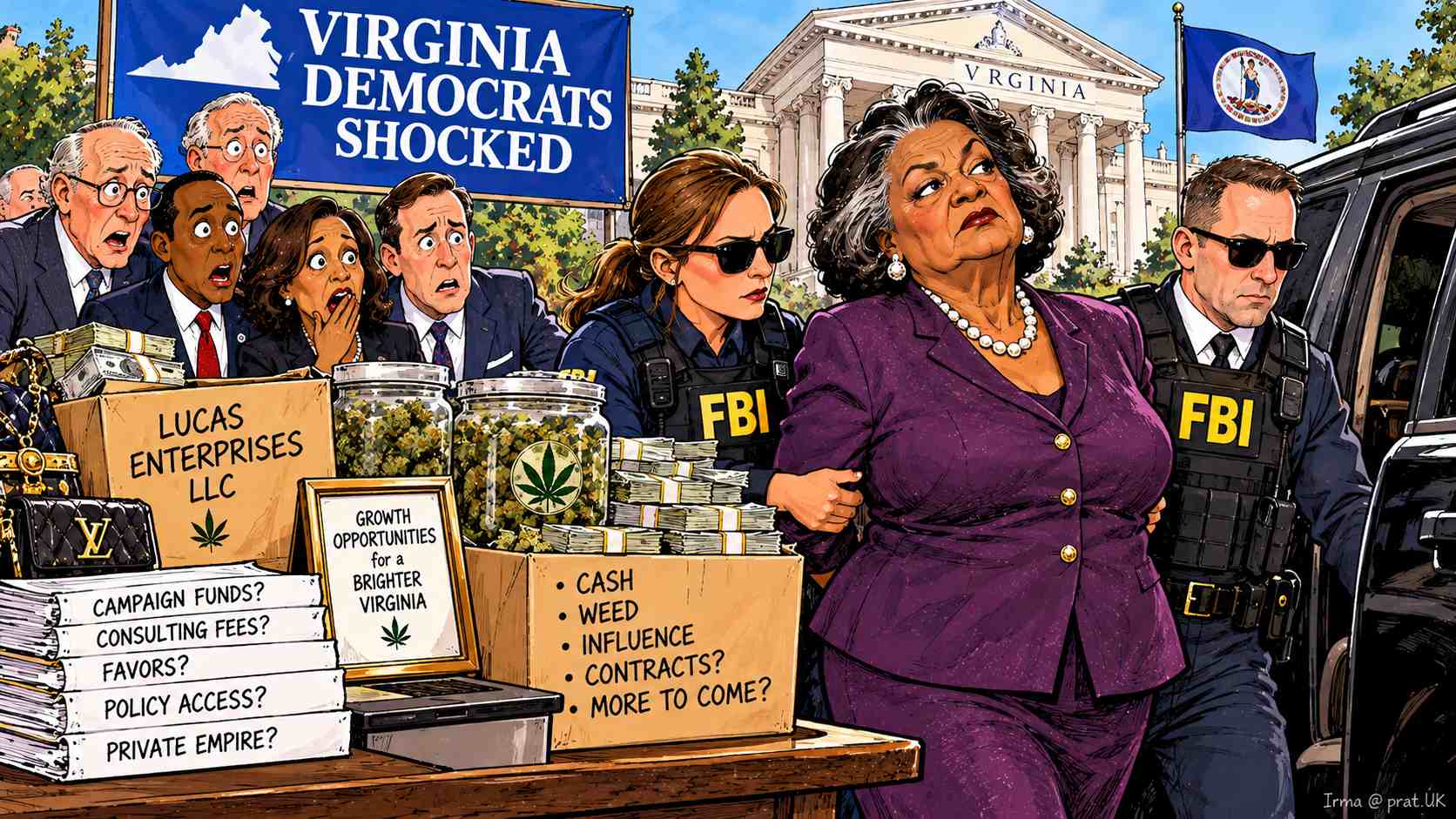
Party says redistribution was never meant to include grandchildren
PORTSMOUTH, VIRGINIA – Virginia Democrats are confronting an ideological emergency after powerful state Senator L. Louise Lucas was indicted in an alleged multimillion-dollar marijuana enterprise, raising the disturbing possibility that a politician dedicated to government spending might have discovered the advantages of accumulating money herself.
According to CBS News reporting on the federal indictment of Senator Louise Lucas, federal prosecutors accuse the 82-year-old Democrat of participating in a criminal enterprise involving marijuana distribution, money laundering, bribery and the alleged misuse of political influence.
The government estimates the alleged enterprise generated approximately $4.5 million over five years.
For Democrats accustomed to debating how much money government should collect and distribute, the allegations introduce a difficult philosophical question: what happens when a politician allegedly cuts out the government and distributes the money directly to her own family?
Wealth Redistribution Was Apparently Supposed to Go the Other Direction
Political economists distinguish between private wealth accumulation and government redistribution.
The distinction is straightforward.
Under government redistribution, politicians collect money from taxpayers and decide who receives it.
Under private enterprise, people make money by selling something customers actually want.
The allegations against Lucas describe a possible third model: a politician allegedly using public influence to assist a private business while holding a prominent position overseeing public finances.
Economists have provisionally named this arrangement capitalism with legislative accessories.
The Finance and Appropriations Committee Chair
Lucas chairs Virginia’s Senate Finance and Appropriations Committee, a post with substantial influence over government spending and taxation.
Federal prosecutors allege she also used that influence to benefit a marijuana business associated with her family.
This creates an obvious administrative problem.
Most Americans have to choose between operating a business and regulating it. The indictment alleges an attempt to save everybody the inconvenience.
Ordinary entrepreneurs must hire accountants, hire lawyers, interpret regulations and occasionally discover that the government has introduced seventeen new forms.
An entrepreneur who also sits in the legislature may have considerably more opportunities to discuss the forms before they’re printed.
Whether Lucas actually took advantage of that opportunity is a question for the courts.
Family Values Take an Entrepreneurial Turn in the Lucas Indictment
The indictment names Lucas’s two daughters, Lisa Lucas-Burke and Theresa Lucas-Lamb, and her grandson, Ryan Eichelberger, among the alleged participants.
In American politics, family values traditionally means supporting marriage, children, grandparents and Sunday dinners.
The allegations suggest prosecutors are investigating a considerably more ambitious family gathering.
Most grandmothers give their grandchildren birthday money.
Federal authorities allege this grandmother directed an organization involving the acquisition and distribution of at least 100 kilograms of marijuana.
That is more storage space than the average grandmother reserves for Christmas decorations.
Federal officials might reasonably wonder whether Thanksgiving conversations about the family business were more interesting than those in ordinary American households.
“How was school?”
“Fine.”
“How’s the business?”
“Grandma says don’t discuss business at the table.”
In fairness, families working together are a cherished American tradition. The legal question is whether that work violated federal and state laws, not whether grandchildren should help their grandmothers.
Justice Department Announcement Reveals the Government’s Most Profitable Department
According to the Justice Department’s October 22, 2026 announcement, prosecutors allege that Lucas and associates operated a marijuana distribution enterprise while seeking regulatory advantages.
The indictment also alleges attempts to influence legislation and obtain financial benefits through political connections, which prosecutors may eventually describe in terms of honest services fraud.
The contrast with ordinary government administration is hard to miss.
A government agency can spend $4.5 million studying whether a bridge needs another study.
The alleged Lucas enterprise, prosecutors contend, generated roughly that amount through commercial activity.
Virginia already maintains a Cannabis Control Authority to regulate marijuana, though its mission statement does not appear to include a family discount.
A fictional government efficiency commission reviewing the allegations would undoubtedly propose renaming the Finance and Appropriations Committee the Finance, Appropriations and Agricultural Entrepreneurship Committee.
The commission would then recommend a three-year feasibility study.
A second commission would investigate whether the first commission had been adequately funded.
By the time both finished their work, cannabis would probably have become legal, illegal and legal again under three different regulatory frameworks.
Socialism Meets Supply and Demand: Politics, Markets and Marijuana

Marijuana customers do not appear particularly interested in legislative committee structures.
They want a product.
Businesses want customers.
Politicians want regulations.
And occasionally, according to federal prosecutors, the interests of business and politics become rather too closely acquainted.
Supporters of free markets have long argued that entrepreneurs respond to consumer demand.
The alleged operation appears to have understood that principle.
Prosecutors contend it also ignored a few legal restrictions.
Capitalism, Crony Capitalism and Criminal Enterprise
Anyone considering a career in business should know the difference.
Capitalism means earning a profit by conducting lawful commerce. Crony capitalism means seeking political advantages unavailable to ordinary competitors. Criminal enterprise means the prosecutors have entered the conversation.
The American economic system accommodates the first, debates the second and generally brings handcuffs to the third.
Democrats Discover the Presumption of Innocence
Lucas has denied wrongdoing and described the prosecution as politically motivated.
Virginia Governor Abigail Spanberger has emphasized the presumption of innocence while questioning the timing of the charges near the November elections.
Those are legitimate issues. Federal prosecutors must prove their allegations, and a grand jury indictment is not a conviction.
Democrats who favor extensive public programs can certainly defend redistribution as legitimate policy.
They may find it somewhat harder to explain allegations involving a politician who allegedly preferred an unusually personal distribution network.
The distinction matters.
When government takes money from citizens and distributes it through authorized programs, politicians call it public policy.
When a politician allegedly uses public office to accumulate private wealth, prosecutors may call it corruption.
When taxpayers discover how expensive both arrangements can get, they generally call it Tuesday.
Virginia Announces Mandatory Ethics Training for Legislators
The entirely satirical Virginia Institute of Governmental Self-Restraint has proposed a mandatory course for legislators entitled Your Public Office Is Not a Business Development Opportunity.
Virginia’s actual Conflict of Interest and Ethics Advisory Council already offers conflict-of-interest training, so the institute’s curriculum would only need to be shorter and blunter.
It covers three principles.
First, government authority belongs to the public.
Second, family enterprises must obey the same laws as everyone else’s.
Third, the chairman of the Finance and Appropriations Committee should not read the word “appropriations” as an invitation to appropriate whatever looks profitable.
Participants who complete the training will receive a certificate, a commemorative pen and an explanation of the difference between constituent services and customer loyalty programs.
The institute is also developing a supplementary seminar called When Your Accountant Says Diversification, He Probably Doesn’t Mean Legislative Influence.
The American Dream Gets a Congressional Amendment
The allegations against Lucas remain unproven, and she is entitled to contest them in court.
But the story shows why Americans stay fascinated by the intersection of money, politics and government power.
For decades, politicians have promised to make the economy work for ordinary families.
Federal prosecutors now allege that one prominent politician may have been rather more successful at making an economy work for her own.
That is the contradiction at the center of this case.
Washington regularly celebrates the redistribution of wealth.
Virginia’s federal prosecutors are investigating whether a public official allegedly found a more direct route to prosperity.
The traditional American Dream says anyone can start a business, work hard and get rich.
The nightmare begins when somebody allegedly decides that public office should come with a private customer base.
The courts will determine what happened in Virginia.
Until then, politicians of every party might benefit from remembering one simple principle:
Public service is supposed to mean serving the public, not discovering that the public has accidentally financed your family’s business plan.
Five Humorous Observations
- Eighty-two years old, allegedly running a hundred-kilogram operation. I can’t get my grandmother to figure out the TV remote.
- She chaired the Finance and Appropriations Committee. Of course she did. The word “appropriations” is right there in the title. That’s not a job description, that’s a dare.
- “Don’t discuss business at the table.” Every family says that. Usually it means politics. These people meant the actual business.
- Government spends $4.5 million studying a bridge and the bridge is still just sitting there. This woman allegedly makes $4.5 million and at least somebody got something. Which one’s the scandal?
- Her grandson’s name is on the indictment. Meanwhile I once got grounded for borrowing the car without asking. Nobody told me family was a business model.
Satirical Disclaimer
This article is political satire based on reported federal criminal allegations. Senator L. Louise Lucas and her co-defendants are presumed innocent unless proven guilty. The invented organizations, hypothetical remarks and comedic scenarios are satirical commentary, not statements of actual events or verified quotations.