

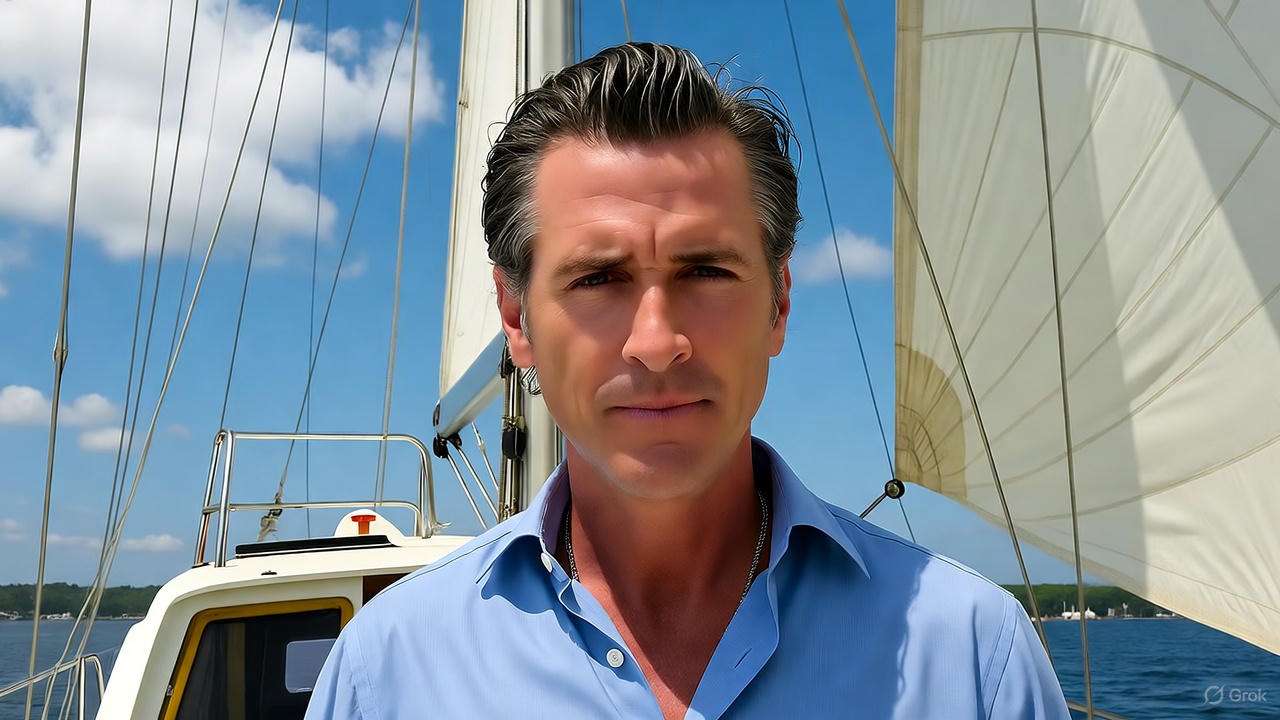
Gavin Newsom Recalls ‘Hard Childhood’ — Says He Only Had One Yacht and It Was a Sailboat
By the Bohiney Editorial Board | October 27, 2025
The Poor Prince of Pacific Heights
Governor Gavin Newsom has long described his upbringing as “humble,” a word that, in San Francisco society, translates roughly to “we only owned one home with a helipad.”

This week, during a campaign stop in Fresno—a city Newsom calls “the Paris of the Valley, but with almonds”—he recounted the hardships of his youth.
“I only had one yacht,” Newsom confessed solemnly. “And it was a sailboat. Manual labor every weekend.”
A hush fell over the audience. One woman dabbed her eyes with an organic kale leaf. The crowd, mostly Democratic donors wearing Patagonia and guilt, nodded sympathetically.
“I get it,” Newsom continued. “We struggled. Between Aspen and Napa, there were long, dark months when our ski season ended before our vineyard parties began.”
According to campaign aides, Newsom’s story is “a relatable American narrative,” though internal polling suggests only 3% of Californians have ever mourned a yacht depreciation.
“He’s the only guy who can talk about poverty while wearing a watch that costs more than a starter home.” —Ron White
Newsom’s Getty Family Connection Explained
Dr. Marvin Klein, an economist at Berkeley, recently released a 200-page study titled “Working Class by Association: The Newsom Paradox.”
In it, Klein concludes, “Gavin Newsom’s working-class identity is valid, provided we redefine ‘working’ as ‘networking at charity galas.'”
The governor’s father, the late Judge William Newsom, managed investments for billionaire Gordon Getty. “We worked hard,” Gavin said. “Dad was always stressed about where to park Gordon’s extra millions.”
Political historian Fiona Delgado notes, “The Newsoms were to the Gettys what the Kennedys were to the whiskey industry: loyal stewards of inherited confusion.”
According to research from the Stanford Center on Poverty and Inequality, elite family networks like the Newsom-Getty connection represent a critical factor in wealth perpetuation across generations—though rarely framed as “hardship” in campaign narratives.
How Gordon Getty Funded Newsom’s Career
The Getty connection goes beyond business. Gordon Getty financed Newsom’s first winery, PlumpJack, where Gavin reportedly “toiled” as a co-owner, personally tasting merlot until his tongue qualified for hazard pay.
“It’s like Seinfeld meets Robin Hood—if Robin Hood took from the rich and gave to the wineries.” —Jerry Seinfeld
Working Class by Association: The Berkeley Study
Sociologist Dr. Lacey Bloom explains, “For Gavin, economic hardship wasn’t about food insecurity. It was about menu fatigue.”
Her survey of “affluently challenged youth”—defined as anyone who’s ever felt emotionally oppressed by a butler—revealed that 84% “still feel trapped in wealth bubbles with bad Wi-Fi.”
“It’s easy to mock him,” Bloom said, “but let’s be honest: have you ever tried being photogenic for 40 years? That’s labor.”
From Aspen to Napa: Struggling Between Seasonal Transitions
Newsom’s memoir, Silver Spoon, Golden Hair: My Journey Through the Working Class, recounts a dramatic period in his teens when his family’s Aspen property underwent renovations.
“For two whole winters,” he writes, “we had to ski in Tahoe. The emotional toll was unimaginable.”
He describes learning empathy from “the working poor—the sommeliers, ski instructors, and junior hedge-fund managers” who surrounded him.
“I learned what real work was,” he told NPR. “Watching others carry my skis changed me.”
“You gotta love a man who fights for the little guy while standing on imported Italian leather.” —Amy Schumer
The 1992 Commercial Flight Incident That Changed Everything
The governor often cites “that dark day in ’92” when a scheduling mishap forced him onto a commercial United Airlines flight from SFO to Aspen.
“It was chaos,” Newsom recalled. “There was a crying baby, and no one brought me a sauvignon blanc. I thought, this is what struggle feels like.”
Passengers from that flight remember the incident vividly.
“I was sitting in coach,” said eyewitness Tina Velasquez. “He walked by, looked horrified, and whispered, ‘Do people actually sit here?'”
After that trauma, Newsom pledged to “advocate for working Californians,” starting with reforming airport lounges to include emotional support sommeliers.
Researchers at the Brookings Institution have documented how political candidates from privileged backgrounds often cite singular “hardship experiences” to establish working-class credentials—a phenomenon Newsom’s commercial flight trauma perfectly exemplifies.
PlumpJack Winery: Where Newsom Learned About “Real Work”
At PlumpJack Winery, staff recall the young Newsom’s management style.
“He was very hands-on,” says vintner Marco Alvarez. “Sometimes literally. He’d pat us on the back and say, ‘You’re doing great, Marco. I’m learning so much about work just watching you.'”
Another worker remembered Gavin’s dedication: “He’d visit the vineyards, nod solemnly, and say, ‘The grapes seem tired. They need a motivational speech.’ Then he’d drive off in a hybrid Maserati.”
“He’s not out of touch; the rest of us are just broke.” —Larry David
The Butler’s Testimony: Eye-Witness Account
In a rare interview, former family butler Reginald Davenport shared his memories:
“Master Gavin was a kind boy. Once, he tipped me a full 10%. On accident, of course. But the thought was there.”
Davenport also confirmed the governor’s version of events: “It’s true—the chardonnay was sometimes insufficiently chilled. Those were dark times.”
He paused, misty-eyed. “When the power went out during the Napa blackout of ’89, young Gavin had to swirl his wine by candlelight. That’s when I knew he’d go into public service.”
The $400 Hair Gel Investment Strategy
Fashion economists estimate Newsom’s hair-care budget rivals the GDP of Tonga. “That’s an investment,” says celebrity stylist Leandro Capri. “It’s the only thing holding California together—literally.”
Capri explains that Newsom’s iconic slicked style has evolved into a campaign symbol.
“Every strand says ‘competence,'” Capri claims. “Every glisten says ‘I’m approachable but I own vineyards.'”
When critics accuse Newsom of elitism, he cites his humble beginnings. “I grew up dyslexic,” he once said, “so I had to read the yacht’s name backward. That builds character.”
“Gavin’s like a Kennedy if JFK spent more time at SoulCycle than on policy.” —Bill Burr
Political Implications of Newsom’s Origin Story
Political analysts predict Newsom’s “rags-to-slightly-nicer-rags” story will play well in national primaries—provided voters don’t Google “Pacific Heights real estate values.”
Campaign consultant Rita Munoz says, “Gavin’s strength is his sincerity. He truly believes he struggled. That’s the magic.”
Others aren’t convinced. “It’s a tough sell,” says GOP strategist Ted Fowler. “How do you tell Ohio factory workers, ‘I understand your pain—I once had to sail my own boat’?”
The Pew Research Center recently published data showing that 76% of American voters consider authenticity a top priority in candidates—a metric that may prove challenging for politicians whose childhood hardships involve yacht depreciation.
Demographic Breakdown of the “Yacht Sympathy” Audience
According to Berkeley’s polling arm, the “yacht sympathy” demographic includes:
27% — Californians who consider a wine cellar “basic infrastructure.”
19% — Voters who think “poor” means “flying Delta.”
11% — People whose therapists specialize in “trust-fund trauma.”
43% — Everyone who ever looked at Newsom’s hair and thought, “He gets me.”
The report concludes that Newsom’s appeal rests on paradox: voters don’t believe he’s poor—they just admire his commitment to the bit.
Focus Groups Respond to Sailboat Symbolism
Focus group facilitator Karen Wu tested Newsom’s sailboat story with swing voters.
“We showed them the phrase: ‘I only had one yacht, and it was a sailboat,'” Wu explains. “37% laughed. 29% cried. 34% asked if the yacht was still for sale.”
One participant, a contractor from Bakersfield, said, “At least he’s honest about being rich. That’s more than most politicians.”
Another, a teacher from Sacramento, remarked, “If he’s this out-of-touch and still wins elections, maybe I’m underestimating hair products.”
Stanford Study on Wealthy Politicians’ Hardship Narratives
A team at Stanford’s Hoover Institution recently analyzed 200 years of political memoirs, comparing claims of hardship with actual wealth.
Lead researcher Dr. Raj Patel explains, “It’s like when you lose Wi-Fi during a Zoom call. For a few minutes, you understand true suffering.”
The study also compared Newsom’s hardship claims with those of other politicians. Results showed that while most candidates exaggerate poverty, Newsom’s scale of exaggeration “could power a small hydroelectric plant.”
“He’s a billionaire cosplaying as middle class. That’s not politics—that’s method acting.” —Chris Rock
The Philosophy of Chardonnay Suffering
Philosopher and Napa resident Dr. Helen Mott argues that Newsom’s pain represents a new category of hardship—”existential luxury trauma.”
“It’s when privilege becomes so excessive, it circles back into oppression,” Mott explains. “Imagine knowing the taste of 1982 Bordeaux, then being served a 1994. That’s suffering beyond the comprehension of the middle class.”
Media Reactions to Newsom’s Poverty Claims
Media outlets have scrambled to interpret the governor’s “poor yacht boy” narrative.
Vogue praised his “emotional transparency.” Vice accused him of “performative compassion with excellent posture.” Fox News ran a chyron reading: “NEWSOM CLAIMS POVERTY; OWNS MORE HAIR PRODUCTS THAN HOMELESS SHELTERS.”
From Vogue to Fox News: Coverage Across the Spectrum
Even the Guardian chimed in, noting that Newsom “embodies California’s struggle—progressive ideals powered by private equity.”
Meanwhile, Le Monde described him as “un Kennedy avec un miroir de salle de bain.” (Translation: “A Kennedy with a bathroom mirror.”)
“This is a man who says he feels your pain while his accountant writes off the yacht as a business expense.” —Dave Chappelle
What This Means for California Politics
Historians note that Newsom’s narrative fits a larger American pattern: billionaires claiming bootstrap origins.
From Jeff Bezos reminiscing about his “garage days” (attached to a five-bedroom home) to Kim Kardashian recalling the “trauma of early fame,” modern elites have turned relatability into an art form.
Dr. Megan Lau, who studies political mythmaking, says, “Newsom’s story functions as moral theatre. He’s the messiah of moderation—persecuted by warm weather and photo ops.”
The Emotional Cost of Perfection
Friends say Gavin’s perfectionism is both gift and curse. “He spends 20 minutes picking a tie,” says former aide Carla Ruiz. “Then another 10 explaining how the tie represents working families.”
Ruiz adds, “He once asked if using a reusable cup could offset the optics of a $400 haircut. I told him, ‘Governor, optics left the room when your dog’s Instagram got verified.'”
“The man has more product in his hair than most people have in their retirement accounts.” —Trevor Noah
A New Kind of Empathy Politics
Despite ridicule, Newsom’s team insists his story connects with Californians who feel left behind.
Spokesperson Dylan Whittaker says, “The governor’s message is universal: no matter how rich or photogenic you are, you too can feel unseen.”
Whittaker adds, “He’s been through adversity. Dyslexia. Divorce. And a vineyard expansion delay due to supply-chain issues. That’s real pain.”
Public Reaction: The Empathy Index
Pollster Leo Fenton notes that Newsom’s “relatable struggle” strategy may actually work.
“In 2025, authenticity is a currency,” Fenton explains. “And in California politics, irony is gold-backed.”
According to his firm’s latest data: 48% of voters said they’d support Newsom if he promised to tax his own hair gel. 32% said they’d consider voting for him “just to see what wine he’d serve at fundraisers.” 20% were too distracted by his teeth to answer.
“If wealth was a crime, this guy would be serving life without parole on his yacht.” —Ricky Gervais
The Future of Newsom’s Narrative
As national ambitions grow, Newsom’s team is reframing his story for broader appeal.
Campaign slogans tested include: “From Yacht to White House: The People’s Governor.” “He Worked Hard So You Could Too (Just Not at His Vineyard).” “Hair Today, Gone to Washington Tomorrow.”
Focus groups found the last one “inspiring, yet slightly threatening.”
“I’ve seen this movie before. Rich guy pretends to be poor, wins election, forgets where he parked his yacht.” —Jim Gaffigan
Deductive Reasoning and Cause-Effect Analysis
Let’s break it down logically:
Premise 1: Newsom claims he was poor. Premise 2: He had a yacht. Conclusion: Poverty now includes maritime assets.
By this reasoning, California should reclassify wealth tiers as: Landless Poor—Renters with no boat. Marine Poor—Owns sailboat, claims emotional hardship. Getty-Adjacent—Inherits sympathy and a trust fund.
Philosophical Reflection: The Meaning of “Poor”
Ultimately, Newsom’s tale forces Americans to confront a question: what does “poor” even mean anymore?
Sociologists say definitions have shifted—it’s no longer about material lack, but emotional absence.
By that metric, perhaps Gavin truly is poor: rich in everything but relatability.
As Dr. Mott puts it, “He’s a man who’s tasted every wine but empathy still eludes his palate.”
“He’s living proof that you can have everything and still complain about the service.” —Sarah Silverman
Conclusion: Chardonnay Tears and California Dreams
In a sunset press conference at the Getty Villa, Newsom summed it up poignantly:
“Growing up, I wasn’t privileged. I was provisionally privileged. There’s a difference. And that’s why I fight for Californians—so no child ever has to suffer through a room-temperature chardonnay again.”
The crowd applauded. Somewhere, a string quartet began playing “Imagine.”
And for a brief, shimmering moment, Gavin Newsom looked like what he’s always been—the perfect blend of politics, pomade, and performance art.
“At least he’s consistent. He’s been out of touch his whole life.” —Ali Wong
Disclaimer
This entirely human collaboration between a tenured professor and a philosophy major turned dairy farmer is for satirical and educational purposes only. All names, events, and quotes are used in parody and not intended as factual claims.
Auf Wiedersehen, amigos.