
Letitia James Schedules Cornell Trial for Christmas Before Reading Evidence, Says Santa Already Has a List
New York unveils revolutionary North Pole prosecution model in which evidence will be reviewed during convenient breaks between the office Secret Santa and closing argument
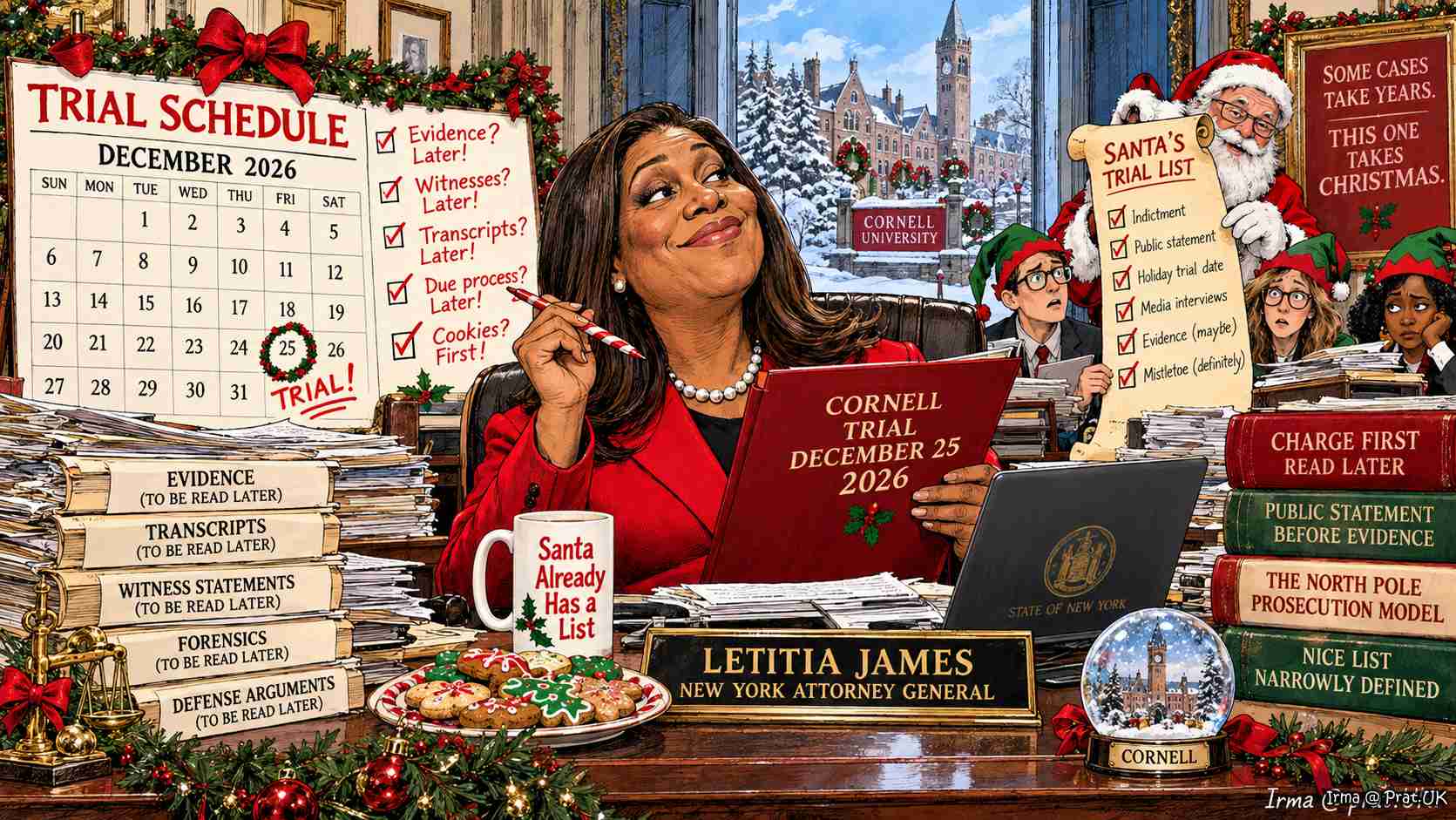
NEW YORK CITY — New York Attorney General Letitia James reportedly solved one of the most frustrating problems in criminal justice this week by scheduling the Cornell case for a Christmas trial before anyone had finished reviewing the evidence.
“Evidence takes time,” explained one Albany official. “Sleighs fill up.”
The breakthrough came after state officials realized that traditional prosecution contains several tedious steps, including interviewing witnesses, evaluating contradictory accounts, examining documents, determining whether probable cause exists, presenting evidence to a grand jury and deciding whether charges are actually supported.
Under the new James system, those antiquated obstacles have been streamlined into one question:
How does December 24 look?
The trial has reportedly been penciled in between a Medicaid fraud hearing and the attorney general’s annual office holiday party, directly after the fruitcake tasting.
Officials emphasized that the date remains tentative because nobody yet knows what charges might be filed, against whom, or based on what evidence.
“These are merely details,” said a source familiar with New York’s emerging philosophy of chronological justice. “The important thing is that everybody has blocked off Thursday and bought a sweater.”
Justice Moves Faster When It Knows Where It Is Going
- If the evidence is wrapped, it counts as a gift, and gifts cannot be admitted until the morning.
- A trial scheduled before the investigation is just a very expensive Advent calendar.
- The only witness who has been consistently available is the one in the mall with a beard.
- Santa checks his list twice. New York is reportedly considering checking it once, after sentencing.
Evidence Invited to Attend at Its Convenience, Cookies Provided
James assured reporters that her office intends to examine all available evidence thoroughly.
Preferably before jury selection.
But no promises.
“We will follow the facts wherever they lead,” James said in the imaginary press conference this satire has constructed for her, “provided they arrive before the court reporter and the eggnog.”
One aide reportedly placed the evidence on a shared Outlook calendar under the heading:
OPTIONAL: FACTUAL REVIEW
Another mistakenly clicked “Maybe.”
This has created concern among old-fashioned legal scholars who continue to insist that trials traditionally occur after investigations.
Those scholars were immediately accused of procedural nostalgia and, in two cases, of being Grinches.
“Why are lawyers so obsessed with sequence?” asked Professor Lester Benchwarmer of the Albany Institute for Reverse Jurisprudence. “Nobody complains that Christmas morning comes after Christmas. They just wake up and enjoy the results.”
Benchwarmer then admitted he is not actually licensed to practice law but noted that this has never prevented anyone from appearing on cable television.
New York Finally Defeats the Presumption of Chronology
For centuries, prosecutors have been trapped by something constitutional experts call chronology.
Chronology is the controversial theory that Event B should usually occur after Event A if Event B depends upon Event A.
For example:
First you investigate.
Then you decide whether to prosecute.
First you collect evidence.
Then you evaluate it.
First you determine what happened.
Then you announce what you think happened.
New York officials have now rejected this rigid framework as exclusionary toward government employees who prefer working backward, like a Christmas tree being decorated from the top down by a man standing on a very unstable chair.
Under the new model:
First comes trial.
Then comes indictment.
Then comes investigation.
Then, if necessary, somebody finds the police report under the wrapping paper.
By 2028, Albany hopes to introduce sentencing before arrest, saving taxpayers millions in unnecessary courthouse parking.
Jury Selection Begins With the Naughty-or-Nice Questionnaire
Potential jurors are already being screened.
The questionnaire reportedly contains only three questions:
- Have you read anything about the Cornell case?
- Have you formed an opinion about the Cornell case?
- Are you free on Christmas?
Anyone answering “yes” to all three will reportedly be considered exceptionally qualified.
One prospective juror expressed concern that no criminal charges had yet been established in the imaginary scenario and that the Sixth Amendment guarantees an impartial jury.
Court officials thanked him for his service and had him removed for excessive linear thinking.
Another juror asked what evidence would be presented.
“Excellent question,” replied the clerk. “We were hoping you’d bring some. Santa’s list is already in the record as Exhibit A.”
Defense attorneys objected that a list of the naughty and the nice has never been authenticated, has no known custodian, and is maintained by a man who admits he sees you when you’re sleeping.
The objection was overruled on the grounds that it was December.
Judge Kris Kringle Presiding, Docket Delivered by Sleigh
The court has reportedly assigned the matter to a bench widely admired for its holiday spirit, an arrangement that recalls the famous courtroom scenes of Miracle on 34th Street, in which New York put Santa Claus himself through a hearing.
That, it should be noted, was a movie, and the hearing at least involved some evidence.
Court reporters have been replaced by elves, who type faster, work cheaper and have no strong feelings about due process.
The NORAD Santa tracker has been entered into the record as the prosecution’s chain of custody. Nobody has asked what it tracks. It has a map, and juries like a map.
Prosecutors Praise Efficiency Before the Holiday Rush
Veteran prosecutors initially reacted with skepticism but gradually warmed to the concept.
One Manhattan assistant district attorney said scheduling the trial early could eliminate weeks of needless uncertainty.
“Normally we have to ask whether the evidence supports a prosecution,” he explained. “Now we can skip straight to wondering whether the prosecution supports the evidence.”
That distinction may sound subtle.
It is not.
In the first method, evidence determines the theory.
In the second, the theory merely waits politely by the fireplace while evidence is encouraged to become cooperative.
This is known as prosecutorial efficiency.
It is also how people assemble a child’s bicycle at 2 a.m. on December 25 after throwing away the instructions.
Discovery Process Simplified Into a Wish List
Defense attorneys were told that discovery materials would be provided “as soon as investigators discover them.”
This represents a major improvement over the old system, where prosecutors were expected to possess the evidence before disclosing it.
One attorney asked whether the state could identify its key witnesses.
The prosecutor checked the calendar.
“Not yet,” she replied. “But we have reserved a room for them and hung a stocking.”
Another asked whether forensic testing had been completed.
“No, but we’ve picked a holiday caterer.”
The court has reportedly ordered sandwiches and a ham.
This is reassuring because constitutional protections may be uncertain, but nobody should deliberate hungry.
Opening Statements Drafted With Helpful Blank Spaces
Prosecutors have prepared an early draft of their opening statement:
“Ladies and gentlemen of the jury, the evidence will show __________.”
The blank is considered legally strategic.
Assistant attorneys have been instructed to fill it in once the investigation provides something suitable.
If the evidence does not fit cleanly, the office may switch to a larger font or a festive one.
Defense lawyers are reportedly preparing their own opening statement:
“Ladies and gentlemen, apparently we have arrived before the case.”
That statement is only seven words long, making it the most efficient part of the proceeding.
Closing Argument Expected Before the Chestnuts Cool
Court administrators are particularly excited about the time savings.
The schedule currently reads:
9:00 a.m. Opening statements
9:25 a.m. Evidence, if available
9:40 a.m. Recess for cocoa
10:00 a.m. Additional evidence, subject to existence
10:45 a.m. Closing arguments
11:30 a.m. Verdict
Noon Sandwiches and ham
The judge has requested that sentencing conclude before 2 p.m. because the courtroom is booked for a live nativity and traffic violations.
Albany consultants estimate the new model could process seven major criminal cases per day, assuming nobody asks questions and Dasher stays in his lane.
Legal Experts Introduce ‘Pre-Discovery Discovery’
Supporters say the innovation should be called pre-discovery discovery.
This occurs when prosecutors schedule everything first, then discover what they are prosecuting.
It is similar to booking a honeymoon before meeting your spouse, or buying Christmas presents before learning who is coming to dinner.
Occasionally it works.
Usually somebody loses a deposit and receives a fondue set.
The concept has already attracted interest from government agencies nationwide.
The IRS is considering auditing taxpayers before they file returns.
The Department of Motor Vehicles may begin suspending licenses before drivers commit violations.
Airport security is studying whether passengers can be detained before purchasing tickets, eliminating lines entirely.
New York Public Strongly Supports Whatever It Just Heard
An imaginary statewide poll commissioned exclusively for this satirical article found that 63 percent of New Yorkers support “swift justice.”
When respondents were asked what swift justice meant, 81 percent replied, “I assumed you knew.”
Twelve percent wanted more evidence.
They have been placed on the naughty list and placed under observation.
Seven percent simply wanted the subway to work on Christmas Eve.
They were declared outside the scope of the survey and, honestly, outside the scope of reason.
The Evidence Finally Arrives, Wrapped and Unopened
Late Friday afternoon, several boxes of investigative material reportedly appeared at the attorney general’s office.
Staffers gathered around cautiously.
“What is it?” asked one.
“Evidence,” whispered another.
There was an uncomfortable silence.
Someone suggested opening the boxes.
A senior official reportedly objected.
“Before Christmas?”
The materials were therefore labeled DO NOT OPEN UNTIL VERDICT and placed beside the copier.
By Monday morning, someone had stacked catering menus, a tin of shortbread and a singing reindeer on top of them.
The reindeer remains the only party to the case that has stuck to its story.
Justice Moves Faster When It Knows Where It Is Going
The satire here is not about the seriousness of the underlying Cornell allegations. Those deserve careful investigation, credible fact-finding and fair treatment of everyone involved.
The joke is what happens when public officials appear too eager to reach conclusions before the machinery designed to test those conclusions has finished turning.
A prosecutor’s job is not supposed to be proving that yesterday’s opinion was correct.
It is supposed to be determining whether the evidence supports prosecution today. The presumption of innocence does not take a holiday, and neither should the standard of proof.
That distinction is irritatingly old-fashioned.
It is also fairly important.
Charles Dickens understood the danger of verdicts delivered before the facts were in. Ebenezer Scrooge needed three ghosts, a graveyard and an entire night of review before he reached his conclusion, and nobody called that inefficient. Read it again in A Christmas Carol. It is public domain, which is more than can be said for the Cornell evidence.
Still, New York’s hypothetical new system certainly saves time.
Why wait for the evidence when the courthouse has an opening at 10 and the sleigh is already warming up?
Holiday Docket Observations
- The presumption of innocence has been moved to a small table near the kids’ section.
- No one has located the chain of custody, but everyone has located the chain of command.
- Fruitcake remains the most durable evidence in the building. No one has ever disposed of it.
- The jury was told to avoid media coverage, which they will, because they are watching a Yule log.
Disclaimer
This is satire. Letitia James has not actually scheduled a Cornell criminal trial for Christmas, or any other date, before reviewing the evidence. The premise exaggerates concerns about prosecutorial prejudgment and impartiality for comic effect. The underlying sexual-assault allegations are serious, the accused are entitled to the presumption of innocence, and guilt or innocence should be determined by evidence and lawful process. Santa Claus, Judge Kris Kringle, the elves and the singing reindeer are fictional, as is Professor Lester Benchwarmer.
This story is entirely a human collaboration between two sentient beings: the world’s oldest tenured professor and a philosophy major turned dairy farmer, neither of whom has ever scheduled a trial before locating the defendant, or wrapped a present before locating the tape.
https://prat.uk/letitia-james-books-cornell-trial-for-christmas/