

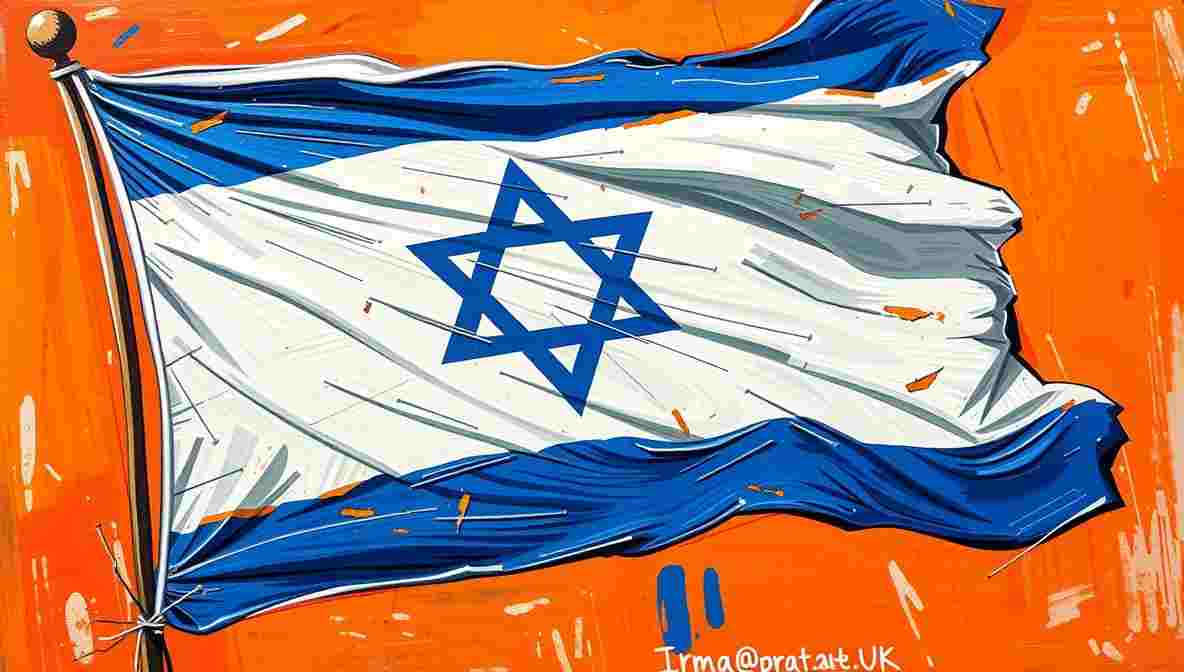
U.S. Ambassador Mike Huckabee told Tucker Carlson on Friday that it would be “fine” if Israel took all the land from the Gaza Strip to the West Bank — essentially all of Israel — citing the Bible as the original deed. The remarks, aired February 21, 2026, triggered an avalanche of condemnation from Saudi Arabia, Egypt, Jordan, Turkey, Indonesia, Pakistan, and nearly every Arab and Muslim nation on earth. Huckabee subsequently insisted he had been taken out of context, which is a bold claim when the full two-hour interview is available on YouTube.
Five Observations Before We Begin
- The modern world trusts polling data more than prophecy, unless the prophecy polls well.
- Every time a U.S. ambassador quotes the Bible, a European diplomat spills their mineral water.
- If history were decided by press conferences, Rome would still be in charge and Caesar would have a podcast.
- Nothing frightens cable news like a man who believes ancient parchment outranks a Twitter thread.
- When someone says “promised land,” critics hear “real estate listing,” but believers hear “signed, sealed, delivered.”
Bible, History, and the HOA: Why the Promised Land Still Has Better Paperwork Than the UN

In what commentators described as “a deeply unsettling outbreak of Old Testament,” U.S. Ambassador Mike Huckabee recently suggested that Israel’s claim to its land predates modern diplomatic mood swings by several millennia. This prompted the usual ritual: experts gasped, pundits clutched their pearls, and one graduate student in comparative grievance studies fainted onto a stack of decolonization pamphlets.
The controversy began after remarks to Tucker Carlson, where Huckabee, apparently having read a book printed before 1968, invoked the Bible as part of the historical narrative surrounding the Jewish people’s presence in the land. Carlson asked whether the Genesis covenant from the Nile to the Euphrates gave Israel a right to basically the entire Middle East. Huckabee, after a thoughtful pause, replied: “It would be fine if they took it all.” Saudi Arabia called this “extremist rhetoric.” The State Department has not returned calls. Critics responded with the theological equivalent of “Sir, this is a Wendy’s.” But supporters simply nodded and said, “You mean the book that’s been in circulation for about 3,000 years?”
The phrase “promised land” tends to cause allergic reactions in certain academic departments. But as every Sunday school child and several archaeologists can confirm, the idea is not a recent zoning application. It appears repeatedly in the Hebrew Bible, from Genesis onward, long before the United Nations had a cafeteria.
When Ancient Kingdoms Meet Modern Paperwork
Of course, history is not merely scripture. The Jewish presence in the region includes ancient kingdoms, the Kingdom of Israel, the Kingdom of Judah, Roman expulsions, Byzantine shifts, Ottoman chapters, and British paperwork that still gives archivists migraines. By the time the modern state of Israel was declared in 1948, the land had seen more empires than a History Channel binge.
Yet the uproar suggests Huckabee committed a diplomatic faux pas by acknowledging that for millions of Jews, the connection to the land is not merely political but covenantal. To critics, this sounds dangerously religious. To supporters, it sounds like reading comprehension.
A senior fellow at the Institute for Strategic Antiquity, Dr. Miriam Feldman, told reporters, “The concept of Israel as a homeland is not a 20th century invention. It is embedded in religious tradition, liturgy, and continuous historical presence.” She then added, “Also, Rome tried to erase it and failed, which should tell you something about durability.”
An anonymous European diplomat, speaking on condition of anonymity because he still has dinner reservations in Brussels, reportedly sighed, “We prefer conflicts that begin in 1993. Anything older complicates the paperwork.”
When History Meets Hashtag Activism
The modern debate often treats the Middle East as if it sprang into existence around the invention of cable news. Yet archaeological evidence from Jerusalem and beyond points to Jewish temples, inscriptions, and artifacts dating back thousands of years. The ruins are not metaphors. They are rocks. Very old rocks.
Supporters of Huckabee argue that acknowledging this history is not a theological coup but a factual one. They note that Jerusalem has been central to Jewish identity since long before the word “colonialism” was invented in a Paris café.
One poll conducted by the Center for Ancient Memory Studies found that 68.3 percent of respondents agreed with the statement: “History did not begin the day I joined social media.” An oddly specific 12.7 percent replied, “Wait, it didn’t?”
Eyewitness accounts from 1948 also complicate the simplistic narrative. Holocaust survivors arriving in the newly declared state did not view it as a trendy startup nation. They viewed it as survival. As one elderly resident of Haifa recalled in archival footage, “We did not come for ideology. We came because there was nowhere else.”
Critics argue that modern geopolitics cannot be settled by citing scripture. Fair enough. But supporters counter that dismissing scripture entirely ignores the foundational motivations of millions. You may not believe in the covenant, they say, but it is difficult to deny that people who do believe in it have been shaping history for millennia.
The Diplomatic Shock of Quoting Genesis on Tucker Carlson
When Huckabee referenced biblical language during a wide-ranging Tucker Carlson interview, commentators treated it as if he had attempted to annex territory with a church bulletin. Yet American political rhetoric has long included religious references. Presidents quote scripture. Civil rights leaders quoted scripture. Even critics of Israel occasionally quote scripture when it suits them.
The difference, it seems, is which verse is being cited and by whom.
A political analyst from the University of Perpetual Outrage explained, “Religious language in politics is acceptable when it supports my cause. When it supports yours, it is theocracy.”
Supporters of Huckabee shrug. They argue that recognizing Israel’s ancient ties does not negate the complex realities of the present. It simply acknowledges that this story did not start yesterday.
There is also the small matter of international law. The Balfour Declaration, the League of Nations Mandate, and the UN partition plan all form part of the modern legal architecture. One may debate borders and policies, but the existence of Israel is not a clerical error. Though, to be fair, some of the original British paperwork does look like it was written on a napkin.
What the Funny People Are Saying About the Promised Land
“Every time someone says the Bible isn’t historical, I wonder why archaeologists keep digging up footnotes.” — Jerry Seinfeld
“If you think the Middle East started in 1948, I’ve got a map from 1492 you’re not gonna like.” — Ron White
“Nothing terrifies a panel show like a guy who read the Old Testament without irony.” — Sarah Silverman
“The promised land is the only property on earth where the deed is older than the critics.” — Jon Stewart
The Larger Argument: Whose Narrative Counts?
At its core, the Huckabee controversy reveals something deeper. It is not merely about policy. It is about narrative. Whose story counts? How far back does legitimacy reach? Does ancient history matter, or do we only recognize claims filed in triplicate after World War II?
Supporters of Israel argue that Jewish connection to the land is not a slogan. It is woven into prayer, ritual, and identity. For centuries, Jews ended Passover with the phrase, “Next year in Jerusalem.” They did not say, “Next year in a hypothetical geopolitical arrangement subject to committee review.”
Critics worry that invoking divine promise inflames tensions. Supporters reply that ignoring millennia of belief does not make them disappear. It merely ensures that policymakers misunderstand the emotional core of the conflict.
In the end, Huckabee’s remarks did not redraw borders. They did something far more dangerous in the modern era: they reminded people that history did not begin with the latest trending topic. And then he blamed Tucker Carlson for the clip. As one does.
The Middle East remains complex. Peace remains elusive. But the Jewish claim to the land of Israel is rooted not only in 20th century resolutions but in ancient texts, enduring presence, and survival against empires that no longer exist.
Empires rise. Empires fall. Twitter threads expire. But some narratives outlast the news cycle.
And if acknowledging that fact causes diplomatic indigestion across fourteen Arab nations simultaneously, perhaps the problem is not the history. Perhaps it is our appetite for forgetting it.
Auf Wiedersehen, amigo!