
Nidal Hasan Discovers Army Has Finally Finished Processing His Extremely Negative Performance Review
Fort Hood mass murderer dreamed of becoming historic warrior, instead spends 17 years discovering United States possesses both due process and an astonishing quantity of paperwork
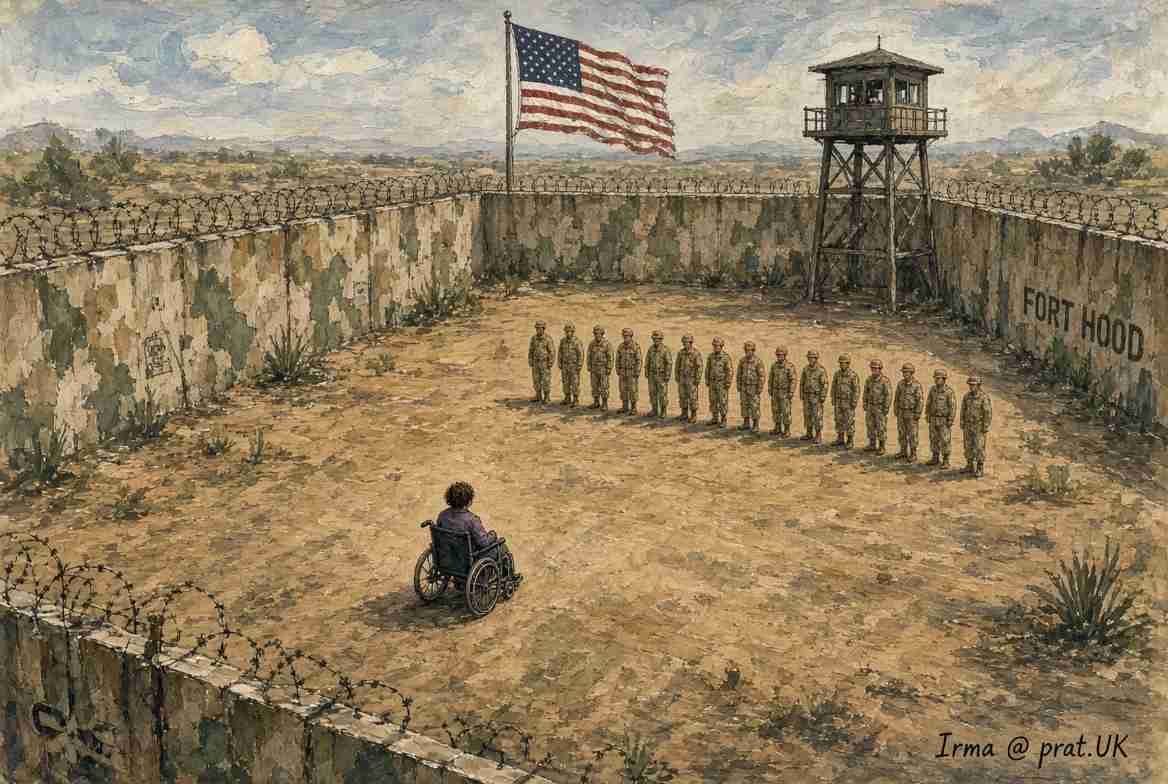
FORT HOOD, TEXAS — Former Army psychiatrist Nidal Hasan, who apparently pictured himself as the star of some grand ideological chapter in the history books, has been reminded that history filed him somewhere less flattering. The label on the folder reads “murderous fool who mistook slaughter for courage.”
President Donald Trump approved Hasan’s execution by military firing squad on October 5, 2026, as the Pentagon announced that evening. It follows his 2013 conviction on 13 counts of premeditated murder and 32 counts of attempted premeditated murder in the 2009 Fort Hood attack. The court-martial panel was unanimous on the death sentence, and according to the Army’s own account of the sentencing, it took them less than two hours.
So we’re looking at roughly seventeen years between the crime and the prospective punishment. That’s enough time to build an airport terminal, demolish it, hold three public consultations about the demolition, and then discover the original blueprints were filed under “Miscellaneous.”

Hasan reportedly framed the attack as retaliation for American wars in Muslim countries, which was supposed to lift the murder of unarmed people into some sophisticated geopolitical statement. It didn’t. This is the standing flaw of the terrorist imagination: everything becomes a historical epic inside the terrorist’s own head. Empires tremble, banners flutter, civilization gasps, and then reality walks in wearing sensible shoes and carrying a clipboard.
“Name?”
“Nidal Hasan.”
“Occupation?”
“Former Army psychiatrist.”
“Achievement?”
“Shot unarmed people.”
“Right. Cell’s down the hall.”
So much for Saladin.
Fort Hood’s Islamist Shooter Nidal Hasan
- Nidal Hasan spent 17 years waiting for the Army to finish his paperwork, proving military bureaucracy gets everywhere eventually, provided you pack several presidential administrations and a lunch.
- He apparently wanted history to remember him as a warrior. History remembers him as a psychiatrist who murdered unarmed people and then got shot by police, which is a lot less Lawrence of Arabia and a lot more “worst employee incident report ever filed.”
- Hasan was convicted of 13 premeditated murders and 32 attempted murders. That’s no military campaign. That’s a criminal résumé where every reference says, “Please never call us again.”
- The court-martial panel deliberated less than two hours before sentencing him to death. Apparently some government meetings can end before the sandwiches arrive.
- Hasan was an Army psychiatrist, which makes perhaps the strongest argument ever for occasionally asking the psychiatrist how he’s doing.
Fort Hood Shooter Nidal Hasan: The World’s Least Impressive Military Strategist
Hasan was a physician and an Army psychiatrist. Think about the road that took: medical school, residency, psychiatry training, years of taxpayer-funded professional development. After all that accumulated human knowledge, he landed on the breakthrough you’d normally credit to a drunk teenager throwing a patio chair through a Taco Bell window. Violence.
Centuries of philosophy, medicine, theology, diplomacy and political science were sitting right there on the shelf. He skipped straight to the chapter titled “Shoot People and Pretend You’ve Solved Foreign Policy.”
This is why terrorism deserves ridicule as well as condemnation. It runs on self-importance. Terrorists don’t just commit crimes; they badly need the rest of us to read those crimes as proof of enormous historical significance. They want the manifesto studied, the motive debated, the grainy photo laid under ominous documentary narration while historians murmur about “complex grievances.”
Sometimes the healthier response is just: no, you’re an idiot.
That takes nothing away from the horror the victims and their families lived through. It only strips out the grandeur the killer was angling for.
Hasan didn’t command an army, defeat an army or liberate a single square foot of anything. He attacked people at an Army installation and was stopped when law enforcement shot him. The FBI’s study of active shooter incidents counts 13 killed and 32 wounded at Fort Hood. Napoleon at Austerlitz it was not. It was homicide followed by handcuffs.
Army Court-Martial and Appeals: Even His Grand Cause Became Government Paperwork
After the murders came the legal system. Hearings, motions, a court-martial, appellate review, more filings, more proceedings, more years. Hasan wanted a war with America and got America’s administrative department instead, which might be the cruelest ideological defeat on record.
Picture expecting to become the face of a global revolution, then spending your years watching attorneys argue procedural questions while somebody in an office stamps RECEIVED across your file.
The Army sentenced him to death in August 2013. The punishment also included dismissal from the service and forfeiture of all pay and allowances, which adds a lovely bureaucratic flourish. Murderer, extremist, mass killer, and somewhere in payroll a clerk still had to confirm the direct deposit stopped.
Government can be slow. It does like to finish the form, though.
Military Due Process: America Gave Him the Trial He Denied His Victims
Here’s where Hasan’s historical fantasy falls apart completely. His victims got no trial, no appeal, no panel, no years of motions. Hasan got all of it.
America handed an accused mass murderer counsel, judicial proceedings, appellate protections and the full machinery of military justice. That isn’t weakness. That’s civilization showing off.
A man can reject civilization while civilization keeps treating him better than he treated anyone else. The contrast is almost embarrassing.
Lead prosecutor Col. Mike Mulligan put the key distinction plainly at sentencing, arguing that Hasan should be punished for his hate, not his religion. Exactly right. This was never about Muslims. It’s about one murderer.
Blurring Hasan’s extremism into ordinary Islam would hand him a victory he hasn’t earned, letting one homicidal fanatic appoint himself spokesman for millions of peaceful people who never elected the fool to anything.
He also represented himself at trial, which means that for once his lawyer and his client shared exactly the same judgment, and it was terrible.
Fort Hood Lessons Learned: The Military Took Notes. Hasan Took None.
The Department of Defense dug into the Fort Hood attack and flagged weaknesses around internal threats, information sharing and force protection. The review was published as Protecting the Force: Lessons Learned from Fort Hood, and the services spent the following years working through its recommendations.
That’s what a competent institution does after a catastrophe. It asks what failed, changes the procedures, tries to learn.
The fanatic does the opposite exercise, because learning would mean entertaining the idea that he is not history’s misunderstood protagonist. Normal people sometimes ask, “Could I be wrong?” Fanatics tend to ask, “Why hasn’t everyone else noticed how magnificent I am?”
Seventeen years in military custody have supplied a fairly thorough answer.
Firing Squad Execution Announcement: The First U.S. Military Execution Since 1961?
The U.S. military hasn’t carried out an execution since Private John Bennett was hanged in 1961. That means Hasan managed something genuinely difficult: he got Americans to reopen a procedural manual nobody had consulted since John F. Kennedy was president.
Somewhere there may be an Army binder whose first page reads:
FIRING SQUADS
STEP ONE: FIND SOMEBODY WHO REMEMBERS HOW THIS WORKS.
The Secretary of the Army will set the time and place. Until then, every appeal and every procedure matters precisely because Hasan decided his victims deserved none of them.
That’s the whole contrast in a sentence. The murderer acted on fanaticism; America answered with law. Hasan reduced human beings to targets, and the legal system kept treating even him as a person with rights. Call that moral superiority and you won’t get an argument here.
Terrorism After the Propaganda Soundtrack: Make Him a Symbol
Fine, let Nidal Hasan be a symbol. Just not of strength, devotion, resistance or heroism.
Let him stand for what terrorism looks like once you mute the soundtrack: a murderer in a prison cell, a failed ideologue waiting on lawyers, a self-appointed warrior whose most stubborn opponent for seventeen years was appellate procedure.
He chased historical greatness and ended up as a case study in government reports about institutional warning systems.
That’s how terrorism ought to be remembered, with contempt rather than awe, because nothing deflates a fanatic faster than refusing him the dignity he imagined for himself.
Hasan wanted the world afraid. Seventeen years on, the United States basically peered into a filing cabinet and asked, “Are we still dealing with this guy?”
Apparently so.
10 Humorous Observations About the Nidal Hasan Execution
- He tied his murders to opposition to American wars abroad. That’s the intellectual equivalent of protesting bad airline food by attacking the baggage carousel.
- He wanted ideological significance. He got seventeen years of lawyers turning his grand historical crusade into folders, appeals, docket numbers and administrative correspondence.
- The military hadn’t executed anyone since 1961. Hasan ran into a government waiting list so long that even the DMV whispered, “That seems excessive.”
- His trial strategy was remarkably thin. When your best legal argument sounds like “Yes, but allow me to explain my manifesto,” your attorney is probably browsing retirement property during recess.
- The prosecution said Hasan should be punished for his hate, not his religion. That distinction matters. Murderous extremism is the target here, not millions of peaceful people whose principal crime today may be arguing about parking.
- Hasan tried to turn cowardice into ideology. Unfortunately, ideology can’t perform the one miracle he needed: making the murder of unarmed people courageous.
- President Trump approved execution by firing squad on October 5, 2026. Somewhere in the federal bureaucracy, a printer presumably woke from hibernation and said, “WAIT, WE STILL HAVE THAT FILE?”
- The Army secretary will pick the time and place. After seventeen years, Hasan has finally reached the stage of government service where somebody schedules his exit interview.
- Hasan sought immortality. History gave the memorable parts to his victims, the survivors and the first responders, and left him as the cautionary footnote explaining why institutions should take extremist warning signs seriously.
- The central absurdity is that terrorists imagine they’re terrifying civilization. Civilization’s usual reply is to assign them an inmate number, lock the door and eventually go back to arguing about football.
Disclaimer
This is satire aimed at a convicted mass murderer and murderous extremist ideology, not at Islam, Muslims or any peaceful religious community. The factual backbone comes from reporting and official U.S. Army records; the jokes, the imaginary bureaucratic dialogue and the alleged conversations with government printers are satire.
This story is entirely a human collaboration between two sentient beings: the world’s oldest tenured professor and a philosophy major turned dairy farmer. Any resemblance to sober institutional dignity is purely accidental.
For authoritative background, see the U.S. Army’s account of Hasan’s conviction and death sentence and current reporting on the firing-squad decision.