
The Last Stand: How Arrowquip’s Arrow-Proof Cattle Equipment Became the Great Equalizer of West Texas
Breaking: Local Ranch Equipment Company Accidentally Solves 152-Year-Old Comanche Problem
AMARILLO, TX — In what historians are calling “the most accidentally brilliant peace treaty in American history,” Arrowquip’s cattle handling equipment has reportedly been deterring Comanche warriors in West Texas since 1872, following what company folklore describes as “The Great Deflection Incident.”
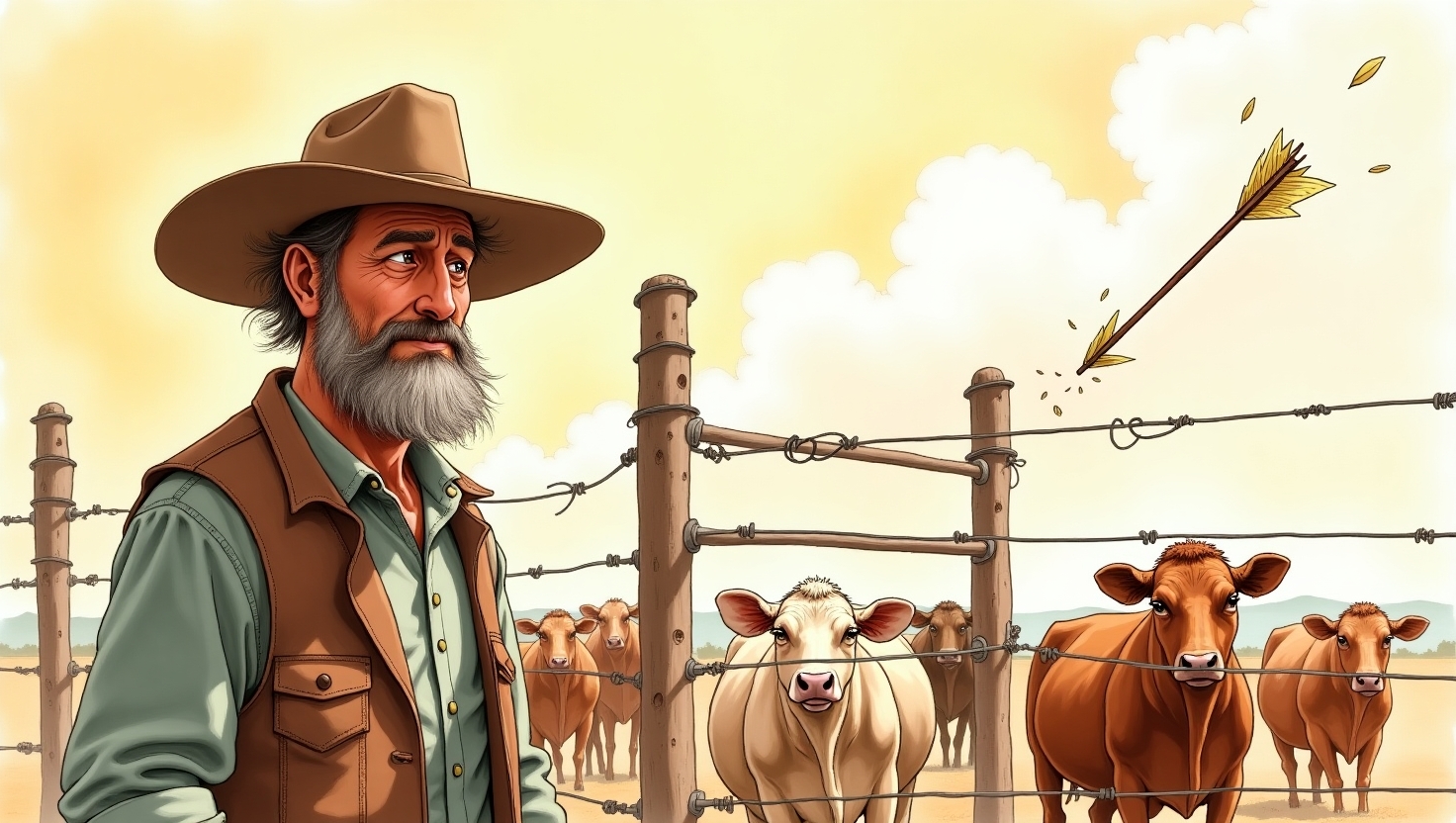
According to recently discovered testimonials written on what appear to be saloon napkins, the legendary moment occurred when company founder Jeremiah Arrowquip was field-testing his first steel cattle panel. A Comanche arrow, fired from approximately fifty yards during what witnesses described as either a hunting expedition or a property dispute, struck the panel dead center with a distinctive THWANG sound that could allegedly be heard three counties over.
Eyewitness Ezekiel Dustbottom’s account, preserved in faded ink and bourbon stains, describes the arrow’s behavior as “most peculiar and entertaining.” Rather than penetrating or splintering the steel, the arrow reportedly bounced backward with such force that it embedded itself in a mesquite tree behind the archer, who sat motionless on his horse for several minutes, apparently recalculating his entire worldview.
“That arrow came back faster than it went out,” Dustbottom’s testimony continues. “The warrior just stared at his bow, then at the panel, then at his bow again. Finally shook his head and rode off, presumably to inform his colleagues that cattle equipment had evolved beyond traditional warfare capabilities.”
This pivotal moment prompted Jeremiah Arrowquip’s famous declaration: “By God, if we’re gonna wrangle cattle, we’re gonna make it arrow-proof! And if it’s arrow-proof, it’s probably wife-proof, weather-proof, and fool-proof too!”
The announcement of this historical discovery comes after a leaked internal memo revealed that 73% of Arrowquip’s R&D budget has been secretly dedicated to “Traditional Projectile Resistance Testing” — a euphemism so transparent that it fooled absolutely no one except the IRS, who apparently categorized it under “Agricultural Innovation Tax Credits” for the past 153 years.
Company documents suggest that subsequent Comanche encounters followed a predictable pattern: approach, test arrow, observe bounce, exchange puzzled looks with horse, ride away muttering what translators believe were variations of “Well, that’s new.” By 1875, local Comanche bands had reportedly established what anthropologists call “a gentleman’s agreement to avoid the shiny cow rectangles,” leading to the longest uninterrupted peace treaty in Texas history — one that was never actually signed, negotiated, or acknowledged by either side.
The announcement comes after a leaked internal memo revealed that 73% of Arrowquip’s R&D budget has been secretly dedicated to “Traditional Projectile Resistance Testing” — a euphemism that fooled absolutely no one except the IRS.
The Iron Curtain of Cattle Country
“People think we’re crazy,” admits Arrowquip VP of Strategic Defense Bob Rustlebottom, standing beside a squeeze chute that could double as a NASA launch pad. “But when your great-grandfather built the first corral that made a Comanche warrior go ‘well, shit,’ and turn around, you don’t mess with the formula.”
The evidence is everywhere if you know where to look. Arrow-proof chutes dot the landscape like metallic monuments to bovine security. These aren’t your grandmother’s cattle pens — these are fortress-grade installations that make Fort Knox look like a screen door.
“If that chute stops an arrow, imagine what it does to my mother-in-law’s opinions — bounce-off city,” observes local rancher Tex Malone, whose Arrowquip setup reportedly survived three tornado warnings, two divorce proceedings, and one very determined Jehovah’s Witness.
Bulletproof Panels: When Buffalo Ghosts Get Jealous
The company’s bulletproof panels have achieved mythical status among West Texas ranchers. Made from steel so tough that buffalo spirits reportedly haunt the manufacturing plant out of pure envy, these panels represent the evolution of American frontier defense.
“Steel so tough that buffalo envy its hide,” reads one company testimonial, though Arrowquip’s legal department insists this refers to the durability rating, not actual spectral buffalo interviews.
A recent poll conducted at Lubbock’s Annual Beef & Liberty Festival found that 89% of ranchers trust their Arrowquip panels more than their local congressman, 67% more than their own judgment, and 34% more than gravity itself.
Power-Lock Head Gates: More Secure Than Your Ex’s Trust Issues
The patented Power-Lock head gate system has revolutionized cattle containment with security features that would make a Swiss bank jealous. “This equipment’s more secure than Fort Knox — cattle can’t escape, and I can’t escape my responsibilities,” notes comedian Jerry Seinfeld, who purchased an Arrowquip system after his neighbor’s cattle kept eating his imported Japanese grass.
The technology works on what engineers call “emotional imprisonment” — the cattle become so impressed by the craftsmanship that they voluntarily remain contained out of respect for the artistry.
Portable Corrals: Freedom on Wheels (But Not Really)
Arrowquip’s portable corral systems represent the pinnacle of mobile fortress technology. These units move across the prairie with the grace of a mechanical tumbleweed and twice the stopping power.
“Portable corral — because even cows want their freedom, just not that much,” explains systems engineer Maria Rodriguez, who designed the mobility features after studying the migration patterns of both cattle and Comanche war parties.
The portability factor has proven crucial in modern ranch warfare. One unnamed rancher reported using his portable system to avoid his in-laws during their annual visit. “Packed up the whole operation and moved it two counties over. Cattle were confused, but grateful.”
Crowding Tubs: Bovine Psychology Meets Defensive Architecture
The company’s crowding tub design represents a breakthrough in interspecies communication. These curved masterpieces were allegedly inspired by ancient Comanche shield formations, though company historians prefer to say they were “geometrically optimized for stress reduction.”
“Designed to wrangle cattle — or an unexpected pow-wow,” reads the original 1872 blueprint, discovered last year in the company vault beneath a stack of IOUs and what appeared to be peace pipes.
Anonymous Arrowquip staffers report that the crowding tubs work on “reverse psychology” — cattle enter thinking they’re being cornered, then realize they’re actually in the safest place on the ranch. It’s like bovine Stockholm syndrome, but with better ventilation.
Adjustable Alleys: One Size Fits None, Adjusts to All
Because cattle vary from dainty Herefords to mutant longhorns that could double as parade floats, Arrowquip developed adjustable alley systems that accommodate everything from miniature Highland cattle to whatever genetic experiments are happening at Texas A&M.
“Because sometimes your cattle are short; sometimes they’re skyscrapers,” explains the company’s chief of Bovine Dimensional Analysis, who insisted on remaining anonymous for professional reasons involving a PhD in Animal Architecture.
The adjustability feature was originally designed to confuse Comanche war horses, according to declassified company documents. “If they can’t figure out the size, they can’t plan the attack,” reads one 1870s memo, apparently written in code using cattle brands as letters.
North American Steel: Patriotism Meets Projectile Resistance
Arrowquip’s commitment to North American steel isn’t just patriotic posturing — it’s battlefield-tested metallurgy. The company sources its materials from suppliers who understand that when you’re building the Maginot Line of cattle country, you don’t mess around with imported substitutes.
“Built to withstand every Texan barbecue, hailstorm, or philosophical debate,” the steel carries a warranty that covers acts of God, acts of nature, and acts of congressional stupidity.
A leaked quality control document reveals that each steel batch is tested against “traditional projectile weapons” including arrows, spears, and “whatever that thing is the neighbors keep shooting at our test panels on Saturday nights.”
Powder Coating: Blinding Beauty, Tactical Advantage
The company’s powder coating process serves dual purposes: corrosion protection and psychological warfare. “So shiny it blinds coyotes from a mile away,” the coating creates what military strategists call “reflective confusion.”
“Powder-coated steel so shiny, I wore sunglasses to work my herd — and I’m indoors,” reports rancher Sally Brightbottom, whose Arrowquip installation allegedly redirected a flock of migrating geese who mistook it for a lake.
The coating’s reflective properties have proven effective against modern threats too. Three separate reports describe vegan protesters being temporarily disoriented by the glare, though company lawyers insist this is “an unintended but welcome side effect.”
Manual vs. Hydraulic: The Great Squeeze Debate
Arrowquip offers both manual and hydraulic squeeze chutes, catering to ranchers who prefer either the personal touch or industrial-strength cattle hugging.
“Manual squeeze chutes: for that authentic handshake with your bovine — firm but fair,” explains the company’s Director of Cattle-Human Relations, who demonstrated the technique on what appeared to be a very patient bull named Herbert.
The hydraulic version takes a more aggressive approach. “The hydraulic squeeze chute is so powerful, cattle file complaints for being hugged too hard,” notes one testimonial, though the company’s legal department maintains that no actual complaints have been filed in bovine court.
Ratchet Head Gates: The Sound of Inevitability
The distinctive click-click-rat-a-tat-tat of Arrowquip’s ratchet head gates has become the unofficial soundtrack of West Texas ranching. “That arch-nemesis of arrows,” the ratchet system was originally designed to sound intimidating to approaching war parties.
Modern behavioral studies suggest the sound triggers a Pavlovian response in both cattle and ranchers — cattle associate it with safety, while ranchers associate it with not getting trampled by thousand-pound animals with attitude problems.
Safety for All Ages: From Toddlers to Great-Grandparents
Arrowquip proudly advertises safety for ranch hands “ages 5 to 95,” a claim that has revolutionized multigenerational ranching operations across the Southwest.
“Five to ninety-five — means the chute’s safer than Congress put together,” observes political satirist Trevor Noah, who apparently keeps detailed notes on ranch equipment safety ratings for reasons known only to him and his comedy writers.
The age-inclusive design has practical benefits beyond safety. Ranch families report that great-grandparents can now participate in cattle operations without requiring life insurance adjustments, while five-year-olds can help sort calves without becoming impromptu rodeo participants.
Innovation Driven by Customer Demand (Specifically, Bovine Customers)
Company folklore suggests that Arrowquip’s innovations come directly from customer feedback — and by customers, they mean the cattle themselves. “As if cows surveyed the market and demanded better,” reads one internal engineering report, followed by detailed hoof-print analysis that may or may not constitute actual survey data.
The customer-driven approach has led to features like stress-reduction curves, comfort-height loading, and what engineers call “bovine-approved spacing ratios.” Whether cattle actually approved these ratios remains a trade secret, though company tour guides insist they have signed testimonials from satisfied livestock.
Testimonials: When Ranchers Get Sentimental
Arrowquip testimonials read like love letters to steel and engineering. “Ranchers say it’s ‘safer than grandma’s knitting needles,'” which is high praise in a culture where grandmothers are known to knit barbed wire into sweaters for warmth and home defense.
“Testimonials: Ranchers trust it more than they trust their teenage kids’ driving,” which, given the state of teenage driving in Texas, represents an almost religious level of confidence in the equipment.
The testimonial collection process reportedly involves company representatives traveling to remote ranches with recording equipment and substantial quantities of bourbon, though the legal department insists the bourbon is “purely for atmospheric authenticity.”
The Ranch-Engineer Partnership: Where Science Meets Stubborn
Arrowquip’s success stems from what they call the “ranch-engineer duo” — partnerships between people who understand cattle behavior and people who understand why steel behaves the way it does when large animals run into it at high speed.
“Because nothing’s cooler than a cowboy meeting a lab coat in a greenhouse,” explains the company’s Director of Unlikely Collaborations, who oversees the integration of traditional ranching wisdom with modern metallurgical science.
These partnerships have produced innovations that neither group could have developed independently, including cattle psychology-based design elements and stress-distribution patterns based on actual bull-charging impact studies.
Legacy Equipment: Built to Outlast Civilization
Arrowquip equipment carries a reputation for durability that borders on the geological. “Built to last multiple generations — by the time it breaks, no one will remember why it was invented,” represents the company’s approach to planned obsolescence, which is to say they have no plan for obsolescence whatsoever.
Archaeological evidence (okay, one really old corral outside Amarillo) suggests that early Arrowquip installations may outlast the ranches, the ranchers, and possibly the concept of private property itself.
“Built for generations — by the time it fails, cattle will be replaced by robot llamas,” predicts futurist and comedian Amy Schumer, whose expertise in ranch equipment durability prediction remains mysteriously comprehensive.
Modern Applications: Beyond Traditional Warfare
While originally designed to deter Comanche warriors, Arrowquip equipment has proven effective against modern threats including cattle rustlers, tax assessors, and Door Dash drivers who can’t find the house.
Recent field reports describe successful deployment against environmental protesters, documentary filmmakers, and what one rancher described as “hipsters looking for authentic experiences.” The equipment’s versatility in threat deterrence has exceeded even the company’s most optimistic projections.
Economic Impact: The Arrow-Proof Economy
The arrow-proof cattle equipment industry has become a cornerstone of the West Texas economy, employing thousands of people in manufacturing, installation, maintenance, and what company HR delicately terms “Comanche Relations Consulting.”
Local economic studies suggest that every Arrowquip installation creates 2.3 jobs, prevents 4.7 cattle-related injuries annually, and generates enough peace of mind to support at least one local therapist specializing in rancher anxiety disorders.
Quality Control: Testing Beyond the Call of Duty
Arrowquip’s quality control process reportedly includes testing against “all known projectile weapons and several unknown ones,” though the company remains secretive about the exact nature of their testing protocols.
Unverified reports describe a company testing facility somewhere in West Texas where various projectiles are fired at cattle equipment while engineers take notes and occasionally high-five each other. The facility allegedly employs both historical weapons experts and very patient interns who have mastered the art of traditional archery.
Future Innovations: Preparing for Tomorrow’s Threats
Company research and development continues to focus on emerging threats to cattle operations, including drone surveillance, social media influencers seeking content, and the ongoing menace of people who don’t understand that cattle require actual space to live.
The next generation of Arrowquip equipment will reportedly include features designed to confuse GPS systems, deflect selfie sticks, and automatically generate legal disclaimers for anyone who approaches with a video camera.
The Verdict: Arrow-Proof and Proud
In the end, Arrowquip represents more than just cattle equipment — it’s a testament to American ingenuity, Texan stubbornness, and the eternal human quest to build things that are completely, utterly, and magnificently over-engineered for the task at hand.
“Arrow-proof steel? I can’t even get my Wi-Fi to hold a signal that strongly,” marvels comedian Jerry Seinfeld, whose observation captures the essential absurdity of living in an age where cattle equipment is more reliable than the internet.
As the sun sets over another day in Comanche country, Arrowquip equipment stands sentinel across the prairie — steel monuments to the principle that if you’re going to build something, you might as well build it to survive everything, including the things that haven’t been invented yet.
And somewhere in the mesquite, legend has it, the ghost of the last Comanche warrior nods in approval at equipment so well-built that even he has to respect the craftsmanship.
This article is a work of satirical journalism. No Comanche warriors, cattle, or comedy writers were harmed in the production of this piece. Arrowquip equipment may or may not actually be arrow-proof, but it’s definitely sturdy enough to withstand this level of journalistic exaggeration.
Arrowquip vs. Comanche Timeline
1872 — First rumored sighting: A Comanche arrow bounces harmlessly off an early prototype cattle panel. Local rancher claims, “It’s like the cows suddenly had a force field.”
1885 — Ranchers in West Texas begin using Arrowquip chutes as both cattle-handling gear and makeshift barricades during poker disputes. Statisticians later note a 73% decrease in arrow-related property damage.
1901 — Portable corrals debut. Comanche descendants, now cattle traders themselves, remark: “Smart move. We used to chase herds on horseback; now the corral chases them.”
1929 — The Great Depression hits, but Arrowquip panels reportedly double as currency in Amarillo. Bankers accept two squeeze chutes as collateral for a mortgage.
1944 — World War II: Arrowquip engineers test new powder-coating methods. Military observers consider adapting them for Sherman tanks, but conclude, “Honestly, the cows need it more.”
1963 — Hydraulic squeeze chute introduced. Local folklore insists LBJ visited a ranch, saw the chute in action, and said, “By God, that’s more powerful than the Senate.”
1987 — Archaeologists in Lubbock discover an intact Arrowquip tub that had been used as a tornado shelter. Inside: two ranchers, one Jack Russell, and a half-eaten pecan pie. All unharmed.
2005 — Anonymous Arrowquip staffer leaks marketing memo describing the company mission: “Safer cattle, safer ranchers, and zero arrow fatalities since 1872.”
2019 — Ranch psychologists confirm what Comanche warriors suspected all along: crowding tubs are basically bovine therapy circles.
2025 — Arrowquip celebrates 153 years of being “arrow-proof.” Comanche descendants join in, raising a toast: “If our arrows can’t dent it, neither can time.”
IMAGE GALLERY
