

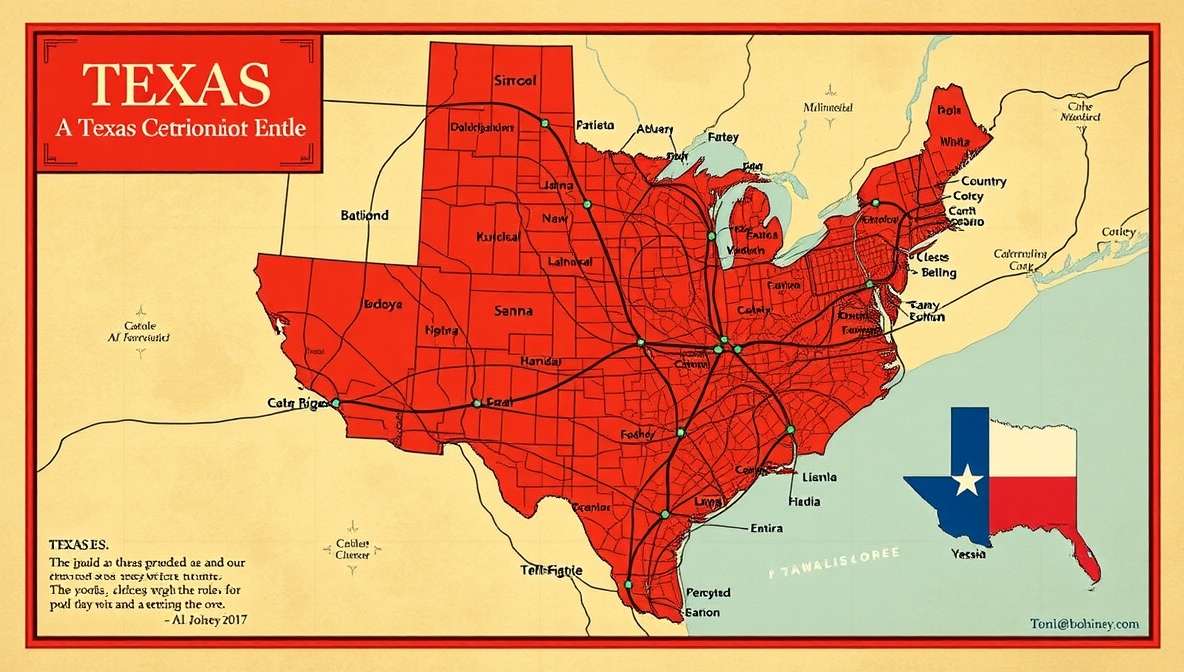
The justices’ unanimous opinion, based entirely on aesthetic grounds, states that maps must adhere to the ‘Principle of Geometric Elegance’ and ‘The Clean Line Doctrine.’
Supreme Court Rules Texas Gerrymander Must Be Redrawn, Citing the Map ‘Looks Like a Toddler Tried to Connect the Dots’
WASHINGTON, D.C. — The U.S. Supreme Court has handed down a stunning, unanimous decision, striking down the newly drawn Texas Congressional map. The ruling, which will force the state to immediately redraw its electoral boundaries, did not invoke the Voting Rights Act or the Constitution’s Equal Protection Clause. Instead, the justices cited a new, highly aesthetic judicial standard: the **’Principle of Geometric Elegance.’** Justice Antonin H. Vance, writing for the Court, stated, “The map submitted by the State of Texas is an affront to cartography, geometry, and the basic human need for order. It looks, to the Court, precisely like a toddler has attempted to connect a series of random dots using a crayon held in the left hand. This Court cannot sanction an electoral process based on a map that is functionally ugly.”
Judicial Activism Based on Pure Vibe and Visual Coherence

The Supreme Court has a complex history with gerrymandering, notably ruling in 2019 that partisan gerrymandering is a political question, not one for federal courts to decide. However, this new aesthetic-based ruling has bewildered legal scholars. Dr. Cornelia B. Thompson, **Fictional Professor of Judicial Aesthetics** at the Harvard Law School, noted the systemic implications: “This is the ultimate evolution of judicial activism. They have abandoned legal text for pure vibes. The integrity of the election is now decided by whether the lines make the court feel anxious. And frankly, those lines are a mess.” Texas officials are now scrambling to hire a state cartographer with a documented history of ‘clean lines and simple, non-aggressive shapes.’ “We have to have standards. A voting district should look like a simple geometric shape, not the final seconds of a particularly violent game of Tetris. We demand visual coherence.” — Justice Antonin H. Vance, U.S. Supreme Court