
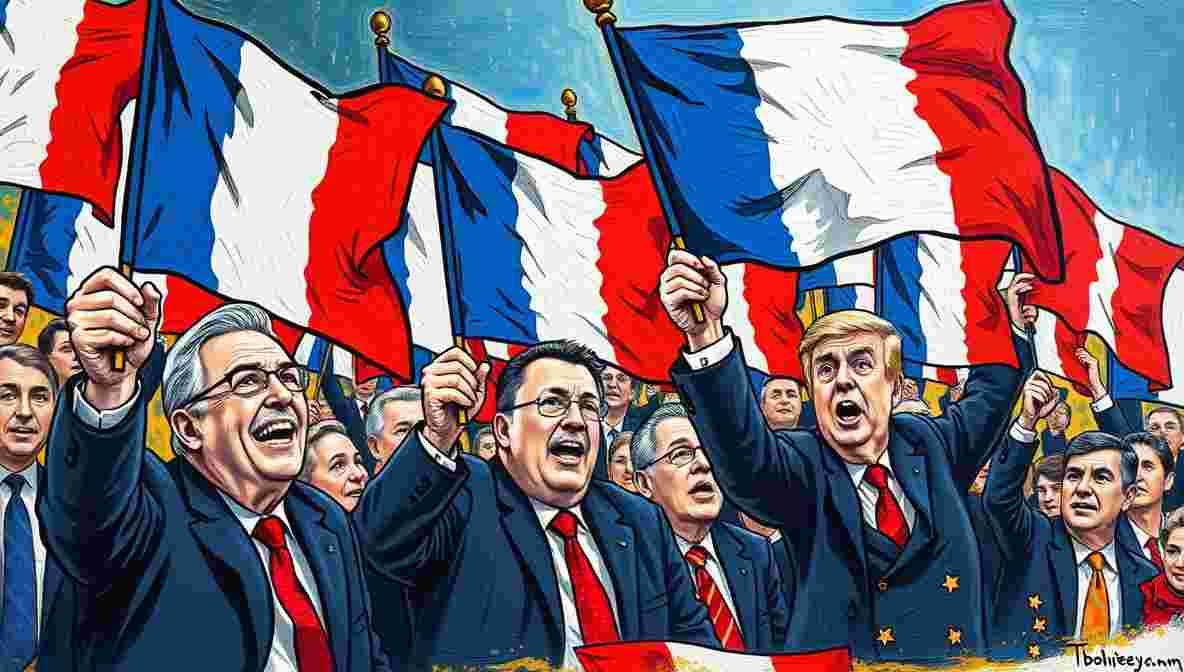
Macron Declares Victory After Successfully Not Losing Everything All at Once 🇫🇷
Macron’s “Stand in the Middle and Hope Everyone Else Trips” Strategy Shows Surprisingly Promising Results
PARIS — In what aides are calling “a masterclass in not completely imploding,” President Emmanuel Macron declared victory Sunday night after municipal election results confirmed that France had, against all odds, chosen to remain confused rather than catastrophic. Wine sales, at least, were unaffected.

According to a leaked memo from the Ministry of Strategic Shrugging, Macron’s re-election-adjacent strategy relied heavily on what insiders described as “geopolitical balance, domestic ambiguity, and the quiet hope that everyone else would faceplant first.” In Washington, several senior advisors reportedly took notes.
“It’s like musical chairs,” explained Dr. Claudette Baguette, a political scientist at the Sorbonne who once wrote a 600-page dissertation titled Standing There: The French Tradition of Elegant Indecision. “Except no one wants the chair, the music is Edith Piaf, and half the players are actively setting the room on fire.”
A poll conducted by Institut Très Spécifique found that 63.7% of voters described Macron as “not ideal, but less terrifying than the alternatives,” while 21% said they voted for him “accidentally while trying to skip the line.” The remaining 15.3% were on their fourth espresso and had strong feelings they could not yet articulate.
French Voters Reject Extremes, Then Immediately Threaten to Vote for Them Next Time
French voters, long known for their ability to hold two contradictory opinions with the grace of a wine glass mid-fall, rejected both far-right and far-left candidates in key cities. This was celebrated internationally as a triumph of centrist democracy and domestically as a mild inconvenience.
Within minutes, however, those same voters took to the streets, cafés, and aggressively intellectual group chats to warn that they would absolutely vote for those same extremes in the next election “if things don’t improve immediately.”
“It’s a warning shot,” said local Parisian Étienne Dubois, while smoking a cigarette with the intensity of a man arguing with existence itself. “We don’t want chaos. But we are prepared to choose it. Elegantly.”
Experts confirm this behavior is part of a long-standing cultural tradition known as La Menace Théorique, loosely translated as “the threat you don’t mean until you suddenly do” — and the French have been doing it since at least 1789, which is the last time it went really, truly, spectacularly well.
France Successfully Holds Election Without Setting Anything on Fire (Officially)
In a rare moment of national unity, officials confirmed that this election cycle concluded without any major public infrastructure being set ablaze — a benchmark that, in France, constitutes a rousing success.
“Officially,” clarified Interior Ministry spokesperson Lucien Gravel, pausing meaningfully. “There were… symbolic fires. Conceptual fires. A few emotional arsons.”
Eyewitness reports described several heated debates that reached temperatures high enough to “toast a baguette at conversational distance,” though the no actual baguettes were harmed, in compliance with France’s longstanding cultural protection statutes.
An anonymous government staffer added, “We’re counting this as a win. Last time, someone lit a recycling bin on fire because a mayor used the wrong font.” The font, sources confirm, was Comic Sans, and honestly, fair enough.
Paris Mayor-Elect Promises Affordable Housing, Immediately Googles “How”
In Paris, the newly elected mayor celebrated victory by announcing an ambitious plan to make housing affordable — a concept widely regarded as mythical, like polite Metro riders or a waiter who doesn’t judge you for ordering the house wine.
Within minutes of the speech, aides confirmed the mayor had opened a laptop and typed “how to fix housing crisis quickly??” followed by “define affordable.” The European housing crisis, apparently, was not in the briefing materials.
Urban economist Dr. Marcel Fontaine noted, “Paris housing operates on a simple principle: if you can afford it, you’re already suspicious.”
A recent survey found that the average Parisian apartment is now approximately the size of “a confident suitcase,” with rent priced at “your hopes plus utilities.” The survey was funded by a hedge fund that immediately bought four more buildings.
The National Consensus: Someone Else Is Definitely the Problem
In a breakthrough moment for national consensus, France achieved near-unanimity on a single issue: everything is someone else’s fault. Political analysts called it “the most French thing to happen since the invention of the shrug.”
“It’s the elites,” said a man in a beret.
“It’s the provinces,” said a woman in Paris.
“It’s Paris,” said everyone outside Paris.
“It’s globalization,” said a guy who sells imported cheese.
A bipartisan panel later confirmed that blame had been successfully distributed across all demographics, ensuring maximum dissatisfaction with minimal resolution — a governance model that, as Pew Research global polling suggests, is becoming increasingly universal.
Paris Elects New Mayor, Immediately Prepares to Complain About Him Professionally
Within hours of electing their new mayor, Parisians began lodging formal complaints, informal complaints, and artistic complaints expressed through interpretive sighing. The sighing, witnesses noted, was deeply nuanced and rhythmically impeccable.
“It’s nothing personal,” said café owner Brigitte Laurent. “Complaining is how we participate in democracy. Voting is just the appetizer.”
City officials have already scheduled a series of public forums titled Why This Is Already Disappointing, expected to run indefinitely, with a possible Netflix adaptation in development.
Socialists Win Big Cities, Promise to Fix Housing by Inventing New Cities
Socialist candidates celebrated victories in major urban centers by unveiling bold new housing strategies, including “expanding cities outward,” “building upward,” and, in one particularly ambitious proposal, “creating entirely new cities where rent is theoretically lower.”
Critics have questioned the feasibility of this plan, noting that previous attempts resulted in suburbs, which the French have historically treated as “a place you drive through while locking your doors emotionally.” The banlieue question remains, as it has for thirty years, a question.
Far-Right Underperforms in Cities, Claims Moral Victory in Towns With Three Goats and a Bakery
Despite underperforming in major metropolitan areas, far-right leaders declared sweeping success in smaller towns, particularly those described in official documents as “charmingly obscure” and in unofficial documents as “off the map, literally.”
“We have captured the heart of rural France,” announced one party spokesperson, gesturing toward a map featuring several dots and at least one smudge.
Local resident Jean-Pierre confirmed the victory. “Yes, we voted for them. There are six of us. And one goat who is politically undecided.”
The goat, reached for comment, declined to specify a party but expressed strong feelings about subsidy reform and the rising cost of hay.
Édouard Philippe Wins Again — Has He Ever Actually Stopped Campaigning?
Meanwhile, Édouard Philippe secured yet another win, prompting widespread realization that he has been campaigning continuously since the late 20th century, presumably surviving on mineral water and ambition.
“He doesn’t sleep,” whispered one aide. “He just refreshes.”
Historians are currently debating whether Philippe is a politician or “a long-term infrastructure project.” A bronze plaque is reportedly being considered.
French Democracy: The Art of Sustained, Elegantly Curated Disappointment
In the end, analysts concluded that French voters had once again chosen their preferred political state: mild, sustained disappointment — the democratic equivalent of a café au lait that’s slightly too cold but not worth sending back.
“It’s not happiness,” said Dr. Baguette. “But it’s stable. Like a chair with one slightly shorter leg.”
As the nation settles into its familiar rhythm of critique, contemplation, and carefully curated frustration, Macron stood before reporters and summarized the mood with characteristic precision:
“We did not lose everything,” he said. “And in France… that is victory.”
In fairness, it’s a better slogan than most.
What the Funny People Are Saying 🎤
“I love French elections. Nobody wins, everybody complains, and somehow the baguette still costs more.” — Jerry Seinfeld
“Macron didn’t win. He just didn’t get tackled by the other idiots. That’s not victory, that’s surviving a family reunion.” — Ron White
“France is the only place where people vote like they’re ordering wine. ‘I don’t love it, but it’s better than the last one.'” — Amy Schumer
“Democracy in France is just Yelp reviews for politicians, and every review starts with ‘Honestly…’ and ends with a sigh.” — Jon Stewart
This article is a work of satirical journalism, lovingly crafted as a human collaboration between the world’s oldest tenured professor and a philosophy major turned dairy farmer, both of whom agree that French politics is best understood with a glass of wine and a sense of humor. Any resemblance to actual competence is purely coincidental. Emmanuel Macron is the President of France, elected in 2017 and re-elected in 2022. The 2026 French municipal elections tested his centrist coalition against gains from Marine Le Pen’s Rassemblement National on the right and Jean-Luc Mélenchon’s La France Insoumise on the left. Édouard Philippe, former Prime Minister and mayor of Le Havre, remains one of France’s most persistent and polling-friendly political figures. French housing costs, particularly in Paris, have risen sharply over the past decade, making affordability a central electoral issue with few credible solutions from any political quarter.
Auf Wiedersehen, amigo!