

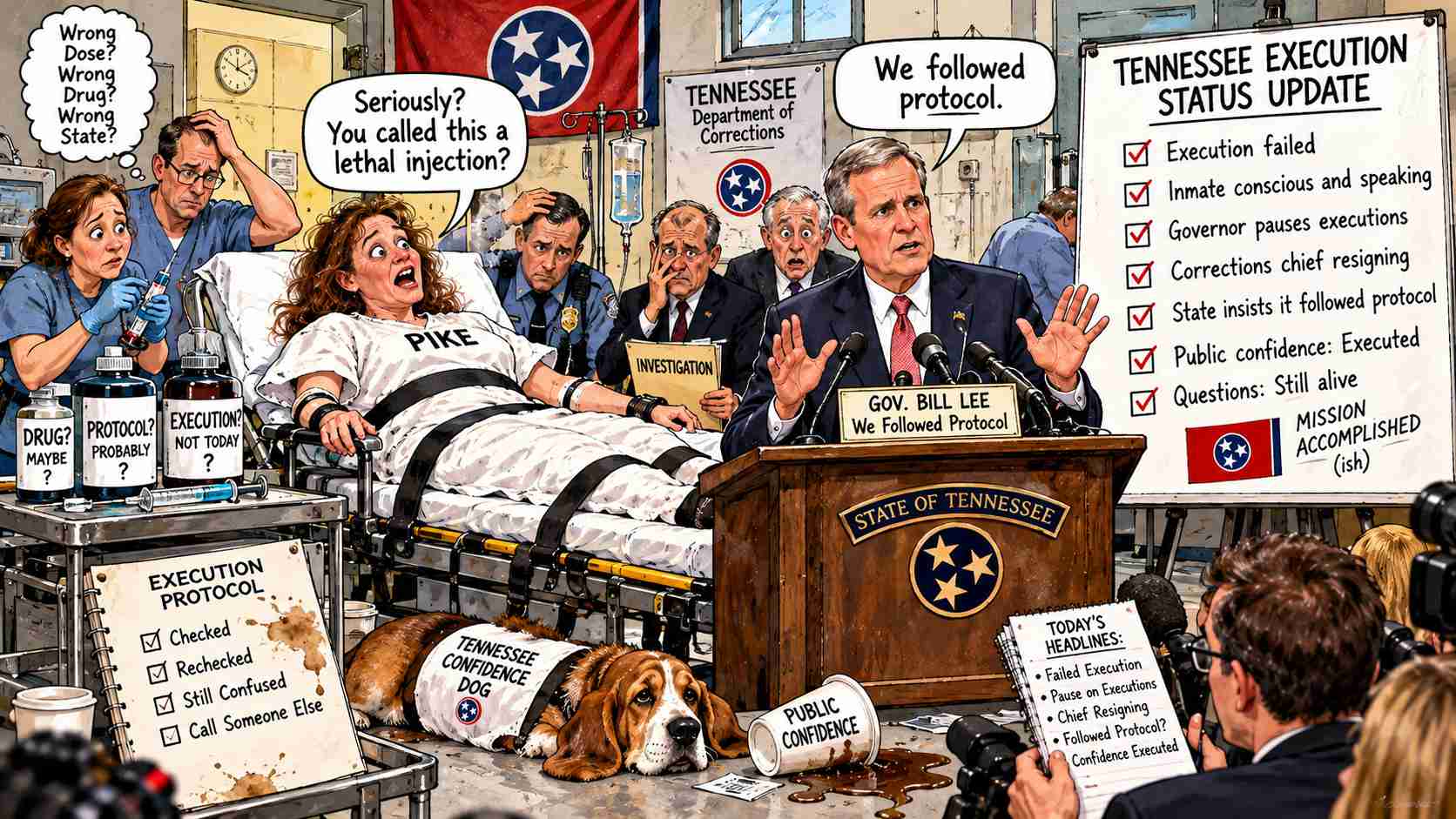
Tennessee Successfully Executes Confidence in Tennessee
Christa Pike’s failed execution has Gov. Bill Lee pausing executions, the corrections chief heading for the exit, and the state still insisting it followed protocol
NASHVILLE, Tennessee — Tennessee officials are investigating how an execution involving two lethal doses of pentobarbital ended with the condemned prisoner alive and hospitalized, an outcome generally considered undesirable in the execution industry.
Governor Bill Lee halted additional executions for the remainder of 2026 and ordered an independent review after Christa Pike survived the procedure. The state’s corrections commissioner, Frank Strada, subsequently announced his resignation.
That is a considerable amount of administrative movement for something officials initially suggested had been performed according to protocol.
Whenever government tells you, “We followed the procedure exactly,” there are two possibilities.
Either somebody did not follow the procedure.
Or you should become extremely interested in whoever wrote the procedure.
Tennessee appears determined to investigate both possibilities while avoiding the third possibility, which is that everybody involved arrived at work that morning after watching a six-minute YouTube tutorial titled LETHAL INJECTION MADE EASY: Five Mistakes Beginners Make.
What Went Wrong in the Christa Pike Execution: IV Access, Two Doses and an Ambulance
The execution attempt reportedly continued for more than an hour. Witnesses said Pike continued breathing and making sounds after the administration of the drugs. Her attorneys later said she arrived at the hospital with swollen, burned and blistered arms. Her legal team had also warned the state beforehand about the possibility of IV infiltration because of difficulties involving her veins and a blood disorder.
There is your first problem.
If anyone warns beforehand that putting drugs into somebody’s veins may be unusually difficult, and your entire plan consists of putting drugs into that person’s veins, that information should perhaps appear somewhere above “confirm parking validation” on the checklist.
Instead, America witnessed the extraordinary spectacle of a government administering drugs intended to end a life and then transporting the same person to medical professionals whose immediate job was to save it.
Imagine the ambulance conversation.
“What happened?”
“We gave her drugs.”
“Which drugs?”
“The fatal ones.”
“And now?”
“We need you to keep her alive.”
That is not a medical handoff. That is a philosophical debate traveling 65 miles an hour with the siren on.
Everybody Wants the Bottle: The Execution Drug Tampering Theory
Pike’s attorneys have sought preservation of evidence relating to the execution, including documents and information concerning the drugs themselves. The state says evidence is being preserved while investigators try to determine what happened.
This is where the tampering theory enters the room wearing sunglasses.
Nobody has publicly established deliberate tampering.
That matters.
But mystery loves secrecy the way barbecue loves smoke.
Execution drugs already occupy a strange procurement universe because many pharmaceutical manufacturers restrict their products from being used in executions. States have consequently faced increasingly complicated supply problems involving pentobarbital and other execution chemicals. Tennessee itself previously experienced disputes over testing, sourcing and execution procedures.
So when somebody says, “Could something have happened to the drugs?” the responsible answer is presently:
We do not know.
The internet’s answer is:
I HAVE CONNECTED SEVENTEEN RED STRINGS TO A PHARMACIST IN MEMPHIS.
This is why transparency matters.
If government refuses to explain where a mysterious chemical came from, who handled it, how it was stored, how it was tested and what happened after it entered the execution chamber, people begin behaving like detectives at a murder-mystery dinner where everyone has access to Facebook.
Soon someone notices the vial had been within 40 miles of a Prius.
Then we have motive.
The Protocol Apparently Survived Too: Tennessee’s Lethal Injection Protocol Under Scrutiny
The most magnificent phrase in the entire affair remains the state’s contention that it followed its lawful execution protocol.
That sentence belongs in the Bureaucratic Hall of Fame.
“We followed protocol” is government language for, “Please concentrate on the binder rather than what just happened.”
The Titanic probably had a procedure for deck chairs.
The Hindenburg presumably had paperwork.
The existence of a checklist does not become more impressive when the building behind the checklist is smoking.
Suppose a restaurant serves you a chicken that begins giving financial advice.
You complain.
The manager returns and says, “I checked with the kitchen. They followed our recipe exactly.”
You do not become reassured.
You become interested in the cookbook.
Likewise, if Tennessee’s lethal injection procedure was followed precisely and produced a living patient requiring emergency treatment, perhaps investigators should place the procedure itself under oath.
“Protocol, where were you on the evening of September 30?”
“Section 14, paragraph C.”
“Did you observe anything unusual?”
“I cannot recall without consulting Appendix Four.”
Capital Punishment Meets Supply-Chain Management: Pentobarbital Sourcing and Lethal Injection Problems
The deeper absurdity is that modern lethal injection was supposed to make execution appear clinical, predictable and controlled.
Instead it has occasionally produced something resembling a government software rollout.
The state wants a medical-looking process without ordinary medicine.
It wants pharmaceutical drugs without pharmaceutical companies enthusiastically supplying them.
It needs people capable of establishing IV access while many medical professionals operate under ethical restrictions concerning participation in executions.
It demands absolute reliability from a system constructed from components whose manufacturers may want nothing to do with the system.
Then everyone acts surprised when procurement begins looking like someone buying concert tickets through a man called Dave behind a bowling alley.
This does not establish that Pike’s drugs were compromised.
It establishes something more basic.
Investigators need to find out.
Questions the Pike Execution Investigation Must Answer
- What drugs were used?
- Where did they originate?
- How were they stored?
- Were they properly tested?
- Were the IV lines properly placed?
- Why did the first dose fail?
- Why was another dose administered?
- Why did officials apparently fail to recognize the infiltration problem?
These are not ideological questions.
These are questions normally asked whenever the government attempts to kill somebody and accidentally creates an intensive-care patient.
Tennessee Announces Bold New Policy: Find Out What Happened in Governor Lee’s Independent Review
Governor Lee deserves credit for ordering an outside review rather than merely announcing that the execution was “mostly successful except for the continued existence of the prisoner.”
Executions were halted for the remainder of the year.
This is government troubleshooting at its purest.
When the printer stops working, you turn it off and on.
When lethal injection stops working, apparently you turn capital punishment off until New Year’s.
The investigation should be exhaustive because there are several possible explanations, and none makes Tennessee look particularly comfortable.
If the drugs were defective, find out why.
If the drugs were mishandled, find out who handled them.
If IV placement caused the failure, explain why warnings about difficult access did not prevent it.
If protocol was inadequate, rewrite it.
And if somebody actually tampered with anything, investigators should identify that person through evidence rather than through somebody’s cousin posting a screenshot at 2:13 a.m.
That is the useful distinction between investigation and conspiracy theory.
An investigation begins with a mystery and looks for evidence.
A conspiracy theory begins with an answer and shops for accessories.
The State Has One Particularly Awkward Problem: Competence After the Colleen Slemmer Murder
Pike was convicted for the brutal 1995 murder of 19-year-old Colleen Slemmer. Nothing about the execution failure erases the horror of that crime or the suffering of Slemmer’s family. Her mother traveled to witness the execution and afterward expressed anger at how the state handled it.
That is precisely why competence matters.
Whatever someone’s position on capital punishment, the state cannot demand solemn respect for its judgment while performing that judgment with the technical reliability of a supermarket self-checkout.
“Unexpected item in bagging area” is irritating when buying bananas.
It becomes considerably more serious when the unexpected item is that the prisoner is still alive.
The state possesses enormous power.
With enormous power comes enormous paperwork, followed ideally by enormous competence.
Tennessee appears to have completed the paperwork portion.
Now comes the investigation.
And somewhere inside a locked evidence room, one bottle of pentobarbital is about to experience the most aggressive inventory audit in Tennessee history.
Satire Disclaimer
This article is satire based on a real failed execution and the subsequent investigation. No evidence cited here establishes that the execution drugs were deliberately tampered with; that possibility remains speculation unless investigators produce evidence supporting it. The jokes target institutional secrecy, bureaucratic failure, procurement problems and the extraordinary contradiction of a state execution ending in emergency lifesaving treatment, not the murder victim or her family.
This story is entirely a human collaboration between two sentient beings: the world’s oldest tenured professor and a philosophy major turned dairy farmer.
SOURCE: Washington Post: Christa Pike is conscious and speaking after failed execution, attorneys say
Sources and Further Reading on the Tennessee Execution Investigation
- NPR/WBUR: Tennessee governor pauses executions and orders investigation after botched lethal injections
- Al Jazeera: Tennessee prisons official resigns after Christa Pike’s failed execution
- CNN: Tennessee’s outgoing prison chief had a history of execution missteps
- Tennessee Lookout: Governor defends Correction commissioner in failed executions
- Tennessee Department of Correction
- Death Penalty Information Center