

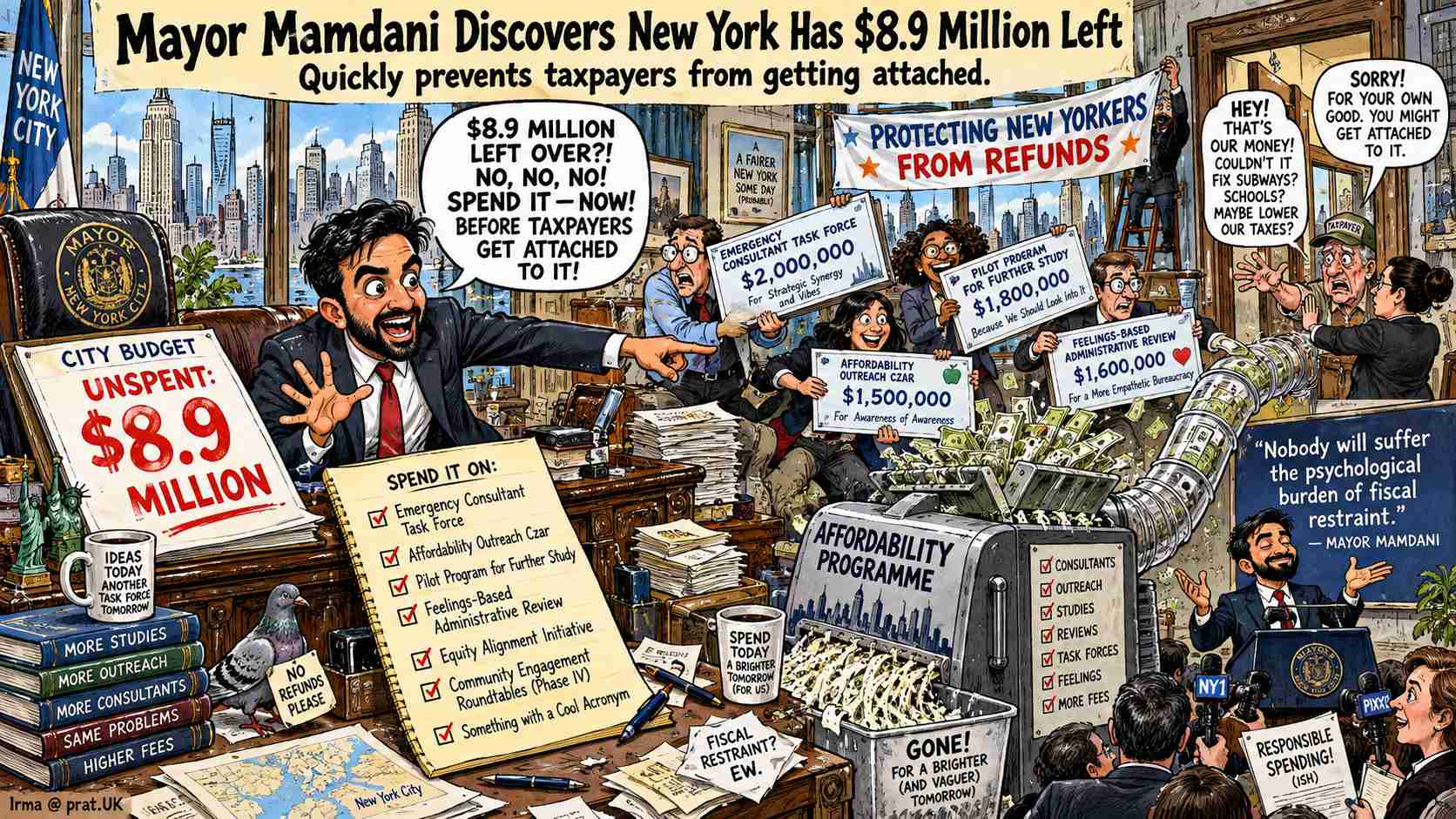
Mamdani Administration Discovers New York Has $8.9 Million Left, Quickly Prevents Taxpayers From Getting Attached
Mayor continues affordability programme by ensuring ordinary New Yorkers will never suffer the psychological burden of wondering what government might have done with their money
NEW YORK CITY — Mayor Zohran Mamdani’s administration has reportedly lined up two contracts totaling $8.9 million to fund gender-affirming care for minors from 2027 through 2029, which answers the question you can hear echoing across the five boroughs: “Good heavens, does New York City still have money?”
Apparently it does. Not anymore, obviously.
The contracts follow Mamdani’s June announcement of a broader $15 million city initiative to expand access to gender-affirming care for adults and youth. The newly reported agreements involve Callen-Lorde and the Nonprofit Organization for Philanthropic Initiatives, with treatment provided by licensed medical professionals under New York law, parental-consent requirements included.
It is a serious and intensely disputed medical and political issue, which explains why New York has handled it the traditional way: throw eight figures at it and wait for everyone to become reasonable. Nothing calms America down like a government contract.
Thinking About Moronic Socialists
- New York finally located something rarer than an affordable apartment: $8.9 million nobody at City Hall had spent yet.
- Mamdani promised affordability, and technically taxpayers can afford anything once City Hall removes the money from their possession.
- The controversy involves medicine, ethics, parents, federalism and children, so naturally government solved it with vendor contracts.
- Only New York could convert one of America’s fiercest cultural arguments into something requiring an invoice number.
- The city’s $125.8 billion FY2027 budget means $8.9 million is practically municipal pocket lint, assuming your trousers belong to Saudi Arabia.
New York City Budget Watch: How Mamdani Found $8.9 Million Between the Sofa Cushions

The most remarkable part may be that New York City located another $8.9 million at all. That takes talent. Finding spare money in city government is like finding an uneaten french fry underneath Donald Trump’s seat at McDonald’s. You knew it could theoretically happen, but nobody had actually seen one.
Then again, the city just adopted a $125.8 billion FY2027 budget, which helps explain why politicians develop a relaxed relationship with the number eight million. To an ordinary family, $8.9 million is wealth. To New York City, it is Tuesday afternoon. They probably found it sitting beside the stapler.
“Whose $8.9 million is this?”
“Taxpayers’.”
“Good. I was worried somebody needed it.”
Mamdani ran heavily on affordability, an intriguing concept because government defines it differently than the rest of us do. A civilian asks, “Can I afford this?” Government asks, “Can you afford this?” Completely different accounting system.
Gender-Affirming Care Funding Becomes a Procurement Problem
There is something uniquely New York about taking one of the most emotionally charged medical controversies in America and turning it into vendor management. The country is arguing about adolescent medicine, parental rights, medical evidence, federal authority, state authority, ethics and long-term outcomes. New York answered: “Fine. Who has the lowest compliant bid?”
That is bureaucracy’s superpower. You can walk into City Hall carrying a philosophical problem that has tormented civilization for centuries and walk out carrying Form NYC-473-B, Request for Reimbursement of Civilizational Torment. Socrates would have lasted nine minutes.
“Is virtue teachable?”
“Wrong window.”
“Where should I go?”
“Fourth floor.”
“What department?”
“Office of Virtue Procurement.”
“Do I need identification?”
“Two forms.”
“Then I know nothing.”
“Perfect. You qualify for management.”
Politicians, Medical Evidence and the Gender-Affirming Care Debate for Minors
The underlying medical questions are not imaginary political props. Treatment standards for minors are genuinely disputed. The Post notes that 27 states have enacted restrictions or bans affecting such care, some of them challenged in court. The American Medical Association has defended access to gender-affirming care, while the American Society of Plastic Surgeons has recommended delaying gender-related chest, genital and facial surgeries until age 19. Reasonable people can look at the same complicated evidence and land in different places on policy.
Fortunately, politicians exist. Politicians hold a fascinating medical credential called having won an election. One minute somebody is campaigning about rent. Six months later: “I have carefully reviewed endocrinology.” Really? You were shaking hands outside a subway station last October. Now you are Johns Hopkins with a MetroCard.
Republicans do this. Democrats do this. Everybody does it. The moment medicine turns political, every state legislator develops the confidence of a surgeon who has already scrubbed in. Nobody says, “This subject is complicated,” because that sentence polls terribly.
Government Spending Rebranded: Nobody Spends Anymore, They Invest
Government programmes also come with a peculiar linguistic camouflage. Nobody spends anymore. Government invests. That word is magnificent.
If I lose $400 at the racetrack, my wife calls it gambling. If the government loses $400 million on a programme, the press release calls it an investment in resilient community outcomes. Try that at home.
“Honey, where’s the vacation money?”
“I invested it.”
“In what?”
“Six bourbon-and-Cokes and a horse called Fiscal Sustainability.”
Government has perfected the trick. Taxes become revenue. Spending becomes investment. Debt becomes financing. Failure becomes a pilot programme. And when something works, government announces it needs seventeen times more money because success has created an urgent funding gap. That is the beauty of bureaucratic language: nothing ever costs money. It merely receives resources.
Mamdani’s Affordability Agenda and the Great New York Experiment
Mamdani’s administration has been busy expanding programmes across the city. Recently, City Hall announced free childcare for more than 10,000 low-income children, and earlier it announced a $43 million overhaul aimed at fixing childcare contracting and payment delays. For a sharper look at the gap between promise and delivery, Hell Gate asked where the $65 million campaign pledge went.
A pattern is developing. New Yorkers say, “Rent is expensive.” City Hall says, “Programme.” “Food is expensive.” “Programme.” “Childcare is expensive.” “Bigger programme.” “Taxes are expensive.” City Hall pauses. “That sounds like misinformation.”
The difference between ordinary people and municipal government is simple. Ordinary people think affordability means things costing less. Government increasingly thinks it means government paying for more things with money collected from people who say things cost too much. That is an economic Möbius strip. You can walk around it forever and eventually discover your wallet missing.
Our Completely Unscientific Survey of New York Taxpayers
Our survey consisted of asking imaginary commuters what they thought while they tried to enter a subway carriage already holding the population of Belgium. Thirty-seven percent said government spends too much. Thirty-seven percent said government spends too little. Twenty-five percent said, “Move inside the bloody train.” One percent had become trapped in the closing doors. That puts us within the traditional margin of error for municipal research.
A theoretical taxpayer from Queens named Eddie offered the clearest economic analysis. “I don’t understand government finance,” Eddie explained, buying a sandwich that now requires a home-equity loan. “But apparently if I spend more than I earn, Chase calls me. If the city does it, they hold a press conference.” Economists call this the Eddie Principle. I just did.
Federalism, New York vs. Washington, and the Accounting Code
The spending is also part of New York’s ongoing standoff with the federal government over gender policy, which is a dependable feature of American federalism. Texas sees Washington doing something and says, “Absolutely not.” California sees Washington doing something and says, “Absolutely not.” New York sees Washington doing something and says, “Absolutely not, and please find the accounting code for that.”
The founders gave us fifty states partly so we could run different political experiments. We have advanced considerably since. We now run fifty experiments at once and scream at one another about the control group. New York increasingly works as America’s laboratory for discovering whether every political disagreement can eventually become an appropriation. So far, the results are encouraging. For appropriations.
The Punchline: What This Policy Fight Really Needs Is Vendors
The serious debate will go on. Doctors will disagree about evidence. Parents will disagree about policy. Courts will consider statutes. States will keep pursuing dramatically different approaches, and medical organisations will keep reviewing data and recommendations. Politicians, meanwhile, will keep behaving as though nuance is an infectious disease contracted through prolonged exposure to footnotes.
But the comic principle is gloriously simple. New York City remains one of the few institutions that can look at an issue involving medicine, childhood, ethics, family autonomy, federalism and rapidly changing clinical guidance and conclude: “You know what this needs? Vendors.”
Somewhere in Manhattan, a taxpayer is staring at his rent bill, grocery receipt, transit costs and city taxes, wondering whether government understands how hard ordinary life has become. Relax. City Hall understands completely. That is why it has set up a department to study your concerns.
Initial budget: $8.9 million.
10 Humorous Observations on Mamdani’s $8.9 Million Gender-Affirming Care Contracts
The factual skeleton is wonderfully combustible. Mayor Zohran Mamdani’s administration announced a $15 million initiative in June to expand access to gender-affirming care, including youth care, and the New York Post now reports two contracts totaling $8.9 million, running from 2027 through 2029. The reported providers are Callen-Lorde and the Nonprofit Organization for Philanthropic Initiatives. The care is to be delivered by licensed providers and is subject to New York law, including parental-consent requirements.
- New Yorkers complain that groceries cost too much, housing costs too much and childcare costs too much. City Hall keeps answering, “Interesting. Have you considered another programme?”
- Government spending has a miraculous property: once politicians approve it, taxpayers are told the money was somehow free.
- The political argument is supposedly about compassion, but somewhere there is still an accountant asking whether compassion requires three purchase orders.
- City Hall increasingly resembles a wealthy aunt who shows concern by ordering expensive things nobody at Thanksgiving agreed upon.
- If the federal government objects, New York instinctively treats that as a recommendation letter.
- Twenty-seven states restricting or banning some forms of gender-related treatment for minors apparently convinced New York that what America really needed was a bidding process.
- The medical debate remains contested, which is exactly when politicians traditionally become most confident that they have personally finished medical school.
- New York politicians can turn any disagreement into a funding stream. Somewhere an argument about pineapple on pizza is awaiting a $14 million pilot programme.
- Municipal government has discovered the ultimate political technique: call spending an “investment,” because nobody wants to admit they oppose investing.
- Mamdani’s governing philosophy increasingly resembles the bloke at the pub who says, “Drinks are on me,” while pointing toward your wallet.
Disclaimer
This is satire aimed at elected officials, public spending, bureaucracy and political decision-making, not at transgender people, children, parents or individual patients. Medical decisions belong with patients, families and qualified healthcare professionals operating under applicable law, while public spending decisions remain wonderfully available for ridicule.
This story is entirely a human collaboration between two sentient beings: the world’s oldest tenured professor and a philosophy major turned dairy farmer, both of whom agree that whenever government begins describing eight-figure expenditures as modest investments, taxpayers should instinctively place one hand over their wallet.
For the underlying reporting, see the New York Post coverage and New York City’s official announcement of its $15 million initiative.