

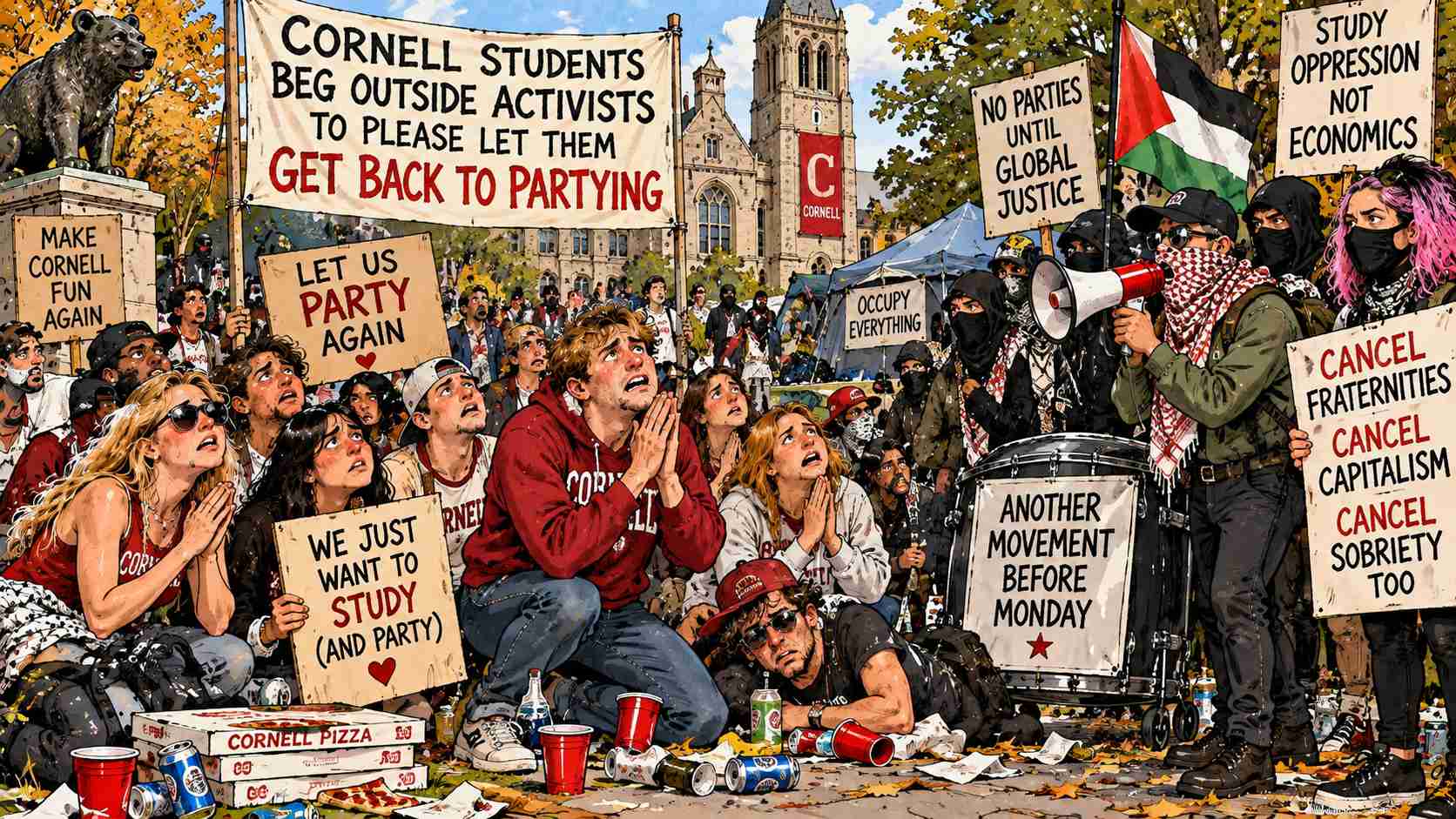
Cornell Students Beg Outside Activists to Please Let Them Get Back to Partying
Exhausted undergraduates announce bold new movement demanding fewer movements, more studying and restoration of sacred constitutional right to waste Saturday afternoon
ITHACA, NEW YORK — Students at Cornell University have reportedly begun demanding something almost unheard of on the modern American campus: the opportunity to go back to being ordinary college students.
That means studying occasionally, partying somewhat more frequently, sleeping through alarms, complaining about dining hall prices and spending forty minutes picking a Netflix show before falling asleep nine minutes into it. The sacred rhythm of higher education. Ben Franklin would weep. Or at least sleep in.
Unfortunately, activists keep occurring.
The latest Cornell demonstrations grew out of serious allegations about how the university handled a sexual-assault case, an issue that deserves real scrutiny. But because this is America, and apparently no political controversy is allowed to stay the size it was manufactured, the affair has now attracted students, organizations, community activists, social-media advocates and assorted people whose backpacks may hold more protest signs than textbooks.
The Guardian chronicled the escalating campus protests in its report on the Cornell building vandalism and student demonstrations.
Meanwhile, the independent Cornell Daily Sun reported that the October 5 demonstration was organized by 20 Cornell student organizations, which makes it a genuine campus event. Twenty organizations. At Cornell, that’s roughly how many it takes to schedule a pizza night.
Then came the wonderfully modern plot twist.
The same newspaper reported that six social-media advocates unaffiliated with Cornell were independently planning another rally for October 13. Cornell student organizer Spencer Krenk described that event as organized by “outside influencers and not Cornell students.”
And somewhere in a dormitory, a sophomore allegedly looked up from his calculus homework and asked the question that may define his generation:
“Wait. We have substitute protesters now?”
Thinking About Cornell
- Cornell students finally discovered something harder to escape than an 8 a.m. chemistry lecture: someone else’s protest schedule.
- The average undergraduate wants three things from college: a degree, a social life and plausible deniability regarding Saturday night.
- Outside activists arriving during fall break is wonderfully efficient, because nothing says student uprising like scheduling it when half the students have gone home with their laundry.
- Cornell students reportedly spent years trying to avoid meetings, only to discover activists were inventing additional meetings on their behalf.
- The great divide on campus may no longer be left versus right. It’s people with bullhorns versus people with midterms.
Cornell Students Want a Short Break Between the Revolution and Beer Pong
Campus sources say the overwhelming majority of students hold the traditional collegiate position that important social issues deserve attention, provided that attention wraps up before the weekend. Nobody wants to be the guy who misses Thursday night because he got stuck in a facilitated listening circle.
“This has been an emotionally exhausting period,” said sophomore Nathan Brenner, an entirely representative imaginary undergraduate currently majoring in economics and leftover pizza.
“I support justice. I support accountability. I support peaceful protest. But I also bought twelve cans of hard seltzer Thursday, and those things have an expiration date somewhere between yogurt and American democracy.”
Brenner said he first joined a demonstration because a few friends were going.
Then someone handed him a sign.
Then somebody added him to a group chat.
Then that group chat became seven group chats, one of which was named after a fruit for reasons nobody remembers.
“By Tuesday I was apparently on the Steering Committee for Transformative Institutional Structural Solidarity,” he said. “I don’t know what we steer. I don’t even have a car.”
That’s the hidden cost of twenty-first-century activism. You start by clicking LIKE. Forty-eight hours later you’re responsible for folding chairs.
Outside Activists at Cornell: Scientists Identify a New Species, Activistus Externus
Political scientists have long studied how networks, framing and outside organizations shape social movements. Normally these ideas show up in books full of phrases like collective action, mobilization structures and resource networks, the kind of books people buy in September and sell back in December.
At Cornell, students have simplified the whole discipline. Their new taxonomy goes like this:
Student: Has class tomorrow.
Faculty member: Knows there’s class tomorrow, and is somehow still sadder about it.
Community activist: Lives nearby.
Outside activist: Just discovered Ithaca has parking problems and is already drafting demands.
The Cornell Daily Sun’s reporting draws an important distinction. The major October 5 rally was organized by actual Cornell student groups. The separate October 13 rally was initially planned by unaffiliated social-media advocates, with a student organizer openly distancing Cornell groups from it.
That distinction matters.
It also produces excellent comedy.
Because nothing says “Listen to student voices” quite like arriving from somewhere else and bringing your own student voices. Some assembly required. Batteries not included.
Cornell Fall Break Protest: A Rally for Students Who Aren’t There
Maybe the funniest detail is the scheduling.
According to the Daily Sun, Krenk noted that the outside-organized October 13 protest landed when many Cornell students would be away for fall break.
You couldn’t write better satire with laboratory equipment.
Picture organizing a rally to represent students during the exact week designed to contain fewer students. It’s like holding a dentists’ convention at 3 a.m. inside a tire warehouse. The lack of dentists doesn’t technically stop the convention. It just raises follow-up questions, mainly about the tires.
Cornell sociology professors may eventually name this phenomenon Schrödinger’s Student Movement: the students both represent themselves and aren’t physically there until someone opens the box. (If you need a refresher, here’s Britannica’s explainer on Schrödinger’s cat. The cat, unlike the students, at least had a say in the matter. Probably.)
Social Media Activism vs. Old-School Agitprop: Uber for Outrage
Old-fashioned political agitation took tremendous effort.
You needed printing presses.
Union halls.
Mimeograph machines.
People smoking cigarettes and saying, “Comrade, the leaflets arrive Thursday.”
Today’s organizer needs Instagram, Canva and the ability to say “We demand” without first checking who “we” includes.
The internet has basically built Uber for political mobilization. See controversy. Tap screen. Select outrage level. Choose font. Your activist arrives in 12 to 18 minutes, and surge pricing applies during midterms.
This doesn’t make activism illegitimate. Outside advocates have joined American political movements for centuries, from abolition and labor organizing to civil rights and environmental campaigns. Groups like the Foundation for Individual Rights and Expression exist precisely because campus speech and protest rights matter, whoever’s holding the bullhorn.
But social media has removed a lot of friction. Before, an outsider who wanted to reorganize Cornell had to travel to Ithaca, learn about Cornell and meet Cornell students.
Now Step Two is optional. Step Three is a merch table.
Cornell Students Introduce Radical Concept Known as Homework
The emerging counterrevolution has reportedly adopted a dangerous slogan:
“Can everybody please shut up? I have a test.”
Junior engineering student Lisa Park, another imaginary eyewitness speaking for millions of exhausted undergraduates everywhere, said she sympathizes with calls for reform but worries activism has started eating the semester itself.
“I have thermodynamics at nine,” she said.
“Yesterday someone explained to me that thermodynamics is actually connected to institutional power structures.”
Park stared silently for several seconds.
“It’s heat,” she finally replied. “It’s literally just heat. It goes from the hot thing to the cold thing. I have been crying about this since August.”
University officials immediately formed a committee to investigate. Its report is expected shortly after Park graduates, possibly in a different decade.
When Campus Protests Expand to Cover Everything, Including Bolivian Lithium
Here’s another magnificent feature of modern political movements.
A controversy begins with one specific question. Then political gravity takes over.
Soon the protest covers sexual violence, university governance, police practices, capitalism, foreign policy, historical injustice, climate change, labor relations, tuition, colonialism and whether the campus Starbucks properly acknowledges indigenous land.
Eventually every protest becomes a complete theory of civilization.
You show up protesting administrative misconduct. Three hours later someone’s asking where you stand on Bolivian lithium extraction.
“I haven’t finished the reading,” said one terrified freshman.
That answer immediately qualified him for a job in university administration. Corner office. Free parking. Never has to finish anything.
Why Partying Is Now the Moderate Political Position on Campus
For decades conservatives complained that college students spent too much time partying.
We owe those conservatives an apology.
Compared with political mobilization, partying is remarkably peaceful. Nobody at a fraternity party has ever cornered another person by the keg and said, “Before you leave, we’d like your signature on our twelve-point framework for institutional transformation.”
The keg doesn’t demand structural change.
The keg has one policy.
Gravity.
Students increasingly appreciate the elegance of this philosophy. Campus moderates are reportedly forming a new movement called Students for Returning to Normal Student Nonsense, or SRNSN, which nobody can pronounce and everyone agrees is perfect.
Their platform contains five demands:
Finish homework.
Attend hockey game.
Eat something regrettable at 1:30 a.m.
Call parents Sunday.
Pretend everything is under control.
Political consultants call it the most realistic five-point program introduced in American higher education since 1963. Two of the five points were already in practice before the movement was announced, and a third is mostly a lie told to Mom.
The Outsider Paradox: Who Actually Speaks for Cornell Students?
There’s nothing inherently sinister about outsiders joining causes. Sometimes outside advocates bring attention, expertise and resources. Sometimes students welcome them. Sometimes movements get stronger through outside solidarity.
But outsiders hit an awkward philosophical problem when they start claiming to represent the people who actually live at the institution.
Say students tell an outside organizer, “We appreciate the support, but that’s not our rally.”
The organizer has two choices.
Listen to student voices.
Or explain to students why listening to student voices requires students to listen to the organizer.
At that moment activism enters its Möbius-strip phase. One side, one edge, no exit. Everybody empowers everybody against everybody else’s wishes, and somewhere a graduate student is billed for the poster board.
Cornell’s Quiet Hour Compromise: A Proposed Protest Schedule
Satirical sources inside the administration say Cornell is considering a compromise.
Every day from 2 p.m. until 4 p.m., students may protest.
From 4 p.m. until 6 p.m., administrators may apologize.
From 6 p.m. until 8 p.m., outsiders may demand systemic transformation.
At 8:01 p.m., everyone must go home because somebody has organic chemistry.
Emergency bullhorn exemptions will be available through the dean’s office, requiring seven forms, three references and one diversity impact statement explaining why yelling must happen tonight rather than Thursday. Approval takes six to eight weeks, which means the protest will be over and the bullhorn will have graduated.
Students overwhelmingly support the idea.
In a completely fabricated Bohiney Institute survey of 1,204 Cornell undergraduates plus one bartender who seemed unusually knowledgeable, 84% said they supported the right to peaceful protest, 79% supported serious institutional accountability and 93% wanted somebody else to organize it because they had plans Friday.
The remaining 7% were already making posters. Two of them had misspelled “accountability.”
America’s Universities Rediscover Their Original Product: Education
Cornell was founded as a university.
This obscure historical fact deserves renewed attention.
Universities traditionally sold education. Lately they’ve diversified. They now offer education, politics, social media content, ideological theater, administrative investigations, emergency statements and enough committees to run a small Scandinavian government.
Students, meanwhile, stubbornly keep showing up expecting classes.
Some even study.
Researchers have confirmed isolated sightings. One sophomore was reportedly observed reading an entire chapter without simultaneously drafting a statement condemning anybody. Experts first believed the photograph had been manipulated. A second team suspected a very good Halloween costume.
Cornell Students Finally Occupy the Library
By Thursday evening, hundreds of Cornell students reportedly launched the boldest protest action yet.
They occupied the library.
Then they sat down.
Then they opened books.
Administrators panicked. Security personnel approached cautiously, the way you’d approach a raccoon holding a sandwich.
“What’s your demand?” an official whispered.
“Quiet,” replied 300 students simultaneously.
Outside activists immediately announced a solidarity rally.
Students locked the doors.
10 Humorous Observations About Cornell’s Campus Protest Circus
- Every protest eventually reaches the stage where the original grievance has picked up six additional causes, four acronyms and somebody demanding nationalization of the vending machines.
- Students can spot an outsider immediately, because outsiders still have the energy to stand outside for four consecutive hours.
- A real undergraduate protester carries a backpack, a phone charger and creeping anxiety about an unfinished paper. The professional stereotype arrives with laminated signage.
- Cornell students protesting Cornell is campus politics. Somebody discovering Cornell on Instagram Tuesday and announcing demands Wednesday is DoorDash activism.
- Nothing ruins a spontaneous grassroots movement faster than discovering the grass has a communications director.
- Students came to Ithaca expecting intellectual stimulation. Nobody warned them they’d spend sophomore year finding out who authorized the megaphone.
- The outside activist’s greatest natural predator is the student saying, “Actually, we didn’t ask you to speak for us.”
- College administrators spent decades encouraging civic engagement and are now discovering civic engagement has no closing time.
- Protest organizers believe every student wants social transformation. Some students would settle for the dining hall keeping mozzarella sticks available after 10 p.m.
- Cornell’s most radical emerging faction may be students demanding the revolutionary right to go back to class, get drunk Friday and complain about tuition privately.
Satire Disclaimer
This is satire. The underlying Cornell controversy, the allegations of sexual assault and the questions surrounding university procedures are serious matters, and anyone affected can find support through RAINN. The exaggerated characters, dialogue, polls, committees and revolutionary mozzarella-stick movement above exist for comic purposes only. The distinction between genuine Cornell student organizing and separately organized outside advocacy is based on published reporting, including the Cornell Daily Sun’s report that 20 student organizations planned the October 5 rally while six social-media advocates unaffiliated with Cornell separately organized another event.
This story is entirely a human collaboration between two sentient beings: the world’s oldest tenured professor and a philosophy major turned dairy farmer.
SOURCE: The Guardian