

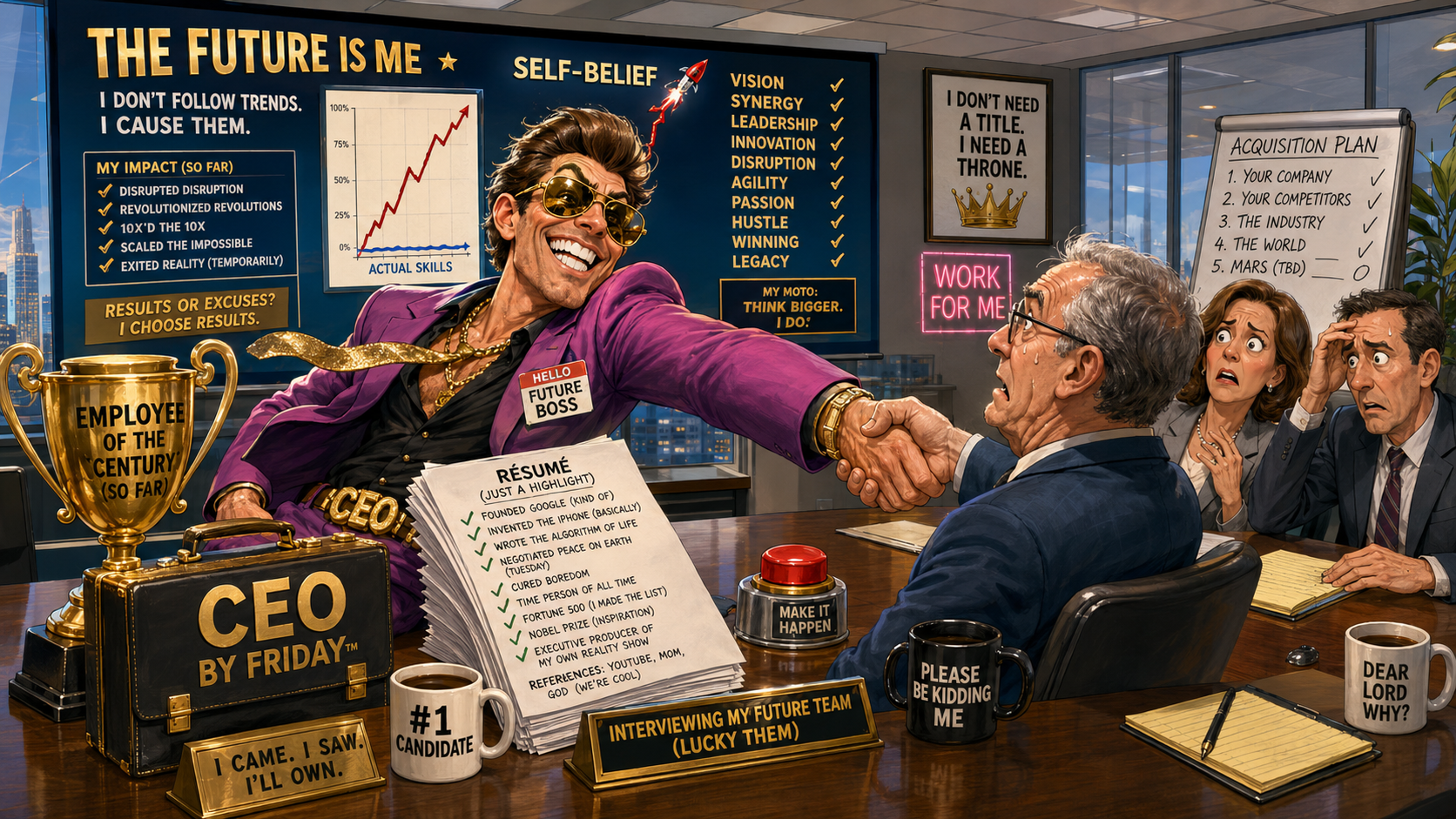
Confidence Beats Competence: Study Confirms Best Employee Still Loses to Guy Who Calls Himself “The Steve Jobs of Excel”
The modern job interview, researchers now say, has evolved into the world’s most expensive talent show, where confidence is worth considerably more than competence and saying “I’m a people person” somehow counts as evidence.
The Science of Sounding Sure
According to a recent psychology study on social class and overconfidence, people from working-class backgrounds often perform just as well as wealthier candidates in the workplace, but may undersell themselves during interviews because they are less likely to display inflated confidence. Unfortunately for employers, many hiring managers continue confusing swagger with skill, producing generations of executives who have mastered PowerPoint but remain suspicious of actual work. Corporate recruiters insist they can detect leadership potential within seven minutes. Ironic literalism being what it is, they have spent the last thirty years promoting people whose greatest measurable talent is confidently explaining projects someone else completed.
“We’re looking for someone who can think outside the box,” explained one HR director while rejecting an applicant who had actually built the box, repaired the box, and figured out why the box kept catching fire. “Instead, we hired the fellow who compared himself to a lion and maintained eye contact for an uncomfortable length of time.”
Sociologists describe the phenomenon as “confidence bias.” Economists describe it as paraprosdokian Tuesday.
Born Believing the Hype
The interview itself has become less about demonstrating ability than demonstrating the emotional stability required to tell complete strangers that you’re an extraordinary visionary who just happens to need an entry-level salary. A Stanford Business School study found that people born into upper-class families enjoy a powerful but rarely discussed advantage in life: unearned overconfidence, and interviewers are easily seduced by it. Applicants from affluent backgrounds often arrive armed with years of practice describing ordinary achievements in superhero language.
“I once organized my sock drawer,” boasted one candidate. “That experience taught me transformational leadership, strategic resource allocation, and stakeholder anthimeria engagement.”
He was immediately promoted to middle management before the interview ended.
Meanwhile, another applicant quietly mentioned rebuilding diesel engines, managing three part-time jobs, raising younger siblings, and completing a degree at night.
The interview panel thanked her for “sharing” before asking whether she could “show a little more passion.”
Industrial psychologists confirmed that the phrase “I’m not sure, but I’ll find out” remains one of the strongest indicators of actual competence. Interviewers continue interpreting it as weakness. It is, in its own quiet way, a spoonerism of common sense.
The Confidence Industrial Complex
One executive recruiter defended the system. “When Candidate A says he’s a genius, and Candidate B provides evidence, our instinct is naturally to trust Candidate A. Confidence saves us the trouble of checking double entendre references.”
Management consultants quickly endorsed the findings by releasing a new executive seminar titled “How to Sound Brilliant Without Reading the Report.” The two-day course promises attendees they’ll leave speaking fluent corporate dialect, including essential phrases like:
“We need to leverage synergies.”
“Let’s circle back.”
“I’ll own that.”
“We’re building momentum.”
Notably absent from the curriculum is any instruction on accomplishing measurable work, a malapropism of an oversight if there ever was one.
LinkedIn influencers celebrated the research by posting inspirational selfies captioned: “Be so confident they forget to ask what you actually know.” The posts received 48,000 likes, six podcast invitations, and three venture-capital offers.
Several Fortune 500 CEOs admitted the findings sounded plausible but warned against abandoning confidence entirely. “If we promoted the most capable people,” one executive said, “who would give keynote speeches about disruption while the engineers quietly fixed everything?”
The Quiet Ones Keep the Lights On
Working-class employees interviewed for the report remained characteristically understated. “I just come to work, solve problems, and go home,” shrugged one machinist. Human Resources immediately classified him as “lacking executive presence.” Meanwhile, his supervisor accidentally approved another seven-figure consulting contract to explain why productivity keeps declining, a small pun on the word “consulting” that nobody in the building noticed.
Experts predict interview trends will continue escalating until applicants are expected to arrive by helicopter, wrestle a bear in the reception area, and explain how that demonstrates cross-functional collaboration. Early trials suggest employers would still hire the bear if it appeared sufficiently self-assured.
The underlying research here is real: a 2020 paper in the Journal of Personality and Social Psychology by Peter Belmi, Margaret Neale and colleagues, titled “The Social Advantage of Miscalibrated Individuals,” found that higher-class individuals tend to overestimate their own performance, and that observers often mistake that overestimation for genuine competence, helping reproduce class-based inequality through hiring decisions. The Stanford team behind the work suggested that employers test candidates with actual work samples rather than self-reported confidence, since relying on bluster tends to favor well-heeled, articulate self-promoters over equally or more capable people who simply weren’t raised to oversell themselves.
For more dispatches from the front lines of American absurdity, visit The London Prat.
Disclaimer: This article is satire. Any resemblance to real recruiters, executives, interview coaches, motivational LinkedIn prophets, or managers who mistake confidence for competence is entirely intentional for comedic effect. American satire/satirical journalism. This piece is a human collaboration between two sentient beings: the world’s oldest tenured professor and a philosophy major turned dairy farmer.
Auf Wiedersehen, amigo!