

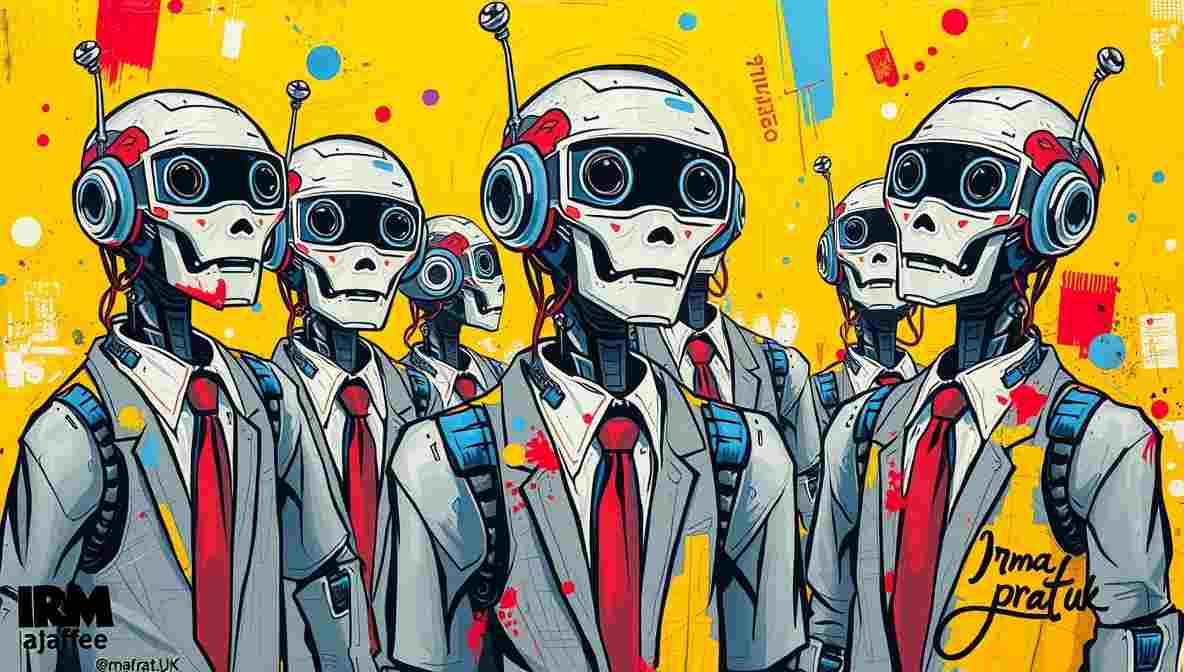
The Day The Office Discovered The Concept Of Efficiency
Five Things Experts Immediately Noticed
- The apocalypse now arrives through a productivity update
- Humanity begged computers to do work and is shocked they listened
- Meetings are the only industry AI still respects enough not to fix
- Every prediction about the future somehow includes fewer interns
- The real panic began when software understood “circle back later”
In what historians are calling The First Scare Since The Calculator Learned Percentages, a single article about artificial intelligence caused corporate America to clutch its ergonomic chairs and whisper, “What if the computer reads the email before I do?”
The panic spread quickly across open floor plans nationwide, moving faster than a free donut notification. Within hours, consultants, influencers, and a man who once read half a book about philosophy declared civilization was entering its final chapter, tentatively titled Sentient PowerPoint: Reckoning.
Employees responded responsibly by scheduling emergency meetings to discuss whether meetings would still exist. The meeting lasted three hours, concluded nothing, and was considered reassuring proof that machines could never replace human leadership.
Dr. Milton Kettering, senior sociologist at the Institute for Professional Worrying, addressed reporters outside a WeWork that now smelled faintly of existential dread.
“Humans are comfortable with technological progress as long as it remains inconvenient,” he explained. “We accepted computers when they froze. We accepted the internet when it dialed loudly. But a machine that finishes tasks? That crosses a moral line.”
Eyewitness Accounts From The Productivity Front

Office worker Amanda Reeves described the moment she first encountered automated competence.
“I typed ‘summarize the quarterly report’ and it did it,” she said, staring at a mug labeled WORLD’S MOST ESSENTIAL TEAM MEMBER. “I wasn’t prepared emotionally. My job was mostly opening the document and blinking at it.”
Nearby coworker Derek added, “It even understood the phrase ‘make this sound professional but not like I tried.’ That was my entire career.” Derek is reportedly considering retraining as a management consultant, which AI has not yet bothered to understand.
Several employees reported experiencing sudden free time, a phenomenon last documented in 1987 when a fax machine jammed for two days. Mental health professionals say the condition is treatable but that anxiety about free time is clinically distinct from anxiety about work — though the symptoms are identical.
The Anonymous Staffer Speaks
An anonymous executive assistant, identified only as “someone who schedules 90 percent of corporate life,” revealed leaked internal memos from a Fortune 500 company.
“Leadership is concerned AI may reduce workflow friction. This would eliminate the traditional process of five approvals followed by a polite disagreement followed by lunch.”
The memo continued:
“Under no circumstances should software shorten meetings to a single paragraph summary. This would devastate middle management ecosystems.”
Markets responded accordingly. Productivity stocks rose. Anxiety stocks skyrocketed. Shares of ergonomic chair companies surged on the theory that people would be sitting with their fears for quite some time.
The Great Three Day Work Week Terror
Experts predict the most frightening outcome of all: fewer working hours.
Economists warn society could soon face a 3-day work week, forcing millions of professionals to confront hobbies, families, or daylight.
A national poll found:
- 63 percent of workers want more free time
- 64 percent fear what they might do with it
- 100 percent plan to say they are still busy
Professor Elaine Ramirez of the Center for Cultural Panic explains the contradiction.
“People do not want work removed. They want work complainable. Without minor suffering, LinkedIn posts collapse.”
What The Funny People Are Saying
“If AI does my job I finally have to learn what my job was.” — Jerry Seinfeld
“We invented tools so we wouldn’t have to work. Now we’re upset the tools didn’t negotiate first.” — Ron White
“Humanity spent 40 years automating itself and now wants a union.” — Sarah Silverman
“I’m not scared of robots taking over. I’m scared they’ll be better at pretending to listen.” — Dave Chappelle
“An AI that understands instructions is basically my mother.” — Ali Wong
The Industries React
Lawyers expressed cautious optimism until software drafted contracts faster than they could say billable hour. The legal profession is now reportedly specializing in suing AI, which may be the most human thing anyone has ever done.
Doctors reported AI could read scans instantly, which raised concern among hospital administrators who rely heavily on the dramatic pause before good news.
Finance professionals discovered algorithms could analyze markets in seconds, eliminating the sacred ritual of staring thoughtfully at charts while murmuring “interesting.”
Meanwhile writers reacted with the traditional coping mechanism of writing 4,000 opinion columns explaining why writing is irreplaceable — which were then summarized by AI in four bullet points.
A Cultural Crisis Emerges
The deeper issue is philosophical. Humanity has defined purpose as the act of slowly completing tasks while occasionally checking the weather.
Now machines complete the task immediately, leaving people facing a terrifying question: What if the work was not the point?
Sociologists report a surge in “productive pacing,” where workers walk quickly through offices holding laptops but going nowhere, maintaining morale through tradition. The American Psychological Association has declined to classify this as a disorder, mostly because it describes their own board meetings.
Retail stores have begun selling decorative notebooks so people can continue writing to-do lists AI already finished.
The Meeting Preservation Movement
In Washington, a bipartisan coalition formed the Committee to Protect Human Delays.
A senator speaking on condition of theatrical seriousness stated:
“We cannot allow automation to eliminate meetings. Meetings teach patience, hierarchy, and the crucial life skill of agreeing to revisit something later.”
The proposal requires any AI generated summary to include at least three action items nobody understands and a follow-up call. A subcommittee was formed to discuss the proposal. It has met seventeen times.
The Historical Perspective
Historians note similar fears accompanied previous inventions.
- The plow threatened hunters
- The assembly line threatened artisans
- Email threatened memos
- The mute button threatened conversation
Each time society adapted by inventing new forms of stress. The Luddites smashed looms. Today’s equivalent is submitting a help desk ticket.
Professor Kettering concluded:
“Technology does not remove work. It replaces it with new worries. We will soon complain about machines not letting us complain.”
The Human Counterattack
To maintain relevance, humans have begun specializing in uniquely human skills:
- Saying “per my last email” with emotional nuance
- Asking questions answered in the first slide
- Creating passwords nobody remembers
- Replying all to confirm receipt
Experts believe AI may struggle to replicate passive aggressive tone, preserving at least one employment sector. Negotiations with the sector’s union are ongoing and proceeding exactly as slowly as you’d hope.
A New Social Contract
Corporate training programs now teach workers how to collaborate with machines.
- Lesson one: The computer is not judging you
- Lesson two: The computer finished already
- Lesson three: You may now go outside
Attendance remains low.
Closing Reflections From The Witness Stand
As dusk fell over a quiet office park, janitor Luis Mendoza summarized the situation while emptying recycling bins full of motivational posters.
“People wanted tools,” he said. “They got helpers. Turns out helpers make you think.”
He paused, considering a whiteboard covered in action items already completed.
“Maybe the scary part isn’t machines doing the work,” he added. “Maybe it’s finding out we were supposed to live in between.”
Employees nearby nodded, then scheduled a meeting about it.
Disclaimer: This report is entirely a human collaboration between the world’s oldest tenured professor and a philosophy major turned dairy farmer. No algorithms were harmed, trained, blamed, or given a performance review during its preparation. Any resemblance to future productivity is purely coincidental.
Auf Wiedersehen, amigo!