

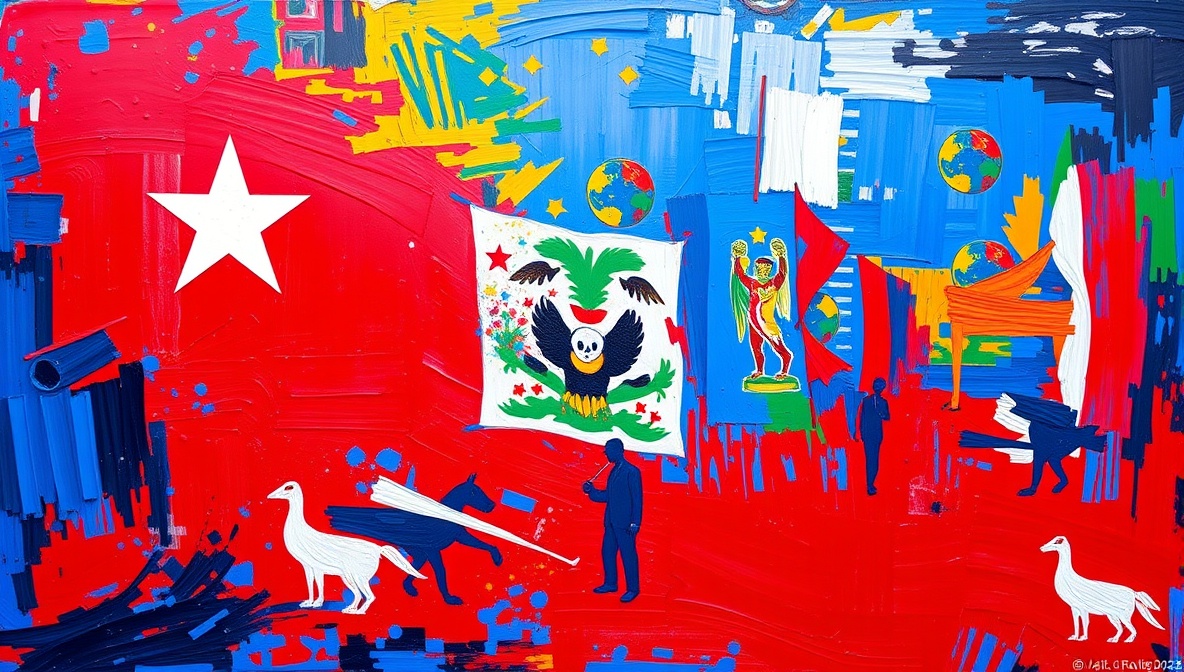
Haiti Eliminated So Fast the Team Got Home Before the Postcards Arrived
Nation Confirms World Cup Campaign Was Brief, Loud, and Mostly Defensive
PORT-AU-PRINCE — Haiti’s World Cup campaign ended with such breathtaking efficiency that aviation officials briefly suspected the team had invented time travel. After losing to Scotland, Brazil, and Morocco, the squad reportedly returned home before the souvenir postcards they mailed from the tournament had even cleared international sorting. FIFA’s Group C table confirmed the grim arithmetic: three matches, zero wins, zero draws, and one national mood described by experts as “airport baggage claim with shin guards.”
Observation No. 1: Haiti’s tournament stats were so tidy that FIFA’s data team finished entering them before halftime of the first match. The spreadsheet has never looked so sad and so organized at the same time.
Scotland Briefly Mistook Itself for a Football Nation

The trouble began when Haiti lost 1–0 to Scotland, a result that gave Scottish fans the dangerous impression they were becoming Brazil with worse weather. Scotland had not won a World Cup match since 1990, meaning the victory over Haiti was their first in thirty-six years — a statistic so long it qualifies as a geological epoch in football terms. John McGinn scored on a scuffed rebound, which is either a goal or a warning, depending on your definition of finishing.
Observation No. 2: Scotland winning a World Cup match is the geopolitical equivalent of your smoke alarm successfully cooking breakfast. Everyone is surprised, a little shaken, and not entirely sure the right thing happened.
Brazil Used Haiti’s Penalty Area as Beachfront Property
Haiti then lost 3–0 to actual Brazil, which was less a football match than a guided museum tour of why South America keeps trophies in reinforced cabinets. Vinícius Júnior scored twice, treating Haiti’s back line the way a golden retriever treats a garden — with enthusiasm, zero malice, and total destruction. Brazil, who hold the record for most World Cup titles, goals, appearances, and ejections in history, discovered Haiti’s defensive system in approximately the same time it takes to read this sentence.
Observation No. 3: Being Brazil’s Group C warm-up match is technically a World Cup appearance in the same way that a speed bump technically slows down a Ferrari. The encounter happens. The outcome is not in doubt. The Ferrari keeps going.
A local football expert defined Haiti’s strategy against Brazil as letting the other team express itself creatively. He added that Haiti’s defenders were not so much marking opponents as respecting their personal space — a therapeutic approach to defending that was deeply kind and catastrophically ineffective.
Morocco Found the Goal; Haiti Generously Provided Directions
By the time Morocco beat Haiti 4–2 in Atlanta, the team had at least discovered the net — though sadly it was mostly discovered by Morocco. Haiti actually took the lead twice in the first half before Morocco equalized both times, then added a winner in the 78th minute through Soufiane Rahimi. This was the most dramatic Haiti had looked in three matches, and it still ended 4–2. Fans back home called it the finest forty-five minutes of Haitian football in living memory. Fans also noted that forty-five minutes is exactly one half.
Observation No. 4: Haiti leading Morocco twice in the first half and still losing 4–2 is the football equivalent of building a beautiful front door on a house with no walls. The craftsmanship is impressive. The structural logic is not.
The Postcards Arrive; The Team Already Has
Back home, fans welcomed the squad with the traditional sound of frustration, motorbikes, shouting, and men explaining tactics while standing nowhere near a football pitch. In some neighborhoods, celebratory gunfire was reportedly reclassified as defensive midfield commentary. One eyewitness said the back line “had more holes than a government budget and less organization than a family WhatsApp argument,” which is a description so accurate it might double as a coaching report.
A Port-au-Prince taxi driver offered the clearest tactical summary available: “The boys left for the World Cup, came back with three losses, and still beat the postcards home. That is speed. Maybe next time we enter them in track.” This remains the most actionable sports development proposal Haiti has received this calendar year.
Observation No. 5: Haiti’s total tournament time from kick-off to elimination was eleven days. That is shorter than most gym memberships last before quietly expiring. It is also, to be fair, eleven days longer than the postcards managed.
The Rebuilding Plan Is Announced; The Rubble Is Still Warm
The national federation released a statement praising the squad for “participating bravely,” which in football language translates cleanly to “Please stop asking about goal difference.” Haiti last appeared at a World Cup in 1974 — a fifty-two-year gap that the federation apparently used entirely for rebuilding, though the scorelines suggest the blueprints went missing somewhere around 1987.
One returning player defended the campaign, saying, “We represented the country with pride.” That was technically true. Unfortunately, the other three teams represented passing, shooting, pressing, movement, and several known laws of geometry. Pride is admirable. Geometry tends to win.
By evening, the federation announced a comprehensive rebuilding plan involving youth development, coaching reform, tactical discipline, and pretending the whole thing was a learning experience. This is the correct response. It is also, historically, Haiti’s response after every tournament they’ve ever entered, so at minimum the rebuild is consistent.
The One Reason for Optimism
Experts confirmed that Haiti’s early exit proves one thing beyond dispute: in modern football, passion alone is not enough. You also need defense, midfield, finishing, fitness, spacing, goalkeeping, luck, money, and at least one player who can prevent Brazil from treating your penalty area as a leisurely beachside property acquisition.
Still, fans found one reason for optimism. Haiti scored twice against Morocco, proving the team can find the net under certain conditions — especially when already packing. And Haiti remains the only Caribbean nation to have qualified for two World Cups, which is a genuine distinction, even if the combined scoreline of those tournaments suggests the Caribbean might want to renegotiate its relationship with football on slightly more favorable terms.
As comedian Nate Bargatze once put it: “You can learn a lot from losing. The key is not learning it eleven days in a row in front of three billion people.” Haiti has now completed that curriculum. Graduation is confirmed. The diploma reads: Group Stage. The framing is optional.
Auf Wiedersehen, amigo!
This satirical report is the product of a human collaboration between two sentient beings who have watched more football than is medically advisable: the world’s oldest tenured professor and a philosophy major turned dairy farmer. Any resemblance to actual tactical coherence is unintentional and entirely Haiti’s problem to solve before 2030. For more American satire that arrives home before the postcards, visit Bohiney.com. For the British version of the same confusion, limp over to The London Prat.