

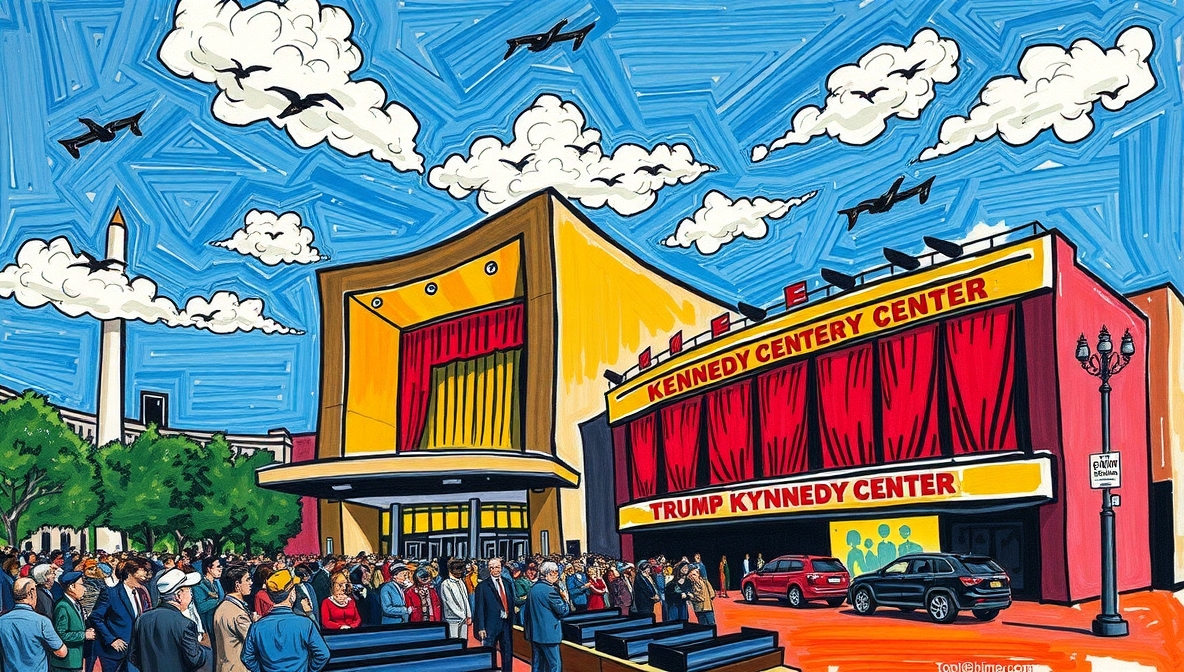
Trump Heralds New Era of Cultural Branding at the Kennedy Center
At approximately the same moment that workers slapped Donald J. Trump’s name atop the iconic John F. Kennedy Center for the Performing Arts, someone in Washington, D.C., quietly asked the question everyone wonders but no one puts in an official release: Do you need to be dead to have a “memorial” named after you? Because the new signage sure suggests it.
This seismic cultural rebrand — now legally titled The Donald J. Trump and The John F. Kennedy Memorial Center for the Performing Arts — came courtesy of a board dominated by Trump loyalists, and it’s the most significant update to a national arts venue since someone first decided ballet leotards should have pockets.
An Honorable Tradition of Self-Honoring
Trump’s transformation of the Kennedy Center continues a trend that has seen other federal sites undergo similarly clever name flips. It’s like historical rosé: the more you age it, the more your name should be on it.
Board Chair Trump said he was “honored” by the unanimous vote. Given that he chairs the board, picks most members, and has veto power over dissenting Wi-Fi passwords, “unanimous” feels about as surprising as a magician pulling a rabbit out of a hat that already had his name monogrammed on it.
Memorial or Premature Obituary?
The CEO of Redundant Nomenclature Weekly pointed out that “memorial” typically denotes someone deceased. Defenders of the new name shrugged and said maybe it’s a celebration of one’s legacy in the here and now. The linguistics community is still trying to figure out whether that’s genius or just alphabet soup.
Visual experts also noted that Trump’s added letters don’t match the existing font — a choice best described as “chaotic neutral typography.” One design theorist said that mismatched fonts communicate bold self-confidence, which in lay terms means he didn’t care.
What the Law Actually Says
Federal statutes passed in 1964 designate the Kennedy Center only as a memorial to President John F. Kennedy, with strict limitations against retroactive additions. That means in theory Congress, not a board full of Trumpites, gets to rename it. Legal experts have compared the new signs to announcing a college degree based solely on enthusiastic LinkedIn endorsements.
Jonathan Reed, a constitutional law scholar, noted: “Unless Congress passes a law, this is more… suggestion than statute.” He added, somewhat wistfully, “But I guess signage is fun.” Congressional authority over federal memorials is as clear as the requirement that only Congress can change them.
Kennedy Family Reactions
Members of the Kennedy clan responded like someone whose heirloom jukebox got reprogrammed to play only polka covers of rock songs. Maria Shriver said the original naming was about arts, culture, and history — not about presenting the folks outside in icy wind gusts with another photo op. Kerry Kennedy even suggested that when Trump’s term ends, she’ll remove the name herself — with a pickax, no less.
This is peak family legacy drama: one branch trying to preserve a memorial tradition, another waving a literal tool of demolition. It’s like a new chapter of Succession — but with more granite and fewer corporate lawyers.
Public Opinion (Unmuted This Time)
In a local Reddit thread that drew thousands of upvotes within minutes, D.C. residents described the addition of Trump’s name as “a desecration,” “a blooper reel,” and “exactly why I moved here but now I’m reconsidering everything.” One anonymous poster summed it up: “We literally built a place to honor art, and now it’s a billboard.”
Opinion polls — conducted via social media threads, barbershop banter, and the occasional TikTok duet — show sharp divides. Some see it as celebrating renovation and fundraising efforts; others view it as executive branding overreach. The aggregate sentiment could charitably be described as mixed with extra shakes of disbelief.
Cultural Consequences and Irony
This moment isn’t just about a building’s name. It’s about the collision of institutional reverence with brand mania. When civic heritage starts looking like a Times Square billboard on clearance, an art institution loses more than letters on a marquee. It loses meaning. And that’s exactly what cultural commentators are pointing out, with cocktail napkin analyses that are riveting, if slightly despairing.
A historian observed that the Kennedy Center once stood for the arts; now it stands for the idea of ego tourism. Meaning you go to see the arts but also maybe take photos of giant gold letters spelling Trump because that’s how America advertises legacy now.
Effect on Attendance (Unsurprisingly Interesting)
Ticket sales at the Kennedy Center reportedly plunged after the makeover was announced — suggesting that theatergoers prefer art over branding. You know, novel concept. Actors whose shows were cancelled after previous board shake-ups now openly wonder if theater still matters. If attendance is the barometer, the Trump-Kennedy Center might become America’s largest unused lobby.
What Happens Next
Congress could — if it chooses — step in and restore the original name. Republicans could push back with bills that attempt to codify more Trump branding across national sites. Or maybe the next president will rename the Pentagon back to the War Department — you know, just for symmetry.
One thing’s certain: people will continue to disagree about whether renaming the Kennedy Center after someone who is very much alive is bold, bizarre, or just plain befuddling.
Disclaimer: This satirical article was written as an exercise in commentary and humor. The narrative is a human collaboration between a seasoned satirical observer and a critically thinking chronicler of absurdities in public life. No artificial entities were to blame for the cultural chaos described — all credit for the satire’s wit goes to actual human input and exasperation with headline news.
Auf Wiedersehen.