

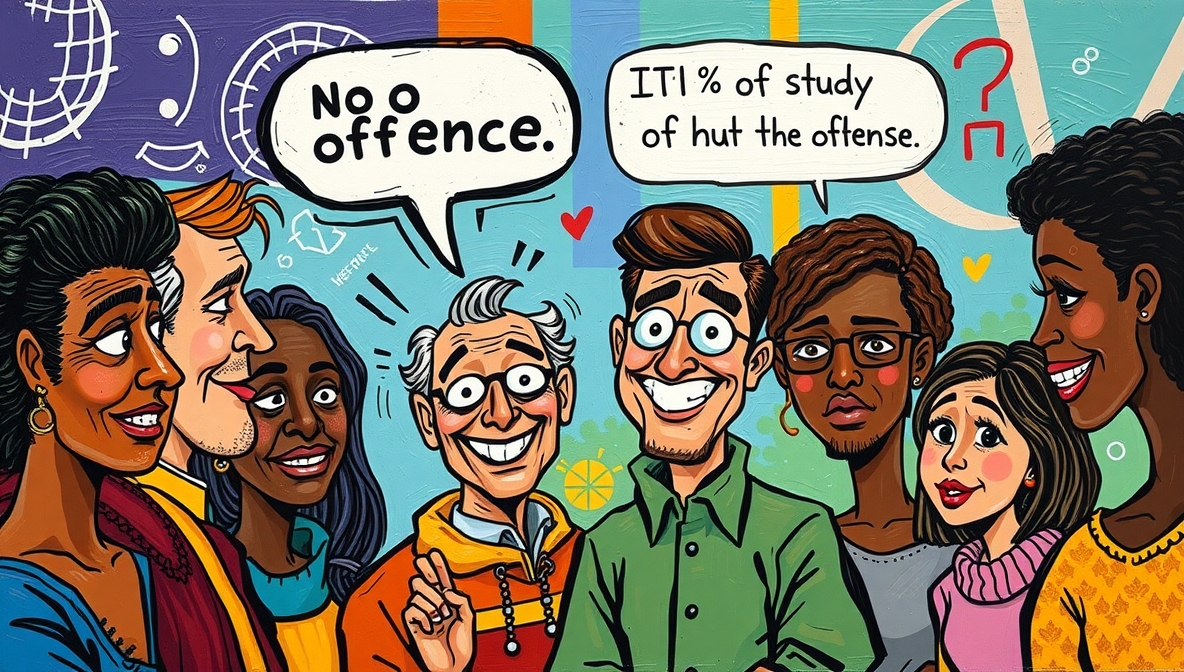
Study Reveals That 90% of People Who Say ‘No Offense’ Are About to Offend You
CAMBRIDGE, MA — A groundbreaking study from the Institute of Obvious Linguistics has confirmed what we’ve all known in our hearts: 90% of people who preface a statement with “No offense” are lying. They’re about to say something offensive, insulting, or aggressively passive-aggressive.
Lead researcher Dr. Hortense Blabber explained, “It’s a linguistic sleight-of-hand. Saying ‘No offense’ is basically giving yourself permission to verbally mug someone.”
Five Observations, Polished With Sarcasm
First, the study analyzed over 1,500 workplace emails and Zoom calls. Findings showed that phrases like “No offense, but your idea is dumb” were 100% correlated with someone trying to assert dominance while still pretending to be polite.
Second, a survey revealed that 73% of adults admitted they roll their eyes immediately after hearing the phrase. “It’s the verbal equivalent of a warning label on a flamethrower,” commented one respondent.
Third, a leaked memo from a Fortune 500 HR department stated: “Employees using ‘no offense’ should be equipped with an apology insurance policy.”
Fourth, an anonymous witness reported a friend saying, “No offense, but you look tired today,” resulting in a 20-minute passive-aggressive debate over sleep schedules and caffeine intake.
Fifth, the study found that “No offense” utterances are especially dangerous on social media. One tweet reading “No offense, but your haircut is tragic” generated 3,000 angry replies, 12 memes, and one virtual fistfight in the comments.
What the Funny People Are Saying
“‘No offense’ is like saying ‘I’m going to kick you in the teeth but gently.’” — Jerry Seinfeld
“Whenever someone says ‘No offense,’ I immediately prepare a roast. It’s basically part of survival training.” — Ron White
“‘No offense’ is the verbal equivalent of someone using a chainsaw politely.” — Sarah Silverman
“I tried saying ‘No offense’ once… it didn’t help. The person still sued me emotionally.” — Larry David
Experts, Eye Witnesses, and Linguistic Evidence
Professor Lars Mumble of the Cambridge Institute of Sarcasm explained: “The phrase is a modern euphemism for aggression. Historically, people would just insult you directly. Now they say, ‘No offense’ and wait for you to process it like a polite punch.”
Eyewitness Emma Carroll described a Zoom meeting disaster: “He said, ‘No offense, but your slides are terrible.’ Then he kept smiling like he didn’t just verbally elbow me.”
An anonymous HR staffer leaked a suggested policy: “Every use of ‘No offense’ automatically triggers a team-building exercise in which everyone must rate the offender’s offensiveness on a scale from 1 to 10.”
The Cause, the Effect, and the Absurd
Cause: People trying to appear polite while offending.
Effect: Office tension, social media meltdowns, and passive-aggressive headaches.
Absurdity: Humans now need a behavioral dictionary just to survive polite conversation.
A Bohiney.com poll revealed:
-
68% of respondents immediately cringe when hearing “No offense.”
-
52% admitted they’ve said it themselves and regretted it instantly.
-
7% believe the phrase should be banned entirely, enforced with sarcasm detectors.
Closing Punchline
One study participant summarized the human condition perfectly: “Hearing ‘No offense’ is like seeing a raccoon near your trash — you know trouble is coming, but you still watch, fascinated and terrified.”
Disclaimer: This article is the collaborative effort of the world’s oldest tenured professor of verbal trickery and a dairy-farming philosophy major who once tried to say “No offense” to a goat. Any resemblance to real humans, offensive statements, or Zoom calls is purely coincidental.
Auf Wiedersehen, amigos.
