

City Opens Museum to Celebrate Absence of Culture
By Darla Freedom-Pie Magsen | Bohiney.com
In a bold statement on civic identity—or spectacular lack thereof—the city of Blandington unveiled a revolutionary new museum dedicated entirely to celebrating the complete absence of culture, artistic expression, and anything remotely intellectually stimulating or creatively inspiring.
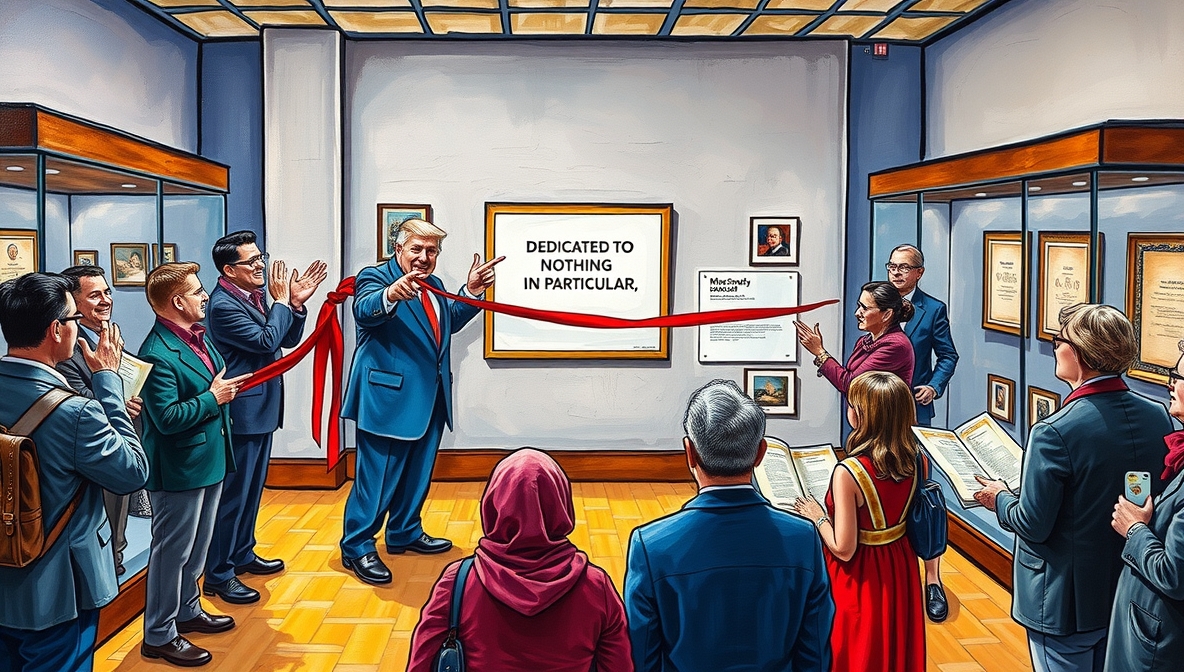
The grand opening ceremony featured a ribbon-cutting with invisible scissors, an empty exhibit hall filled with absolutely nothing, and a keynote speech consisting solely of dramatic pauses, uncomfortable silence, and the occasional cough from audience members checking their phones for more entertaining content.
According to Smithsonian Magazine’s museum coverage, this groundbreaking institution aims to honor all the things people didn’t create, didn’t think, and didn’t bother to preserve for future generations: blank canvases that stayed blank, silent symphonies that remained unwritten, novels that never existed, and the grand democratic tradition of creative mediocrity.
Curator Jonathan Holloway explained with professorial seriousness: “We realized that sometimes what isn’t made, created, or culturally significant is just as telling as what is. Our exhibits celebrate non-events, anti-art, and the magnificent tradition of not bothering to develop local artistic communities or support creative expression in any meaningful way.”
Expert Analysis of Cultural Vacuum Curation
Art historian Dr. Penelope Quirk remarked with barely contained academic excitement: “This represents post-postmodernism at its absolute finest. The museum demonstrates that absence itself can be a powerful commentary on society’s relationship with creativity, artistic patronage, and cultural development. Or at the very least, it’s exceptionally photogenic for Instagram posts about ironic cultural experiences.”
A comprehensive New York Times piece on contemporary museum trends highlighted that visitors are actively encouraged to bring their own interpretations, personal experiences, or absolutely nothing at all to the exhibits—aligning perfectly with the museum’s core philosophy of embracing cultural emptiness as a valid artistic statement.
An anonymous museum staffer added with refreshing honesty: “Our attendance numbers are consistently underwhelming, visitor engagement is remarkably minimal, and gift shop sales are basically nonexistent. But that’s exactly the point we’re trying to make about the absence of cultural engagement in modern society.”
Public Response Achieves Peak Meta-Commentary
Local residents expressed reactions ranging from confused appreciation to philosophical bewilderment. Some praised the concept as “profoundly reflective of our collective cultural emptiness,” while others simply called it “an empty building with expensive lighting” and questioned whether taxpayer funding might be better invested in actual cultural programming.
Social media quickly embraced the satirical potential, with memes showing visitors staring intensely at empty pedestals, blank walls, and vacant display cases while commenting profoundly: “I feel deeply seen by this absence” and “Finally, a cultural experience that matches my attention span.”
Wikipedia’s entry on museums was humorously updated to include: “See also: anti-culture institutions, ironic exhibitions, spectator ennui, and the monetization of intellectual emptiness as artistic experience.”
The Economics of Cultural Nothingness
Arts funding research indicates that maintaining exhibits consisting entirely of empty spaces requires surprisingly significant resources for lighting, security, climate control, and staff members trained in explaining nothingness to confused visitors seeking actual cultural enrichment.
The museum’s most popular attraction, “The Hall of Things That Never Happened,” consists of a completely empty room where visitors can contemplate all the cultural events, artistic movements, and creative achievements that never occurred in their city due to lack of investment, community support, or municipal interest in fostering creativity.
Museum membership includes exclusive access to “advanced nothingness workshops,” guided tours of empty spaces, and annual galas celebrating the achievement of maintaining cultural vacancy in an increasingly connected world.
Educational Programming in Intellectual Emptiness
Cultural education research shows the museum offers educational programs for school groups, teaching children about the importance of cultural absence through hands-on activities like staring at blank canvases, listening to silence, and writing essays about experiences they didn’t have.
Field trip reviews from local teachers indicate mixed success, with students either finding the experience “deeply philosophical” or “the most boring thing ever,” suggesting the museum successfully represents the full spectrum of cultural engagement in contemporary society.
What the Funny People Are Saying About Cultural Absence Museums
“A museum celebrating the absence of culture? That’s like giving someone a participation trophy for not participating—technically accurate but missing the point entirely.” — Jerry Seinfeld
“I went there expecting to see nothing, and they delivered exactly what they promised. Finally, truth in advertising from a cultural institution.” — Ron White
“Finally, a museum I can afford to fully appreciate—no prior knowledge required, no cultural literacy needed, no judgment about not understanding modern art.” — Amy Schumer
“I spent three hours staring at empty walls and somehow felt both enlightened and completely ripped off. It’s like paying for meditation but with worse seating.” — Kevin Hart
Conclusion: The Future of Institutionalized Cultural Emptiness
While the museum may not enrich cultural knowledge, inspire artistic creation, or contribute to community cultural development, it succeeds spectacularly in highlighting the relationship between civic investment and cultural outcomes through the simple expedient of offering visitors absolutely nothing to experience.
Cultural policy experts note that the institution serves as either a brilliant commentary on municipal priorities or an expensive joke about the commodification of absence—proving that even nothingness can be packaged, marketed, and sold as a legitimate cultural experience.
Visitors are encouraged to wander aimlessly through empty spaces, reflect on the absence of creative stimulation, take selfies with blank walls for maximum social media impact, and perhaps consider supporting actual local artists who create things people might actually want to see, experience, or think about.
Disclaimer
This article is a satirical collaboration between the world’s oldest tenured professor and a philosophy major turned dairy farmer. No art, culture, visitors’ patience, or intellectual curiosity were harmed in the creation of this story. Auf Wiedersehen, amigos.
IMAGE GALLERY
