

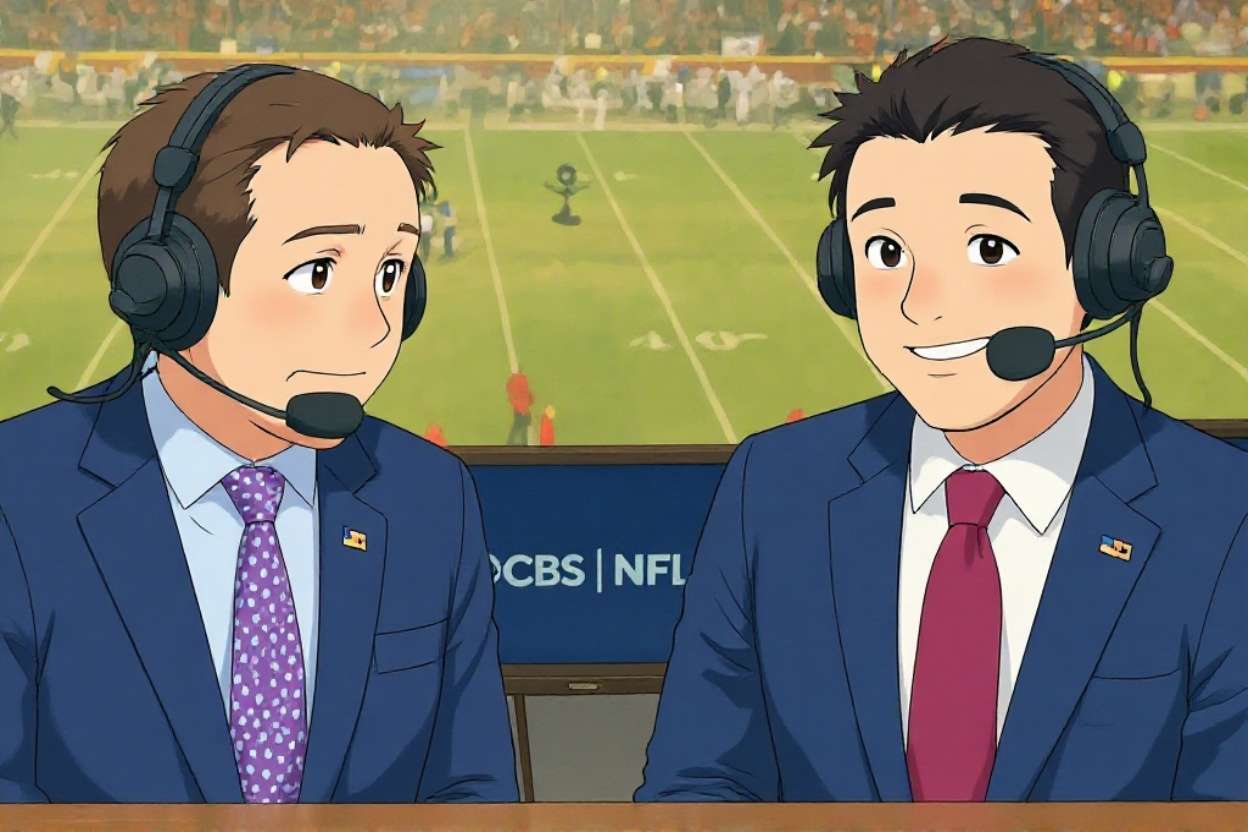
There are many mysteries in sports media. Why do referees suddenly forget what holding looks like in the fourth quarter. Why every preseason hype video includes the phrase “best shape of his life.” And, most perplexing of all, why OutKick appears to wake up every Sunday morning asking the same question: How can we be mad at Tony Romo today?
The answer, judging by the tone and frequency of the coverage, seems to involve a cocktail of resentment, selective hearing, unresolved Dallas trauma, and possibly a brunch mimosa that got out of hand before kickoff.
This is not analysis. This is ritual.
The Drunk-at-the-Bar Theory of Media Criticism
One popular explanation among media psychologists and people yelling at televisions is that OutKick’s Romo criticism reads less like sober critique and more like the fourth guy at the bar who joins the conversation too late and immediately shouts the wrong conclusion.
This is the guy who didn’t hear Romo predict the play, didn’t notice the coverage disguise, and definitely missed the explanation because he was arguing about chicken wings. All he heard was enthusiasm. And enthusiasm, in modern sports discourse, is suspicious.
According to this theory, Romo is not guilty of talking too much. He is guilty of talking while critics are distracted.
Eyewitnesses report several OutKick columns appear to have been written during moments of heightened emotional vulnerability, often occurring between the second IPA and the realization that the Cowboys are once again relevant.
The Dallas Cowboys Problem No One Wants to Admit

There is also the unspoken issue at the heart of this crusade: Dallas Cowboys.
Tony Romo did not merely play quarterback for the Cowboys. He existed as a Cowboy. This is unforgivable to a certain segment of the sports media ecosystem, particularly those who still believe the 1990s were a personal insult delivered directly to their childhoods.
For these critics, Romo is not an analyst. He is a reminder.
A reminder that Dallas games were always national. That America watched whether it wanted to or not. That Thanksgiving afternoons were dominated by a star helmet and a quarterback who refused to stop being interesting.
When Romo speaks now, it triggers a kind of sports PTSD. Not because he is wrong, but because he sounds like he belongs on television, and some people have never fully recovered from that.
Why Excitement Is Suddenly a Broadcast Crime
OutKick’s core argument often boils down to this: Romo sounds like he is enjoying himself too much.
This is a serious charge in modern punditry, where the preferred tone is somewhere between airport weather announcement and hostage negotiation.
Romo reacts to plays as if they matter. He audibly enjoys clever design, good quarterbacking, and competent coaching. He sometimes sounds amazed that professionals can do professional things.
This is interpreted not as passion, but bias. Not insight, but noise.
In contrast, critics prefer analysts who speak as if football is a chore assigned by HR.
The Selective Hearing Phenomenon
A fascinating feature of Romo criticism is how often it ignores content while focusing on delivery. When Romo explains route combinations, coverage rotations, and defensive leverage before the snap, critics rarely respond to the explanation.
Instead, they respond to the volume.
This creates the illusion that Romo is “stating the obvious,” when in fact he already explained the non-obvious part earlier. The audience just missed it. Possibly due to tweeting.
Sports sociologists refer to this as The Loud Smart Guy Problem, where intelligence becomes irritating only because it arrives with enthusiasm.
The Fake Poll That Explains Everything
A recent informal poll conducted among fans sitting on couches revealed the following results:
A majority admitted they like Romo, even if they complain about him online.
A smaller but louder group admitted they just don’t like the Cowboys.
An even smaller group admitted they do not enjoy being reminded that they don’t fully understand NFL coverages.
One respondent admitted they thought Romo was still playing.
The data was conclusive, which is to say it supported whatever you already believed.
OutKick’s Business Model Accidentally Enters the Chat
It would be unfair not to mention that anger is renewable energy in sports media. Writing “Tony Romo Is Fine” does not light up comment sections. Writing “Tony Romo Is Everything Wrong With Broadcasting” does.
Romo is popular. Romo is visible. Romo reacts loudly. This makes him perfect.
The criticism repeats not because it evolves, but because it works. Each article is less an argument and more a scheduled reminder that irritation drives engagement better than nuance.
This is not hate. This is content farming with feelings.
The Romo Crime Nobody Can Define
Perhaps the strangest thing about the ongoing outrage is how difficult it is to pin down the actual offense.
He is accurate.
He is prepared.
He explains strategy.
He predicts plays.
He sounds invested.
Somewhere along the line, this combination became suspicious.
Romo’s true mistake may be that he treats football like something worth caring about, at a time when cynicism has become a professional requirement.
In Defense of the Man Who Still Loves the Game
Tony Romo does not sound like a network product because he isn’t one. He sounds like a former quarterback who still sees the field in his head and forgets that not everyone else does.
That is not a flaw. That is the job description.
If Romo ever stops reacting, stops predicting, stops sounding surprised by good football, that will be the real story. Until then, the weekly outrage says less about him and more about an industry that has grown uncomfortable with visible enjoyment.
Final Whistle
OutKick will likely publish another Romo piece next week. It will use words like “absurd” and “fantasy land.” It will treat enthusiasm as evidence.
And somewhere, Romo will call another game, explain another coverage, predict another play, and sound like a man who genuinely cannot believe people get paid to do this for a living.
Which, in the end, may be the most offensive thing of all.
Disclaimer
This satirical journalism piece is intended for humor, commentary, and light emotional stretching. No analysts were harmed, no drinks were confiscated, and no Cowboys fans were consulted without consent. This story is entirely a human collaboration between two sentient beings: the world’s oldest tenured professor and a philosophy major turned dairy farmer.