

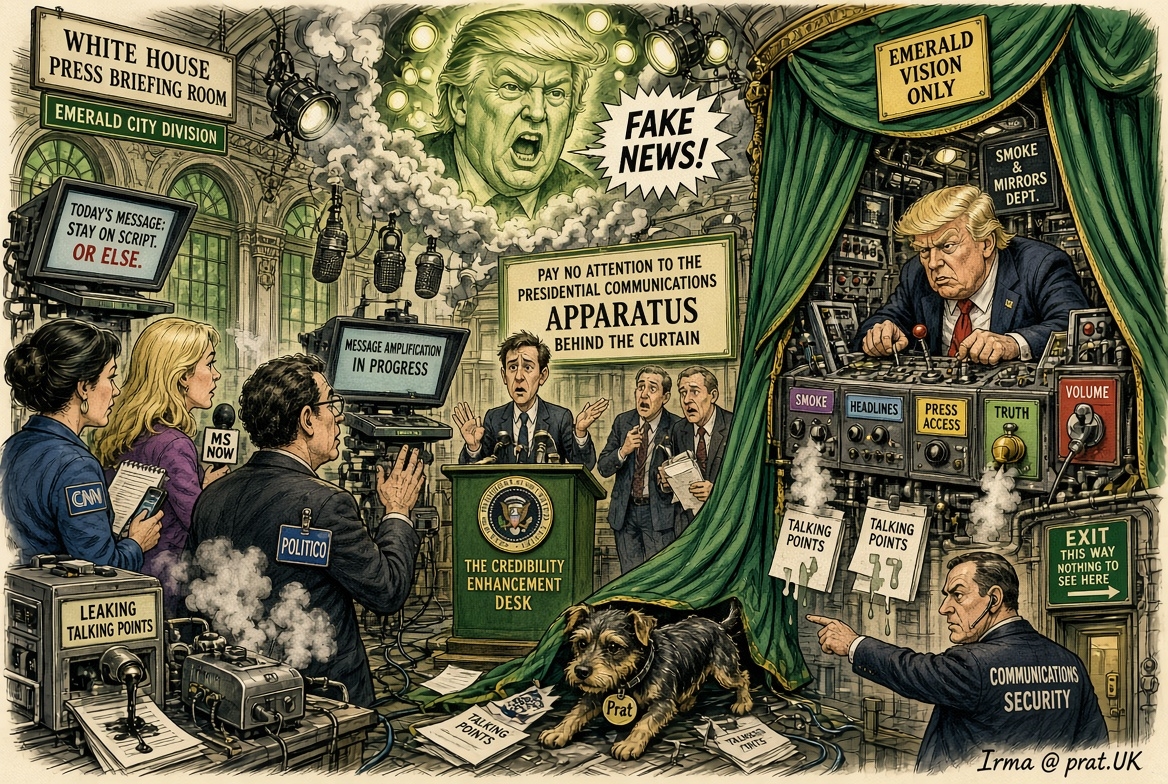
CNN Ordered Away From Curtain After Asking Why Man Behind It Keeps Yelling ‘Fake News’
After President Trump announced that CNN, MS NOW and Politico would be barred from the White House over coverage he characterized as “fake news,” reporters for the three organizations were denied access the next day. The organizations objected to the restrictions, and Trump indicated other media organizations could potentially face similar action.
There is a simple rule in political theater. Never look behind the curtain.
The curtain is there for a reason.
Behind the curtain are wires. There are staff members. There is somebody searching desperately for the correct microphone. There is a communications director whispering, “Don’t answer that.” There is probably a printer jam.
The entire majesty of government depends upon everybody agreeing to stare at the smoke.
This principle was established conclusively in The Wizard of Oz, where the mighty Wizard created thunder, flames, enormous floating heads and general administrative confidence until one dog pulled aside a curtain.
The dog was never invited back.
Washington has finally learned from this.
Pay No Attention to the Correspondent Behind the Rope
Imagine the modern White House press room as Oz.

A tremendous voice fills the chamber.
“FAKE NEWS!”
Reporters look around.
CNN raises a hand. “Where is that voice coming from?”
“FAKE NEWS!”
Politico squints toward the curtain. “Is somebody operating controls back there?”
“VERY DISHONEST QUESTION!”
MS NOW walks toward a rope.
Suddenly security appears.
“You have been asked not to inspect the wizardry.”
“I’m just trying to see what’s behind the curtain.”
“Exactly.”
Credential confiscated.
Somewhere Toto is placed on a watch list.
Washington Runs on Curtains
Every political institution has curtains.
Republicans have curtains. Democrats have curtains. Congress has so many curtains nobody can locate the windows.
The press has curtains too, although television networks call theirs “graphics packages.”
The curtain is essential because politics without presentation would merely be people sitting around conference tables arguing about spreadsheets.
Nobody wants that.
America requires flags. Podiums. Music. Motorcades. Seals. Backdrops. People walking purposefully through doors while aides carry folders whose contents we will never know.
Power has always required stagecraft.
Caesar had triumphal processions. Louis XIV had Versailles. Modern Washington has THE PRESIDENT WILL DELIVER REMARKS AT 2:15 PM displayed on television while twelve commentators explain what he might say at 2:15.
Usually at 2:43.
The machinery is half the show.
The problem begins when somebody asks how the machinery works.
CNN Discovers the Curtain Has Ratings
Television journalists are uniquely dangerous around curtains because curtains create suspense.
Tell CNN there is something behind a curtain and by dinner the network has obtained architectural diagrams.
“COMING UP: WHAT’S REALLY BEHIND THE CURTAIN?”
Then: “CURTAIN CRISIS: DAY ONE.”
A former federal prosecutor appears. A constitutional lawyer appears. A Republican strategist appears. A Democratic strategist appears. A former curtain installer appears.
Eventually CNN locates the man who manufactured the curtain in 1987.
“I always knew this curtain could become controversial.”
The anchor nods gravely. “What kind of fabric are we talking about?”
“Polyester blend.”
MS NOW immediately assembles an eight-person panel to discuss whether polyester represents a threat to democratic norms.
Politico obtains a leaked memorandum titled: RE: CURTAIN
The New York Times publishes a 4,000-word interactive feature: How One Curtain Became the Center of Washington’s Latest Institutional Fight
By sunrise nobody remembers what was originally behind it.
Cable television has defeated the curtain through sheer programming volume.
The Wizard Discovers Sidewalk Journalism
There is another difficulty with removing reporters from Oz.
They can report from Kansas. Or, more practically, the sidewalk.
Reuters documented an MS NOW correspondent broadcasting outside the White House after access was denied.
This creates a fascinating communications paradox.
Inside: “We have removed the reporters.”
Outside: “Good evening. Our top story is that we have been removed.”
Inside: “Excellent.”
Outside: “We’ll be discussing the removal for the next six hours.”
Inside: “Wait.”
Once again, political strategy encounters cable television’s most formidable weapon: time to fill.
A government can close a gate. CNN still has twenty-four hours. That is an uneven fight.
Cable networks have transformed missing airplanes, jury deliberations and minor royal family disputes into programming events lasting longer than some military campaigns.
Give them their own exclusion from the White House? That is renewable energy.
Emerald City Press Credentials
Oz would undoubtedly have had accreditation.
The Scarecrow receives permanent access because he asks thoughtful agriculture questions.
The Tin Man handles economic coverage.
The Cowardly Lion covers the Pentagon but keeps requesting Zoom interviews.
Dorothy represents the Kansas City Star.
Toto is an independent journalist with 2.7 million TikTok followers.
Everything works until Dorothy asks: “Why is there smoke coming from behind there?”
The Wizard responds: “Next question.”
“But…”
“Next question.”
“Is somebody pulling levers?”
“Your credentials have been reviewed.”
By evening Dorothy is reporting outside Emerald City.
“This is Dorothy Gale, live from the yellow brick road, where officials have declined to explain why a giant floating head requires three union electricians.”
The Wizard watches television. “Who let her have a camera?”
The Curtain Is Usually More Interesting Than the Secret
Here is the eternal joke about political curtains.
Often there is nothing especially remarkable behind them.
There are advisers. Talking points. Polling. Legal reviews. People eating sandwiches over laptops.
Government is less Wizard of Oz than Office Space with nuclear codes.
But tell the public, “Do not look behind this curtain,” and suddenly everyone assumes the Ark of the Covenant is back there.
Human curiosity is undefeated.
Put an ordinary filing cabinet in the middle of Pennsylvania Avenue and nobody cares.
Place velvet ropes around it and erect a sign reading: ABSOLUTELY DO NOT OPEN
Washington will have helicopters overhead by lunch. Congress will subpoena the cabinet. Cable news will interview its former roommate. A podcaster will claim the cabinet contains aliens. Someone on social media will announce that there never was a cabinet.
And Politico will obtain the cabinet’s calendar.
Nobody Leaves Oz
The White House can control physical access to its grounds subject to legal constraints that are now part of the dispute. The affected organizations say the restrictions violate constitutional press protections, while Trump has defended the action by attacking their coverage.
But the larger comic reality remains stubbornly twentieth-century Oz.
Everyone wants control of the curtain.
Government wants to decide when it opens. Reporters want to yank it sideways. Partisans argue that the curtain was perfectly acceptable when their side owned it. Lawyers want to determine whether the curtain received due process. Television wants the curtain to remain controversial through sweeps week.
And the American public mostly wants somebody to explain why television has been discussing a curtain since breakfast.
Eventually the smoke machine stops. The booming voice goes quiet. Somebody pulls the fabric aside.
And behind the machinery sits the least mysterious creature in Washington: a human being at a desk saying, “Who approved this press strategy?”
15 Humorous Observations Behind the Premise
- Governments have spent centuries trying to control information, and civilization eventually improved the process by inventing the lanyard.
- “Fake news” is remarkably convenient because it requires no recycling bin.
- A press credential can transform constitutional theory into the bureaucratic question, “Does this little card still beep?”
- The Ministry of Truth would absolutely have a customer-satisfaction survey.
- Every government wants tough questions, provided somebody else’s government receives them.
- The perfect press conference contains penetrating questions such as, “Could you elaborate on your tremendousness?”
- News accreditation increasingly resembles restaurant management: one bad review and suddenly there is no table available.
- The Wizard of Oz had smoke, curtains and a booming voice. Washington added television lighting.
- Telling reporters not to look behind the curtain guarantees seventeen reporters will immediately establish a Curtain Investigations Unit.
- Banning journalists from a building leaves them with the terrifying alternative of journalism from somewhere else.
- Political communications departments spend enormous sums explaining that nobody should pay attention to stories they continuously discuss.
- Nothing makes information seem more intriguing than announcing that certain people are forbidden from obtaining it.
- A reporter denied entrance has acquired the greatest gift cable television can provide: a visual.
- The modern political curtain is transparent, livestreamed and surrounded by people podcasting about what may be behind it.
- Eventually the battle between politicians and journalists becomes self-sustaining: government attacks press, press covers attack, government attacks coverage of attack, and everybody gets another segment.
Satire Disclaimer: This article is satire. The September 2026 White House restrictions involving CNN, MS NOW and Politico are factual and have been reported by Reuters and other news organizations. The Wizard of Oz scenes, Dorothy interviews, Toto’s imagined media career, curtain memoranda and dialogue are fictional comic devices. The Oz comparison is literary parody rather than a factual description of any political figure or administration.