

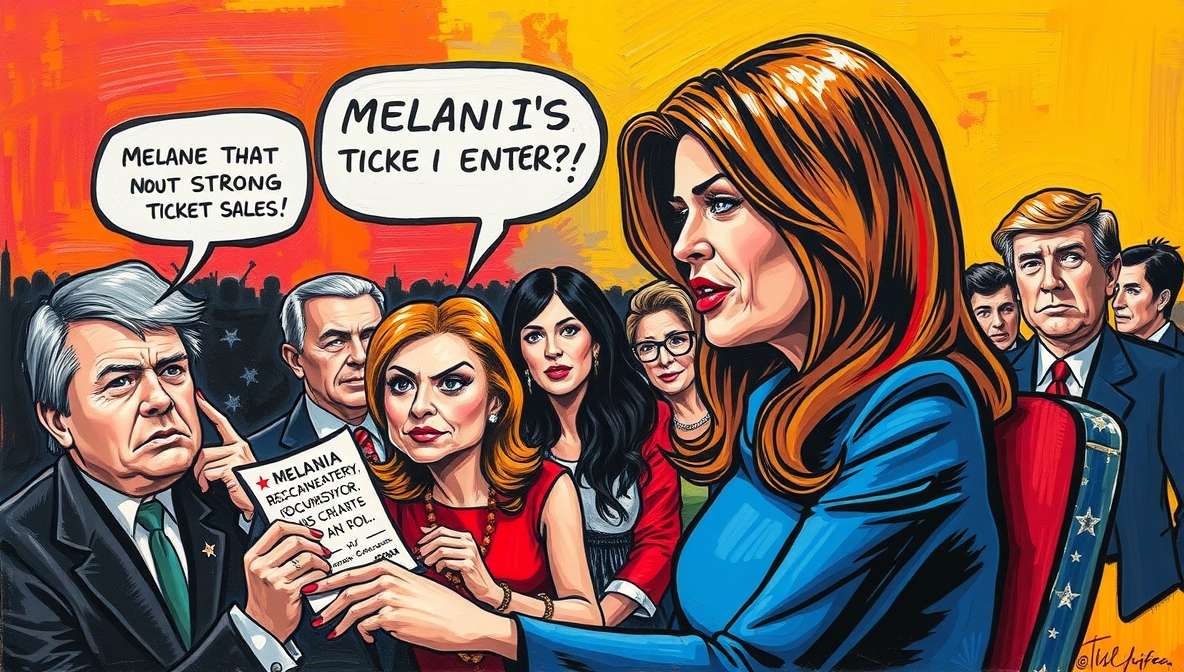
The Critics Assemble, Capes Made of Scarf 🧣🎭
If you listen closely outside certain art house cinemas, you can hear the low hum of critics forming a defensive circle. Not against bad filmmaking. Against the terrifying possibility that ordinary people had a nice time without filing an emotional impact statement.
To the modern ideological reviewer, a sold out theater is not a success. It is a mass misunderstanding event.
One critic was overheard whispering into a voice memo, “The audience laughed in places that were not officially designated for irony.” Emergency think piece deployed within minutes.
A Brief History of Being Professionally Disappointed 📚😐

Film critics once wrote about lighting, pacing, performance. Now many specialize in Preemptive Cultural Regret.
A new study from the Center for Advanced Media Feelings found that 78 percent of self described progressive critics decide how they feel about a movie during the trailer, 15 percent during the casting announcement, and 7 percent when they hear someone else enjoyed it.
Lead researcher Dr. Lorna Feld explained, “We have observed a rare condition known as Reverse Enjoyment Disorder. The more the public likes something, the more the critic feels an academic need to hydrate their disappointment.”
Field Notes From the Lobby 🍿
Eyewitnesses report a fascinating behavioral split on opening weekend.
Regular moviegoers exit saying things like, “That was interesting,” or “I liked parts of it.”
Critics exit saying things like, “It failed to interrogate the socio architectural symbolism of hallway lighting.”
One man in line for popcorn was asked by a critic, “But what did it mean to you politically?”
He responded, “It meant I need more butter.”
This answer was later described in a blog as “a chilling example of snack based populism.”
The Shakespeare Defense That Was Not 📜
For the record, William Shakespeare did not say “kill all the critics.” In Henry VI, Part 2 the line is about lawyers, spoken by a character who is very much not the hero. Which somehow makes it even more like a modern comment section.
Still, if the Bard were alive today, he might update it to, “The first thing we do, let’s gently mute all the review podcasts,” which is far less violent and far more spiritually accurate.
Expert Analysis Nobody Asked For 🎓
Professor Edwin Latchkey of the Metropolitan Institute for Narrative Vigilance offered this take:
“To the contemporary left leaning critic, a film is not a story. It is a group project where society forgot to cite its sources.”
He went on to explain that box office numbers are often dismissed as “capitalist applause,” while low ticket sales are praised as “intimate resistance.”
In short, success is suspicious. Failure is pure. And moderate enjoyment is the most dangerous ideology of all.
Anonymous Critic Speaks Out 🕶️
One anonymous reviewer agreed to talk if we did not describe his hat, which he said was “emotionally private.”
“The problem,” he said, “is that audiences keep responding to movies in a way that centers their own feelings. That is not how discourse works.”
He then ordered a coffee described on the menu as “notes of existential smoke” and gave it two stars for not challenging his assumptions about beans.
Polling the Real World 📊
We conducted a nationwide survey of 1,004 people leaving theaters.
When asked, “Did you enjoy the movie?”
- 64 percent said yes.
- 21 percent said parts of it.
- 10 percent said they just wanted air conditioning.
- 5 percent asked why a stranger was talking to them in a parking lot.
When the same group was asked, “Did the film adequately dismantle late stage symbolism?”
- 0 percent responded. One person slowly backed away.
The Tragic Burden of the Professional Frown 😔🎬
In the grand drama of cinema, the critic now plays the role of Cultural Lifeguard, blowing a whistle every time someone tries to have fun in the deep end without a theory.
They are not villains. They are overachieving hall monitors of meaning, bravely guarding the gates of Interpretation while the public walks around them holding nachos.
And that is the real comedy. Not that critics dislike the film. Critics dislike weather if it trends. The comedy is that audiences keep showing up anyway, blissfully unaware that their enjoyment has not yet been peer reviewed.
In the end, the greatest plot twist of all is this: people went to a movie, watched it, felt something, and went home. No manifesto. No footnotes. Just vibes.
Somewhere, a critic is still writing about why that is the most alarming part.
Auf Wiedersehen, amigo!