

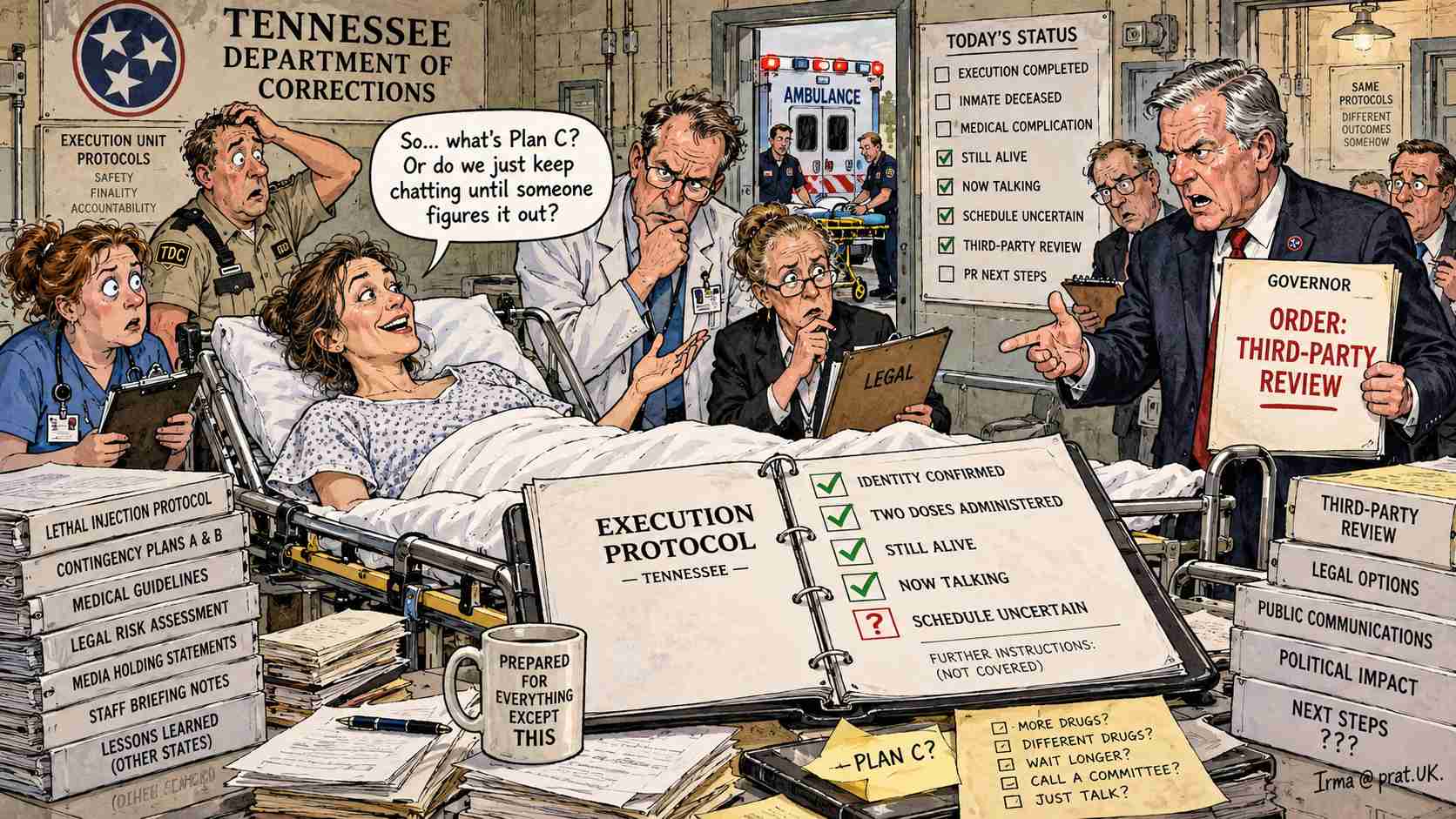
Two doses of pentobarbital, one very awake inmate, and a governor who has ordered a binder.
NASHVILLE – Tennessee tried to execute Christa Pike. It had a protocol. The protocol said two doses. She got two doses. She’s awake. She’s talking. What’s the deal with a protocol that doesn’t have a page for the thing that happened.
What Happened at Riverbend on October 1
This is the state equivalent of assembling the bookshelf and still having a bag of bolts, except the bookshelf is a person and the bolts are the entire point. Pike, 50, was convicted of killing Colleen Slemmer in 1995. She was going to be the first woman executed in Tennessee in more than 200 years. The appeals court said no. The Supreme Court said yes. The clock said go. Riverbend gave her both syringes of pentobarbital. Her heart did not stop. Witnesses said she was breathing. Lawyers said she was snoring, then conscious, then asking if her arm was supposed to feel like that.
The basics are laid out in Fox 4’s report on Christa Pike surviving the execution attempt. The curtains went up a little after 7:30 that Wednesday evening, and she ended the night in a hospital in critical condition. Slemmer was 19, a classmate of Pike’s at a job training program in Knoxville. She was the reason any of this was on the calendar, and it’s worth keeping her in the story, because the story keeps wandering off.
The Arm, the Ambulance and the Box Nobody Printed
No. The arm is not supposed to feel like that. If the arm is asking questions, you are no longer in the procedure. You are in a different building, which is where she went. An ambulance. A hospital. The one outcome the form did not have a box for. You’d think “still alive” would be box one. It’s the sort of thing that comes up.
Governor Bill Lee Orders a Third-Party Review of Tennessee Executions
Governor Bill Lee stopped the last execution on the calendar and ordered a comprehensive third-party review. I love a third party. The first party did the doses. The second party did the snoring. The third party is going to bring a binder and a face. Gary Wayne Sutton’s December date is off. The review will determine what occurred. Buddy, people in the room have already determined what occurred. It occurred in front of them. It made a noise.
Lee called the night deeply disturbing and paused the remaining scheduled executions for the rest of 2026. That’s a real step. A governor who wants a state to keep using a process doesn’t usually pull the cord on it in public, and he didn’t sound like a man looking for an exit. He sounded like a man who wants the thing to work and just watched it not work.
I keep thinking about the people who wrote the protocol. They sat in a room, probably a nice one, with a printed agenda and a pitcher of water, and they imagined every way the night could go. Delays, stays, a bad vein, a late phone call. They had a page for each. What they didn’t have, apparently, was a page for the one thing that makes the whole exercise stop being an exercise. That isn’t a joke about incompetence. It’s a joke about how hard it is to write a manual for something nobody should ever have to improvise.
The Death Penalty Debate After a Botched Lethal Injection
You can be for the penalty or against it and still notice the state got the one job wrong. Opponents say a system that can’t do the thing it claims as its reason shouldn’t be in the business. Supporters say a botched night is an argument for doing it right, not for quitting, and the conviction has survived every court that looked at it. The family that was promised an ending got a hospitalization. No press release is the size of that. Don’t try to write one. You’ll just have extra words.
If you want the longer history, the Death Penalty Information Center keeps a running page on lethal injection and problematic executions. It’s an advocacy organization with a clear view, so read it that way, but the record it assembles is a record. Pike’s case is already on there.
What the Review Will and Won’t Answer
Lee’s review won’t relitigate 1995. It’ll ask why two doses didn’t do what the page said two doses do. That’s smaller than the public’s question and bigger than the department’s. Reviews take months. They produce binders. Sometimes the binders are followed by new syringes. Sometimes by a law. Rarely by an apology with a subject and a verb.
Pike is conscious. The schedule isn’t. The state is thinking about which of those it considers temporary. Thinking is not a protocol. Thinking is what you do when the protocol has left the building and the arm is still taking attendance.