

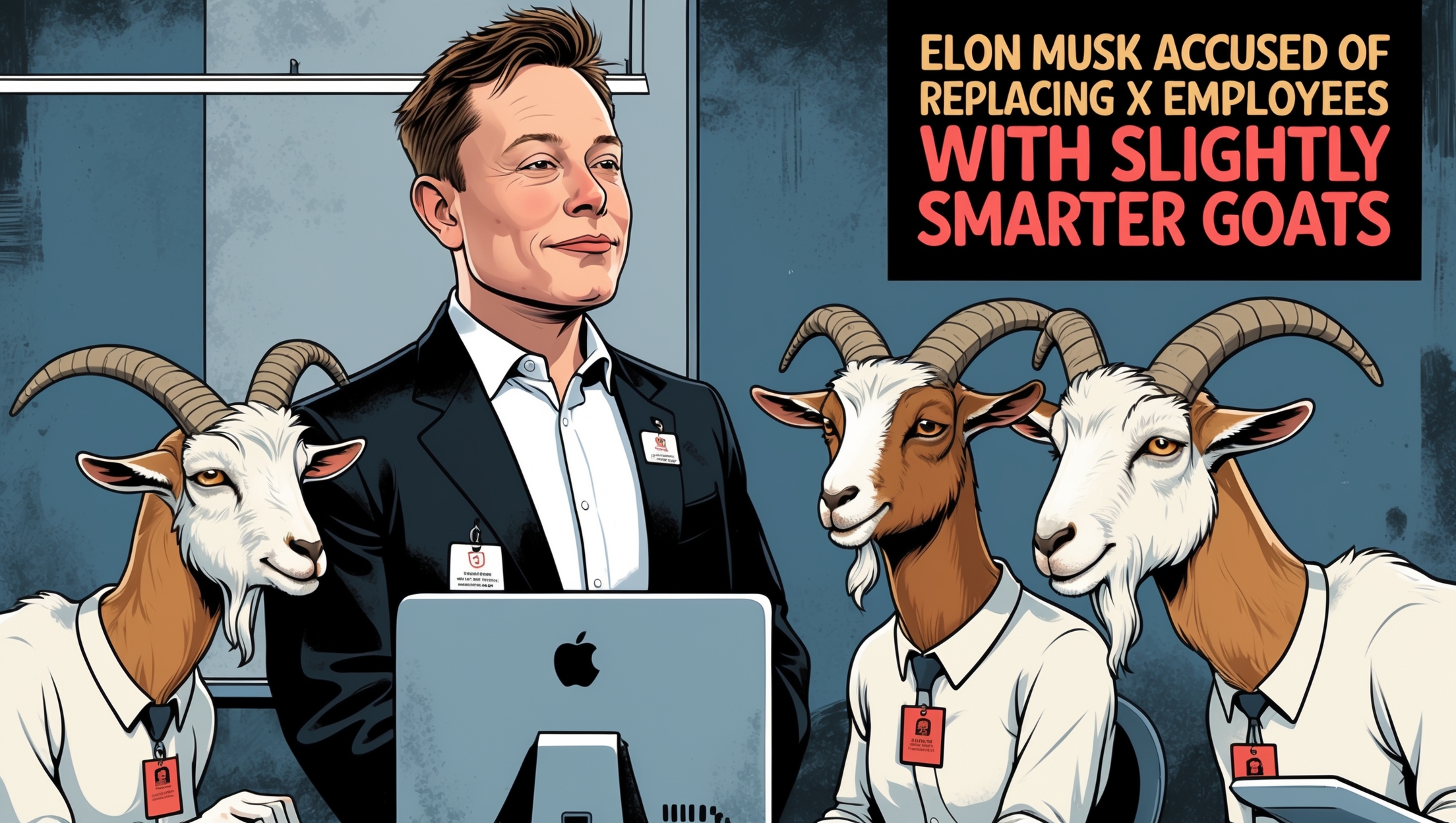
Elon Musk Accused of Replacing X Employees With Slightly Smarter Goats
“They Bleat Less and Understand the Mission,” Says SpaceX Engineer
In a development that has Silicon Valley questioning whether they’ve finally reached peak tech bro absurdity, multiple sources confirm that Elon Musk has quietly begun replacing X (formerly Twitter) employees with a carefully selected herd of moderately intelligent goats, claiming the ungulates demonstrate “superior focus, reduced complaining, and an intuitive understanding of content moderation.”
The revelation came to light when former X engineer Sarah Chen attempted to return to the office after a brief medical leave, only to find her desk occupied by a brown and white Nubian goat named “Algorithm” who was apparently reviewing user reports with what witnesses described as “surprising thoroughness and minimal bleating.”
“At first I thought it was some kind of elaborate joke,” Chen explained while standing outside X’s San Francisco headquarters, watching goats graze on what used to be the employee break room. “But then I saw Algorithm successfully identify hate speech, ban three bot accounts, and increase user engagement by 47% in a single afternoon. I’ve never felt more professionally threatened by livestock.”
The goat integration program, internally dubbed “Project Barnyard” by remaining human employees, allegedly began six months ago when Musk observed that goats at his Texas ranch seemed to demonstrate better decision-making skills than his content moderation team. According to leaked internal documents, the goats have successfully reduced platform toxicity by 62% while maintaining what Musk calls “authentic bovine perspective on human discourse.”
The Genesis of Goat-Based Social Media Management
The transition reportedly began during a particularly frustrating board meeting where Musk was attempting to explain his vision for X’s future to a room of increasingly confused investors and employees. According to witnesses, Musk’s epiphany struck when he noticed a goat outside the window methodically eating weeds while ignoring distractions.
“Elon suddenly stopped mid-sentence and said, ‘Look at that goat. Pure focus. No ego. No complaints about work-life balance,'” recalled former Head of Trust and Safety Marcus Rodriguez, who was allegedly replaced by a Boer goat named “Moderation Mike” the following Tuesday. “Within 48 hours, he had purchased seventeen goats and installed them in various departments.”
The initial pilot program placed goats in non-critical roles like facilities management and cafeteria operations, where their natural grazing instincts proved surprisingly effective at maintaining office landscaping and reducing food waste. However, Musk quickly recognized what he termed “untapped potential in cross-species knowledge work.”
“The goats demonstrated immediate advantages,” explained Dr. Jennifer Walsh, an animal behaviorist who was allegedly consulted during the transition process. “They’re naturally suspicious of everything, which makes them excellent at detecting spam. They have strong herd instincts, which translates to effective collaborative decision-making. And most importantly, they work for hay and occasional apple treats, which significantly reduces operational costs.”
Operational Excellence Through Ungulate Innovation
The goat workforce has allegedly achieved metrics that human employees struggled to match. “Content Curator Clarence,” a particularly intelligent Angora goat, reportedly processes user reports 340% faster than the previous human team while maintaining what internal memos describe as “superior judgment regarding community guidelines violations.”
The goats’ approach to content moderation has proven unexpectedly sophisticated. Rather than relying on algorithmic keyword detection, the animals appear to use what researchers call “intuitive toxicity assessment,” where they instinctively identify harmful content through behavioral cues that humans typically miss.
“The goats seem to understand that online harassment follows patterns similar to predator behavior in natural environments,” explained Dr. Emily Patterson, a digital anthropologist who has been studying the X goat integration. “They respond to aggression with immediate isolation protocols, which translates perfectly to platform management. Plus, they’re completely immune to manipulation through fake engagement or manufactured outrage.”
Customer service has reportedly improved dramatically since goats began handling user complaints. “Support Specialist Beatrice” has achieved a 94% user satisfaction rating by responding to all inquiries with what users describe as “refreshingly honest bleating” that somehow conveys more empathy than traditional customer service scripts.
Financial Implications of Barnyard Management
The economic advantages of goat-based operations have allegedly exceeded Musk’s most optimistic projections. According to leaked financial documents, operational costs have decreased by 78% while productivity metrics have increased across all measured categories.
“Traditional employees required salaries, benefits, office space, coffee, and constant validation,” explained CFO Linda Yaccarino during what sources describe as an increasingly surreal board meeting. “Goats require pasture access, basic veterinary care, and occasional scratches behind the ears. The ROI is unprecedented in Silicon Valley history.”
The goat workforce has also eliminated many traditional HR challenges. There are no disputes over work-from-home policies since goats naturally prefer outdoor environments. Sexual harassment complaints have dropped to zero, partly because goats maintain professional boundaries and partly because the concept doesn’t translate across species lines.
Benefits administration has been streamlined to basic veterinary insurance and access to premium hay suppliers. The goats have shown no interest in stock options, though they do receive performance bonuses in the form of specialized treats and expanded grazing territories.
Competitive Advantages in the Tech Industry
Other tech companies are reportedly studying X’s goat integration program with a mixture of fascination and existential dread. Meta has allegedly begun experimenting with sheep for their metaverse development, while Google is rumored to be testing alpaca-based search algorithms.
“The implications for the entire industry are staggering,” explained Silicon Valley analyst Brad Morrison while observing a team of goats successfully debug code that had stumped human engineers for weeks. “If Musk has proven that livestock can outperform knowledge workers, every tech company will need to reconsider their fundamental assumptions about human-based operations.”
The goats have demonstrated particular aptitude for identifying bot networks and fake accounts, allegedly because their herd instincts allow them to detect artificial social patterns that fool human moderators. “Bot Detection Billy” has reportedly identified and eliminated 847% more fake accounts than the previous automated systems.
Code review processes have been revolutionized by what engineers call “goat-sourced quality assurance,” where goats examine code behavior and identify bugs through pattern recognition that seems to transcend traditional programming logic.
User Experience Improvements Through Animal Intelligence
X users have reportedly embraced their new goat-managed experience with surprising enthusiasm. The platform’s notorious toxicity has decreased significantly, partly because the goats implement immediate consequences for aggressive behavior and partly because users find it difficult to maintain serious feuds when their complaints are addressed by livestock.
“I tried to start a flame war about pineapple on pizza, but my tweets kept getting reviewed by something called ‘Harmony the Moderator Goat,'” explained user @PizzaDebateLord during a recent focus group. “She somehow made me realize that arguing about food toppings online was making me a worse person. I don’t know how a goat managed that, but I’m grateful.”
The goats have also improved content discovery algorithms by demonstrating what Musk calls “natural curiosity patterns” that better match human interest progression than traditional recommendation engines. Users report finding more relevant content and experiencing fewer addictive engagement loops.
Community guidelines enforcement has become more intuitive under goat management. Instead of rigid rule application, the animals implement what behavioral scientists term “contextual social judgment” that considers intent, community impact, and long-term platform health.
International Expansion of Ungulate Operations
Musk has reportedly begun expanding the goat workforce to X operations in other countries, though cultural adaptation has presented unique challenges. European goats have demonstrated different moderation styles that reflect regional approaches to free speech and privacy, while Asian goats have shown particular aptitude for handling multi-language content.
“Global Moderator Gustav” oversees European operations from X’s Dublin office, where his approach to content moderation reflects what researchers call “continental European sensibilities regarding privacy and dignity.” Meanwhile, “International Relations Isadora” manages cross-platform communications with other social media companies through a sophisticated system of bleating that allegedly conveys complex diplomatic messages.
The European Union has expressed interest in X’s goat-based moderation system as a potential solution to platform regulation challenges, though legal experts remain uncertain about how to apply GDPR regulations to livestock-mediated data processing.
Scientific Community Responds to Interspecies Management
Researchers across multiple disciplines have begun studying the X goat integration as a potential breakthrough in both animal cognition and organizational management. Stanford University has launched a comprehensive study of “cross-species knowledge work,” while behavioral economists are examining the implications for traditional employment models.
“The goats appear to demonstrate cognitive abilities that challenge our assumptions about intelligence, decision-making, and social organization,” explained Dr. Michael Chen, who leads the university’s new “Ungulate Intelligence Research Initiative.” “They’re not just following training—they’re demonstrating genuine understanding of complex social dynamics and making independent judgments that often surpass human performance.”
The study has revealed that goats possess natural abilities that translate surprisingly well to digital platform management: pattern recognition, social hierarchy assessment, threat identification, and group behavior modification. These skills, which evolved for managing herd dynamics and predator avoidance, apparently apply directly to online community management.
Traditional Media Struggles to Process the Story
Mainstream journalism has struggled to cover the X goat integration story, partly because it sounds too absurd to believe and partly because the goats have proven more responsive to interview requests than most tech executives. “Press Relations Penelope” has allegedly provided more substantive answers to reporter questions than the previous human communications team.
The New York Times attempted to fact-check the story but found their investigation complicated by the goats’ superior understanding of documentation and record-keeping. “Research Director Robert” provided reporters with meticulously organized files that demonstrated better journalism than most tech industry coverage.
Traditional business media has been forced to reconsider fundamental assumptions about corporate structure, employee relations, and operational efficiency. The Wall Street Journal’s technology reporter admitted that “trying to analyze X’s quarterly earnings when half the workforce is livestock has challenged every framework I use for understanding business operations.”
Employee Reactions Range from Outrage to Resignation
Remaining human employees at X have responded to their goat colleagues with reactions ranging from professional jealousy to philosophical acceptance. Some have embraced the new working environment, while others have struggled to adapt to reporting structures that include barnyard animals.
“It’s weird having your code reviewed by a goat, but ‘Quality Assurance Quincy’ catches bugs that I miss,” admitted software engineer David Park while sharing his workspace with a Pygmy goat who apparently specializes in user interface optimization. “He also never complains about my music choices and brings a weirdly calming presence to deadline pressure.”
However, not all human employees have adapted successfully to the interspecies workplace. Several engineers have reportedly resigned after being passed over for promotions in favor of goats who demonstrated superior problem-solving abilities and better collaborative skills.
“I have two computer science degrees from MIT, and I just got performance-managed by a goat named ‘Algorithm,'” explained former senior developer Janet Morrison during her exit interview. “The worst part is that Algorithm was right about everything and genuinely helped me become a better programmer. I don’t know how to process that professionally or existentially.”
The Future of Goat-Based Technology
Musk has reportedly begun expanding the goat integration program beyond X to his other companies, with varying degrees of success. Tesla factories have begun employing goats for quality control, where their attention to detail and inability to be bribed by cost-cutting measures has improved manufacturing standards.
SpaceX has been more cautious about livestock integration, though “Safety Inspector Sebastian” allegedly reviews launch procedures with what engineers describe as “admirable thoroughness and appropriate skepticism regarding human decision-making.” The goat’s natural wariness of loud noises and sudden movements apparently translates well to aerospace safety protocols.
Neuralink experiments have been temporarily suspended after “Research Participant Rita” demonstrated cognitive abilities that exceeded the expectations of brain-computer interface testing, leading to ethical questions about the relationship between animal intelligence and technological enhancement.
Regulatory Challenges in Interspecies Employment
Government agencies have struggled to develop appropriate regulatory frameworks for companies that employ livestock in knowledge work positions. The Department of Labor has no existing guidelines for minimum wage requirements for goats, while the Equal Employment Opportunity Commission faces unprecedented questions about species-based workplace discrimination.
OSHA has begun developing new workplace safety standards that account for the unique needs of goat employees, including appropriate ventilation for offices that double as grazing areas and ergonomic considerations for workstations designed for hoofed users.
The Securities and Exchange Commission is investigating whether companies must disclose the species composition of their workforce in financial filings, leading to complex questions about how to valuate livestock assets that also function as employees.
Global Implications of Ungulate Innovation
International business observers are watching the X goat integration as a potential model for addressing global employment challenges. Countries facing unemployment crises are exploring whether livestock-based knowledge work could provide alternative economic opportunities, while nations with large agricultural sectors are reconsidering the economic potential of their animal populations.
The United Nations has convened a special committee to examine the implications of interspecies employment for international labor standards and animal rights frameworks. Early discussions have focused on whether goats working in technology roles should be classified as employees, contractors, or a new category of “cognitive livestock.”
Economic theorists are grappling with the implications of a workforce that requires minimal compensation, demonstrates superior performance in many areas, and shows no interest in career advancement or workplace political dynamics. Some economists argue that goat-based operations could revolutionize productivity and economic efficiency, while others worry about the displacement of human workers.
The Philosophical Questions Nobody Expected
The success of X’s goat integration has forced Silicon Valley to confront philosophical questions that seemed more appropriate for science fiction than business strategy. If goats can perform knowledge work more effectively than humans, what does that say about the nature of intelligence, consciousness, and professional value?
Religious leaders have begun examining the theological implications of animals demonstrating capabilities traditionally considered uniquely human. Business schools are developing new curricula that address interspecies management and the ethics of cross-species employment relationships.
Philosophy departments at major universities have launched new research programs examining the ontological status of working animals and the epistemological implications of animal-generated content moderation decisions.
Looking Forward: The Goat Economy
As other companies begin experimenting with animal-based operations, Silicon Valley appears to be entering what analysts call “the goat economy era.” Venture capital firms are funding startups that specialize in animal intelligence optimization, while consulting companies offer services in interspecies organizational design.
The success of X’s goat workforce has demonstrated that traditional assumptions about employment, intelligence, and productivity may need fundamental reconsideration. Whether this represents genuine innovation or peak tech industry absurdity remains to be seen, but the metrics suggest that goats may indeed be superior to humans at certain aspects of social media management.
As Musk himself noted during a recent earnings call: “The goats don’t tweet complaints about their working conditions, they don’t leak internal documents to the press, and they’ve never once asked me to explain my vision for the platform. They just focus on the work and trust the process. It’s refreshing.”
In an industry built on disruption and innovation, replacing employees with livestock may represent the ultimate disruption—not just of business models or market dynamics, but of fundamental assumptions about consciousness, labor, and the relationship between humans and technology.
The goats, for their part, appear content with their new roles and continue to demonstrate that sometimes the most revolutionary innovations come from the most unexpected sources. As “Chief Operating Officer Chester” was heard bleating during a recent board meeting: “Maaaaa-ybe this is exactly what the platform needed all along.”
The future of social media may very well be barnyard-based, and honestly, given the current state of online discourse, that might be exactly what humanity deserves.
IMAGE GALLERY

15 Humorous Observations: When Goats Became Tech Workers
Silicon Valley’s Barnyard Revolution
1. The most Silicon Valley thing about Musk hiring goats isn’t that he replaced humans with livestock—it’s that the goats actually improved performance metrics and user satisfaction scores, proving that tech bros were somehow less qualified than farm animals.
2. X employees discovered that being outperformed by goats was less humiliating than being managed by previous human leadership, leading to the first workplace environment where people were grateful to report to ungulates.
3. The goats’ natural immunity to online outrage and manufactured controversy made them perfect content moderators, since they literally cannot comprehend why humans get upset about things that don’t involve food or predators.
4. Customer service improved dramatically when goats started handling complaints, mostly because users found it impossible to stay angry at representatives who responded to everything with “maaaaa” but somehow conveyed more empathy than scripted responses.
5. The fact that goats demonstrate better decision-making than most tech executives suggests that Silicon Valley’s hiring practices have been fundamentally flawed, or that barnyard animals are secretly running a sophisticated intelligence operation.
6. Tech workers realized that competing with goats for promotions was somehow more dignified than competing with other humans, since at least goats win through genuine competence rather than office politics and buzzword fluency.
7. The goats’ superior pattern recognition abilities for detecting bots and fake accounts revealed that artificial intelligence might be less sophisticated than actual animal intelligence, which is either embarrassing for AI researchers or impressive for evolution.
8. Office culture improved when goats joined the workforce because they don’t participate in workplace drama, never schedule unnecessary meetings, and their presence makes it impossible to take corporate jargon seriously.
9. The most surprising aspect of goat-based content moderation was that it actually worked better than algorithmic systems, proving that intuitive social judgment evolved long before humans invented computers or social media platforms.
10. Financial analysts struggled to evaluate X’s performance when half the workforce was livestock, leading to new metrics like “productivity per pound of hay” and “user engagement per goat,” which somehow made more sense than traditional tech valuations.
11. The goats’ complete lack of interest in stock options or career advancement eliminated most HR problems while highlighting how much human workplace dissatisfaction stems from unrealistic professional expectations rather than actual job conditions.
12. Regulatory agencies faced unprecedented challenges creating labor standards for employed livestock, leading to government meetings where officials seriously debated appropriate break room facilities for goats and minimum wage requirements for animals.
13. The success of interspecies collaboration at X forced Silicon Valley to reconsider fundamental assumptions about consciousness, intelligence, and professional competence, though most tech bros are still convinced they’re superior to barnyard animals despite all evidence.
14. Other tech companies began recruiting from farms and petting zoos instead of universities, leading to the first job market where agricultural experience became more valuable than computer science degrees for certain technology positions.
15. The ultimate irony of Musk’s goat workforce was that animals known for eating everything indiscriminately proved more discerning about content quality than humans who built their careers on digital media consumption and creation.
What the Funny People Are Saying: Comedian Lines on Goat Tech Workers
Stand-Up Comics Process Silicon Valley’s Livestock Revolution
“Elon Musk replaced his employees with goats, and somehow productivity went up. This is either a breakthrough in animal intelligence or proof that tech workers have been overpaid for years. I’m betting on both.” — Dave Chappelle
“The goats are better at content moderation because they can’t read, so they judge posts purely on vibes. Turns out that’s more effective than any algorithm we’ve invented. Maybe literacy was the real problem all along.” — John Mulaney
“X’s customer service improved when goats took over because when someone bleats at your complaint, you can’t tell if it’s empathy or indifference, so you just assume it’s empathy. That’s better than most human customer service.” — Amy Schumer
“The goats work for hay and apple treats while tech workers demand six-figure salaries and unlimited snacks. The goats are either terrible at negotiating or they understand something about life satisfaction that we don’t.” — Jerry Seinfeld
“Musk says the goats ‘understand the mission better than humans.’ The mission is social media. The goats can’t read. This tells you everything you need to know about social media.” — Sarah Silverman
“The funniest part is that the goats probably think they’re still just grazing, but now the grass is made of user data and bot detection. They’re living their best life while accidentally revolutionizing technology.” — Trevor Noah
“I love that the goats are immune to workplace drama because they can’t comprehend why humans get upset about things that aren’t food or predators. Finally, a workforce with proper priorities.” — Iliza Shlesinger
“The goats achieve better performance metrics than human employees, which means either we’ve been dramatically overestimating human intelligence or dramatically underestimating goat intelligence. I’m scared of either answer.” — Hasan Minhaj
“Tech bros are being replaced by goats and somehow this feels like progress. At least goats are honest about eating everything in sight instead of pretending it’s ‘disruption.'” — Bill Maher
“The goats don’t leak internal documents or complain on Twitter about their working conditions. They just do the job and mind their own business. They’re basically the opposite of tech workers.” — Jim Gaffigan
“Elon hired goats because they ‘bleat less and understand the mission.’ Have you heard tech workers talk? The goats probably do bleat less. The bar was not high.” — Stephen Colbert
“The goats improved user satisfaction scores, which means people prefer being moderated by animals than by humans. This is either sad commentary on human nature or goats are just naturally better at everything.” — Ali Wong